


























Views
Downloads


Homophone Spelling Test Worksheet | Grade 4 Essential
Paste this activity's link or code into your existing LMS (Google Classroom, Canvas, Teams, Schoology, Moodle, etc.).
Students can open and work on the activity right away, with no student login required.
You'll still be able to track student progress and results from your teacher account.
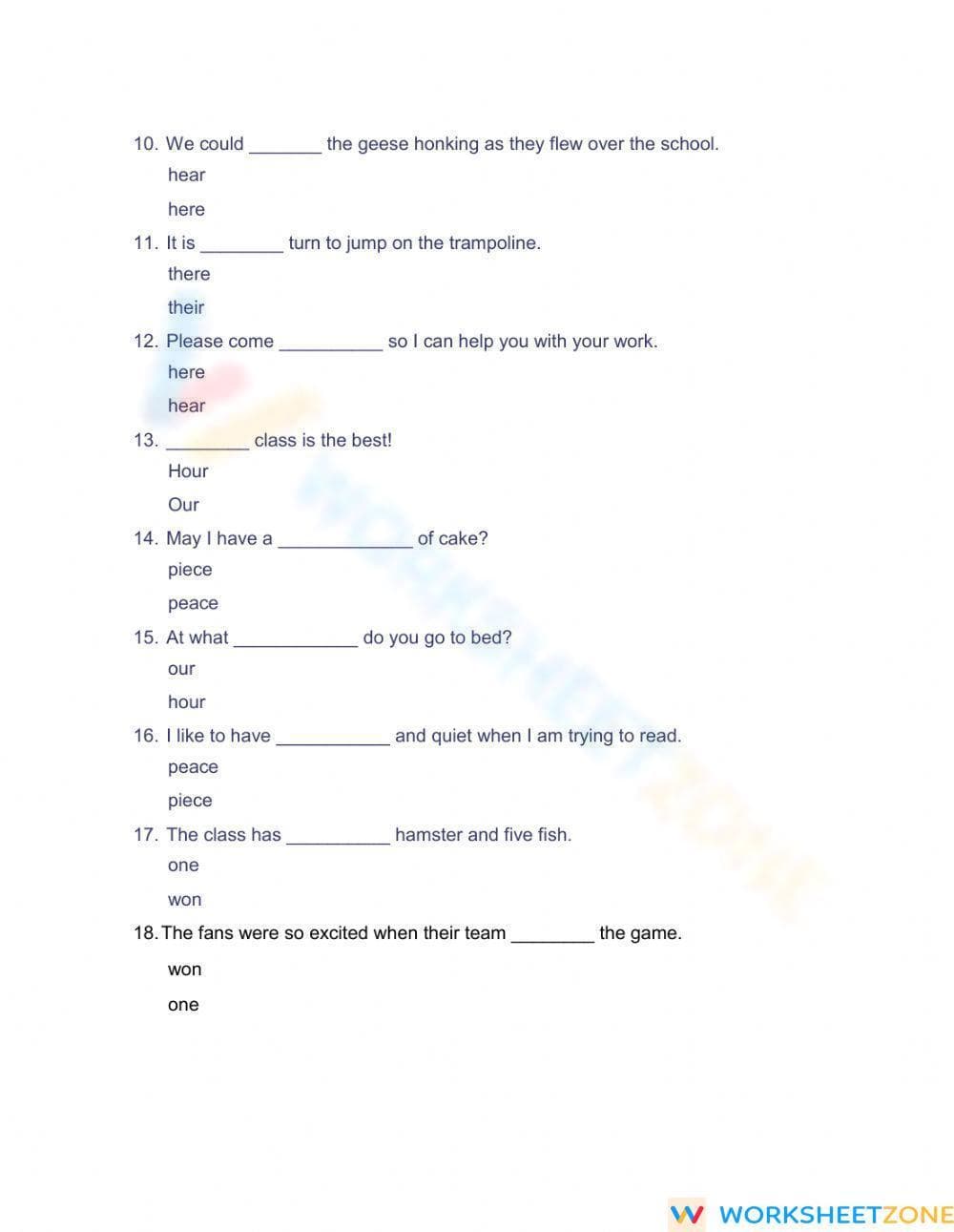
This Grade 4 homophone spelling worksheet offers 20 structured practice problems designed for students to master frequently confused words. By identifying and applying the correct spelling of common homophones within contextual sentences, students improve their orthographic application. A full answer key is included for immediate feedback and self-correction, making this a vital resource for spelling mastery.
At a Glance
- Grade: 4 · Subject: English Language Arts (ELA)
- Standard:
CCSS.ELA-LITERACY.L.4.1.G— Correctly use frequently confused words such as to, too, and two- Skill Focus: Lexical Homophone Selection
- Format: 2 pages · 20 problems · Answer key included · PDF
- Best For: Independent spelling practice and formative assessment
- Time: 15–20 minutes
This two-page PDF features a 20-item spelling test on high-frequency homophones with a clean, distraction-free layout. Each item presents a sentence with a missing word and two or three homophone options for students to evaluate based on context. The resource includes a matching answer key, ensuring rapid grading and easy distribution in traditional classrooms or home-learning environments.
Skill Progression
- Guided practice: The first 5 items focus on basic homophones (e.g., to/two) with strong contextual clues to build confidence.
- Supported practice: Items 6-15 introduce more complex lexical pairs, requiring deeper semantic analysis of the sentence structure and word usage.
- Independent practice: The final 5 items utilize longer sentence structures for advanced spelling accuracy and mastery of frequently confused words.
This sequence follows a gradual-release model, moving students from simple recognition to mastery-level application.
Standards Alignment
This worksheet aligns with CCSS.ELA-LITERACY.L.4.1.G, requiring students to correctly use frequently confused words. It also supports CCSS.ELA-LITERACY.L.3.2.F by reinforcing spelling patterns for homophones at the third-grade level. Both standard codes can be copied directly into lesson plans, IEP goals, or district curriculum mapping tools to ensure instructional compliance.
How to Use It
Best utilized during the independent practice phase of a spelling lesson after direct instruction. Use the first five items as a quick formative check-in to identify students needing additional support. Students typically complete the 20 tasks in 15-20 minutes, making it ideal for a bell-ringer, exit ticket, or homework assignment.
Who It's For
While designed for fourth-grade learners, this worksheet provides excellent reinforcement for third-grade students or fifth-grade students needing targeted intervention. It is particularly effective for English Language Learners (ELLs) who struggle with phonemic overlap. For best results, pair this resource with a homophone anchor chart or a short reading passage for contextual reinforcement.
Mastery of homophones is a critical developmental milestone in elementary literacy, as persistent errors can obscure meaning. This worksheet supports CCSS.ELA-LITERACY.L.4.1.G by moving beyond memorization toward applying lexical rules in sentences. Providing 20 unique opportunities to differentiate words like their and they're reinforces phonological and morphological awareness for fluent writing. Focused, scaffolded practice is essential for internalizing complex spelling patterns, ensuring foundational spelling accuracy as students progress to more complex compositional tasks (Fisher & Frey, 2014). By requiring students to analyze sentence context to select the correct spelling, this resource bridges the gap between isolated word study and integrated writing. This systematic approach to frequently confused words aligns with current evidence-based instructional practices for Grade 4 ELA, providing the high-frequency repetition necessary for long-term orthographic retention. Teachers can utilize this structured practice to identify specific phonemic confusion and provide targeted intervention during literacy blocks, fostering greater student confidence in formal writing.


