


























Views
Downloads
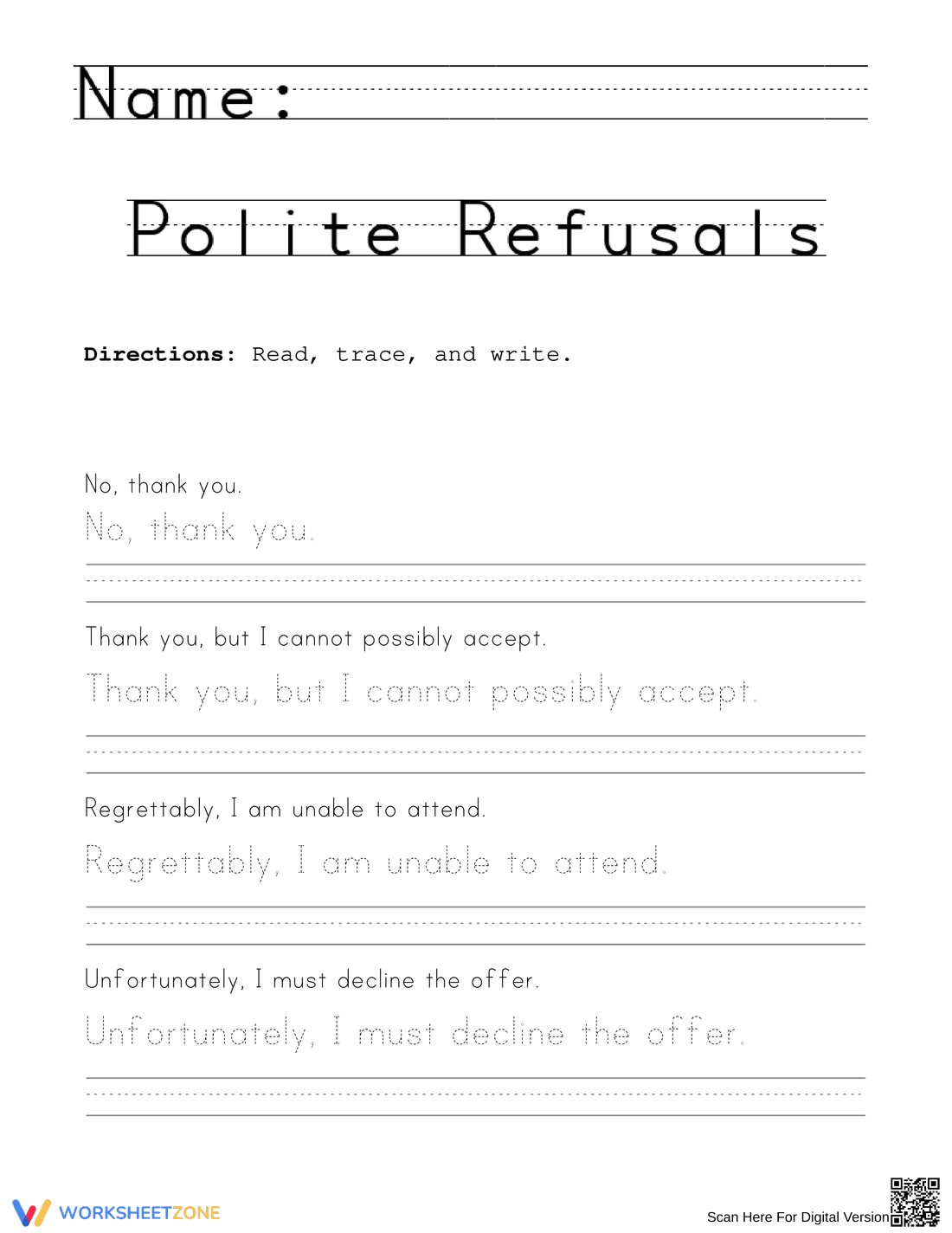

Polite Refusals Handwriting | Grade 3-4 Essential
Paste this activity's link or code into your existing LMS (Google Classroom, Canvas, Teams, Schoology, Moodle, etc.).
Students can open and work on the activity right away, with no student login required.
You'll still be able to track student progress and results from your teacher account.
This Grade 3-4 handwriting worksheet helps students master the social skill of declining offers gracefully while refining their penmanship. By practicing specific phrases for polite refusals, learners build both linguistic confidence and fine motor control. It provides a practical bridge between social-emotional learning and daily writing conventions in the elementary classroom.
At a Glance
- Grade: 3-4 · Subject: English Handwriting
- Standard:
CCSS.ELA-LITERACY.L.3.1— Demonstrate command of the conventions of standard English grammar and usage when writing- Skill Focus: Penmanship and Social Communication
- Format: 1 page · 4 tasks · No answer key required · PDF
- Best For: Morning work or SEL integration
- Time: 10–15 minutes
What's Inside
The resource features a clean, structured layout with four distinct polite refusal phrases ranging in complexity. Each section includes a clear model in a standard print font, a light-gray tracing line to guide letter formation, and a blank primary-ruled line for independent practice. The 1-page PDF is designed for immediate distribution without additional instructions or teacher setup.
Zero-Prep Workflow
- Print: Generate the single-page PDF in less than 30 seconds for your entire class.
- Distribute: Hand out the sheets during a transition period or as students enter the room.
- Review: Perform immediate formative checks on letter height and spacing as students work.
Total teacher prep time is under 2 minutes, making it an ideal sub-plan or bell-ringer activity for busy mornings.
Standards Alignment
This worksheet aligns with `CCSS.ELA-LITERACY.L.3.1`, which requires students to demonstrate command of the conventions of standard English grammar and usage when writing. By focusing on specific sentence structures for social interaction, it also supports language development and functional communication. Both standard codes can be copied directly into lesson plans, IEP goals, or district curriculum mapping tools.
How to Use It
Use this worksheet during a Social-Emotional Learning (SEL) block to discuss the importance of boundaries and respect. After a brief discussion on when to say "no," students complete the tracing and writing tasks to internalize the vocabulary. Alternatively, assign it as a quiet morning work activity to settle the class. Observe student grip and letter slant during the independent writing phase to identify needs for fine motor intervention.
Who It's For
This resource is tailored for Grade 3 and Grade 4 students who are transitioning from basic letter formation to fluent sentence writing. It is particularly beneficial for English Language Learners (ELLs) who need explicit models for social pragmatics. Pair this worksheet with a direct instruction lesson on "I-statements" or a classroom anchor chart featuring polite communication strategies.
According to the RAND AIRS 2024 report, integrating social-emotional learning with core literacy tasks significantly improves student engagement and retention of interpersonal skills. This worksheet addresses the need for functional writing practice by combining penmanship with the standard CCSS.ELA-LITERACY.L.3.1. By practicing polite refusals, students develop the linguistic tools necessary for respectful communication in diverse social settings. Research from Fisher & Frey (2014) emphasizes that purposeful handwriting practice, when embedded in meaningful contexts like social pragmatics, supports the development of cognitive automaticity in writing. This resource provides a structured environment for students to master these essential skills through a gradual release of support, moving from reading to tracing and finally to independent production. The 4-task layout ensures that the cognitive load remains manageable while still providing enough repetition to reinforce both the physical act of writing and the social concept of a polite refusal.


