


























Views
Downloads

Learning Letters a-g Worksheet | Essential Grade K Practice
Paste this activity's link or code into your existing LMS (Google Classroom, Canvas, Teams, Schoology, Moodle, etc.).
Students can open and work on the activity right away, with no student login required.
You'll still be able to track student progress and results from your teacher account.
This printable lowercase letter tracing worksheet provides foundational practice for young learners mastering the first seven letters of the alphabet. By combining fine motor stroke practice with verbal sound reinforcement, students build the muscle memory and phonemic awareness necessary for early literacy success. It is a complete resource for preschoolers and kindergarteners to refine their handwriting.
At a Glance
- Grade: Kindergarten · Subject: English Language Arts
- Standard:
CCSS.ELA-LITERACY.L.K.1.A— Print many upper- and lowercase letters accurately with proper stroke direction- Skill Focus: Lowercase Letter Formation (a-g)
- Format: 2 pages · 56 problems · Answer key not required · PDF
- Best For: Early morning work or literacy centers
- Time: 15–20 minutes
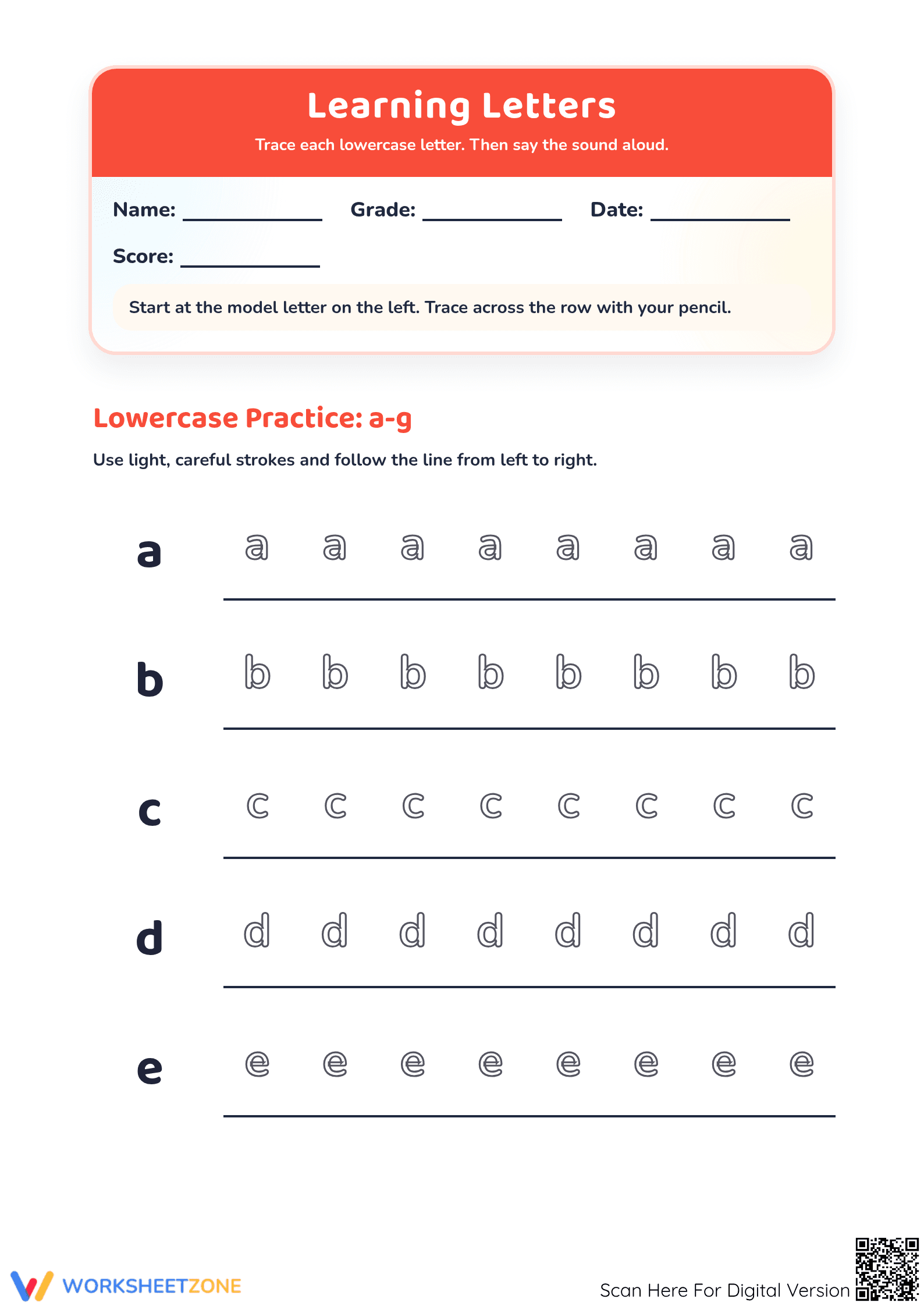
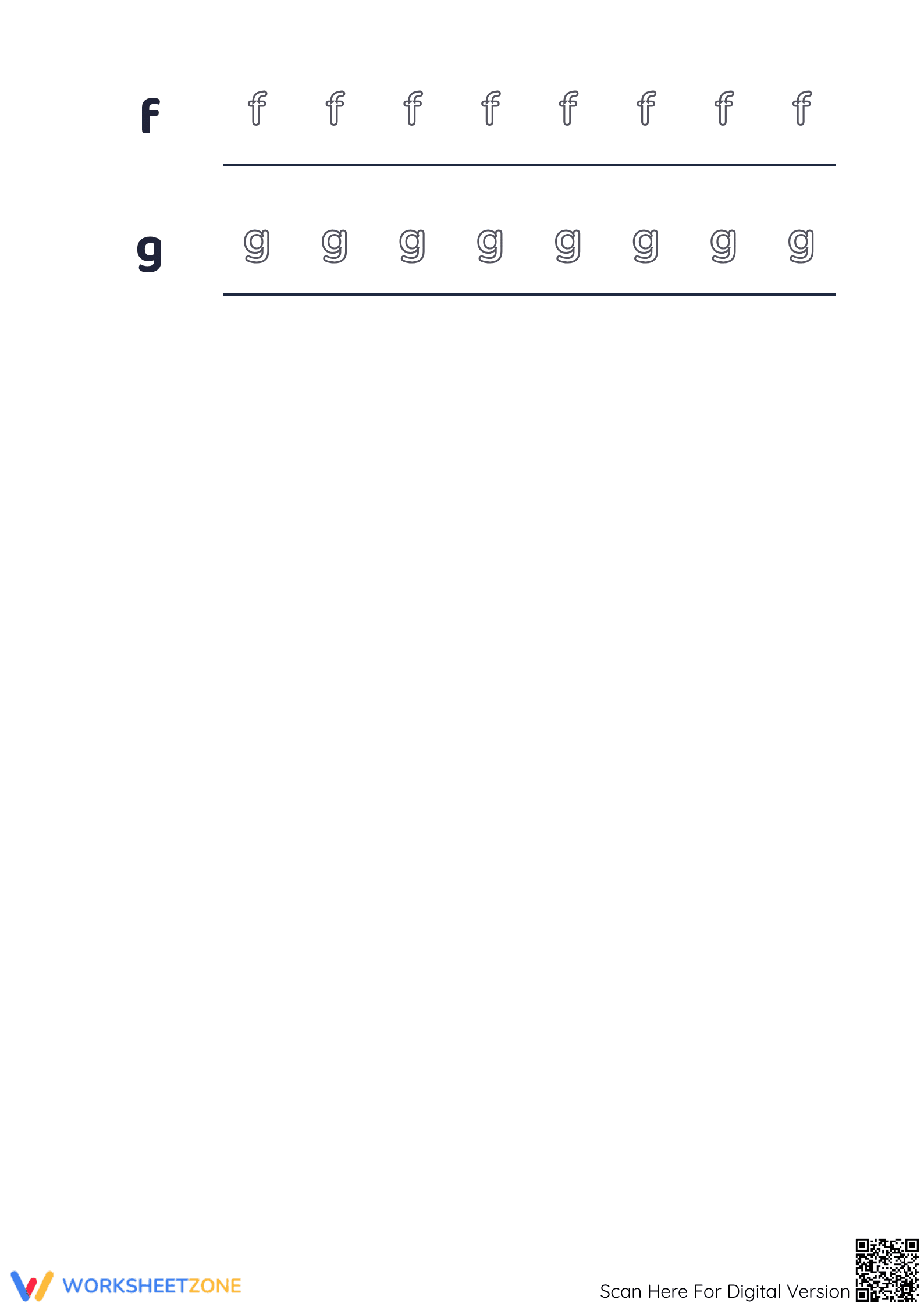
The packet consists of two organized pages focusing on the lowercase letters a, b, c, d, e, f, and g. Each letter row begins with a bold model letter followed by eight guided tracing opportunities. The layout includes spacious horizontal lines to help students manage letter height and baseline alignment. Clear instructions prompt students to use light strokes and vocalize the sounds, making this a multi-sensory learning experience.
Skill Progression
- Guided practice: Students observe the model letter on the left to understand the correct starting point and shape for each character.
- Supported practice: Each row offers eight dotted-line versions of the letter to provide consistent scaffolding as students trace with their pencils.
- Independent practice: While tracing, students are encouraged to say the sound aloud, transitioning from simple visual recognition to phonetic application.
This structure supports the gradual-release model of "I Do, We Do, You Do" through repetitive, successful attempts that build student confidence.
Standards Alignment
The primary standard addressed is CCSS.ELA-LITERACY.L.K.1.A, which requires students to "Print many upper- and lowercase letters." This worksheet specifically targets the formation of lowercase characters through repeated tracing. Additionally, the instruction to "say the sound aloud" supports foundational phonological awareness standards. Both standard codes can be copied directly into lesson plans, IEP goals, or district curriculum mapping tools.
How to Use It
Distribute this worksheet during small-group literacy instruction after introducing the sounds of letters a-g. Teachers should observe students to ensure they follow the "left to right" stroke direction mentioned in the instructions, as this prevents common reversal habits. Expected completion time is approximately 20 minutes, making it an excellent formative assessment for pencil control and letter recognition.
Who It's For
This resource is designed for preschool and kindergarten students who are in the initial stages of handwriting development. It serves as a gentle introduction for those with emerging fine motor skills and can be paired with alphabet anchor charts or tactile sand-tray writing activities. It is also suitable for Grade 1 students requiring remedial support for letter formation and stroke precision.
Research from Fisher & Frey (2014) emphasizes the importance of guided practice and repetitive motor movements in developing handwriting fluency, which is directly linked to later reading and writing proficiency. This Grade K worksheet facilitates that development by providing 56 targeted tracing tasks for letters a-g, aligned to CCSS.ELA-LITERACY.L.K.1.A. By mastering proper lowercase letter formation early, students reduce cognitive load during more complex writing tasks in later grades. The integration of phonemic reinforcement—saying the sounds while writing—aligns with evidence-based multisensory instructional strategies that bridge the gap between letter recognition and sound-symbol correspondence. This printable resource offers a structured, distraction-free environment for students to build the necessary stamina and precision for academic success. Educators can use these worksheets to establish a solid literacy foundation, ensuring that every student achieves the standard of printing lowercase letters with confidence and accuracy.


