


























Views
Downloads

Printable Letter W Tracing Worksheet | Kindergarten Ready
Paste this activity's link or code into your existing LMS (Google Classroom, Canvas, Teams, Schoology, Moodle, etc.).
Students can open and work on the activity right away, with no student login required.
You'll still be able to track student progress and results from your teacher account.
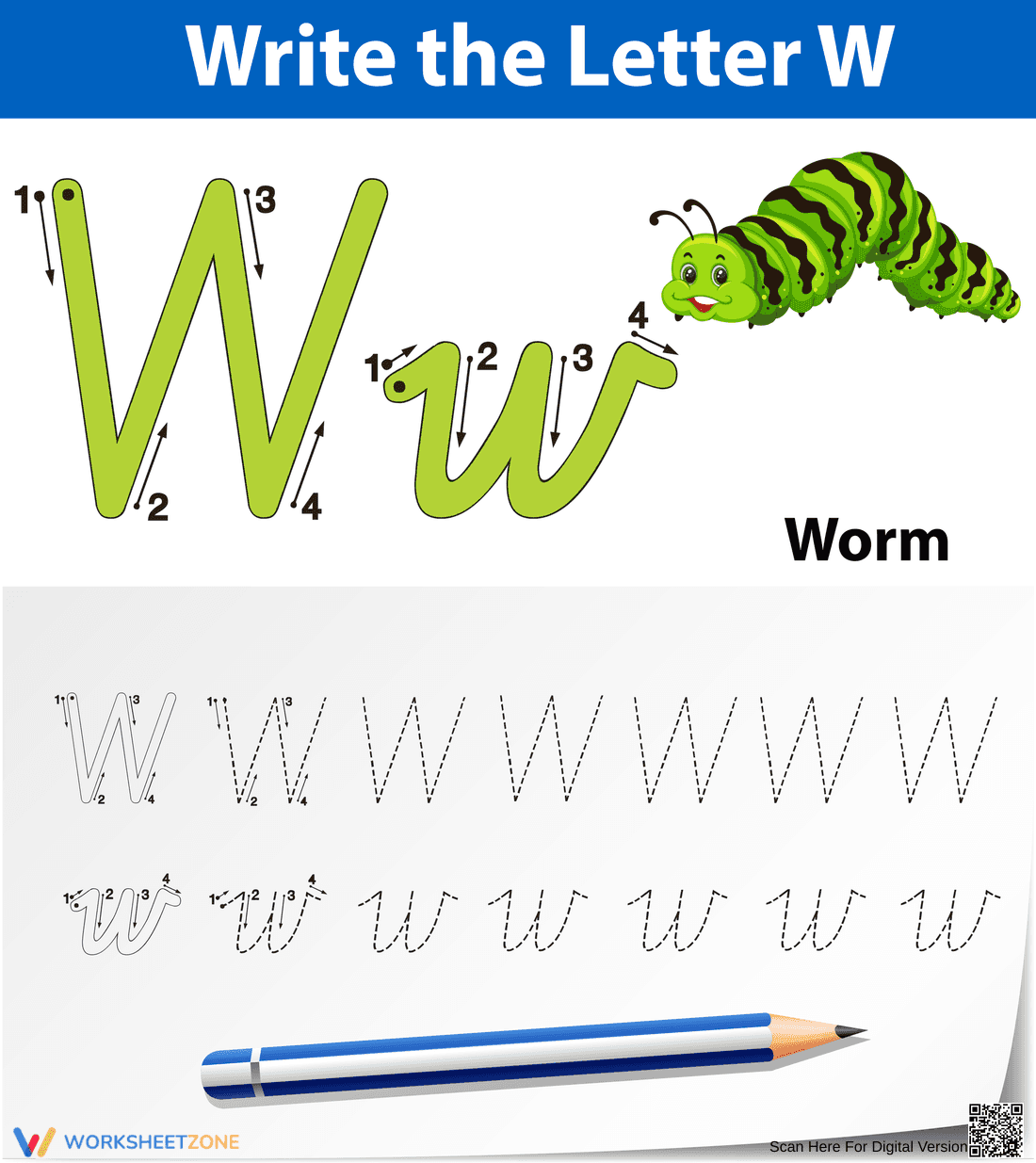
This Kindergarten English worksheet provides essential handwriting practice for the letter W. Students develop fine motor control and letter recognition by tracing both uppercase and lowercase forms. By following numbered stroke guides, learners build the muscle memory required for fluent writing. This resource ensures students master the distinct peaks and valleys of the letter W.
At a Glance
- Grade: Kindergarten · Subject: English
- Standard:
CCSS.ELA-LITERACY.L.K.1.A— Print many upper- and lowercase letters accurately- Skill Focus: Letter W formation
- Format: 1 page · 14 tasks · No-prep · PDF
- Best For: Morning work or literacy centers
- Time: 5–10 minutes
This single-page PDF features a large "W is for Worm" visual aid with numbered directional arrows to guide initial strokes. Below the model, students find two dedicated rows for practice: seven uppercase "W" tracing opportunities and seven lowercase "w" tracing opportunities. The clean layout minimizes distractions, focusing entirely on the mechanical movement of the pencil.
Teachers can implement this resource in under 2 minutes. First, print the desired number of copies for your literacy block. Second, distribute the sheets along with sharpened pencils or crayons. Third, review the completed work during small-group instruction to check for proper grip and stroke order. It is an ideal grab-and-go option for substitute folders.
The primary focus is `CCSS.ELA-LITERACY.L.K.1.A`, which requires students to print many upper- and lowercase letters. This worksheet specifically targets the letter W, providing the repetitive practice necessary for foundational literacy. Both standard codes can be copied directly into lesson plans, IEP goals, or district curriculum mapping tools.
Use this worksheet during the independent practice phase of a lesson on the alphabet. It serves as an excellent formative assessment tool; observe students as they trace to identify those struggling with top-to-bottom stroke direction. Expect most Kindergarten students to complete the 14 tracing tasks within 10 minutes.
This resource is designed for Kindergarten and Grade 1 students beginning their handwriting journey. It is particularly helpful for English Language Learners (ELLs) and students requiring occupational therapy support for fine motor development. Pair this with a "W is for Worm" read-aloud or an alphabet anchor chart for a complete lesson.
According to the RAND AIRS 2024 report, consistent tactile practice in letter formation is a critical predictor of later reading fluency and orthographic mapping success. This worksheet aligns with CCSS.ELA-LITERACY.L.K.1.A by providing 14 specific tracing tasks that reinforce the structural differences between uppercase and lowercase characters. Research by Fisher & Frey (2014) emphasizes that guided practice with clear visual scaffolds, such as the numbered stroke arrows included here, allows students to internalize complex motor patterns more effectively than unguided scribbling. By focusing on the letter W, this resource helps bridge the gap between phonemic awareness and physical production. Educators can utilize this tool to ensure that students meet foundational handwriting benchmarks before transitioning to sentence-level composition. The inclusion of a thematic worm illustration further aids in mnemonic retention for early learners, making the abstract shape of the letter more concrete.


