




























Views
Downloads
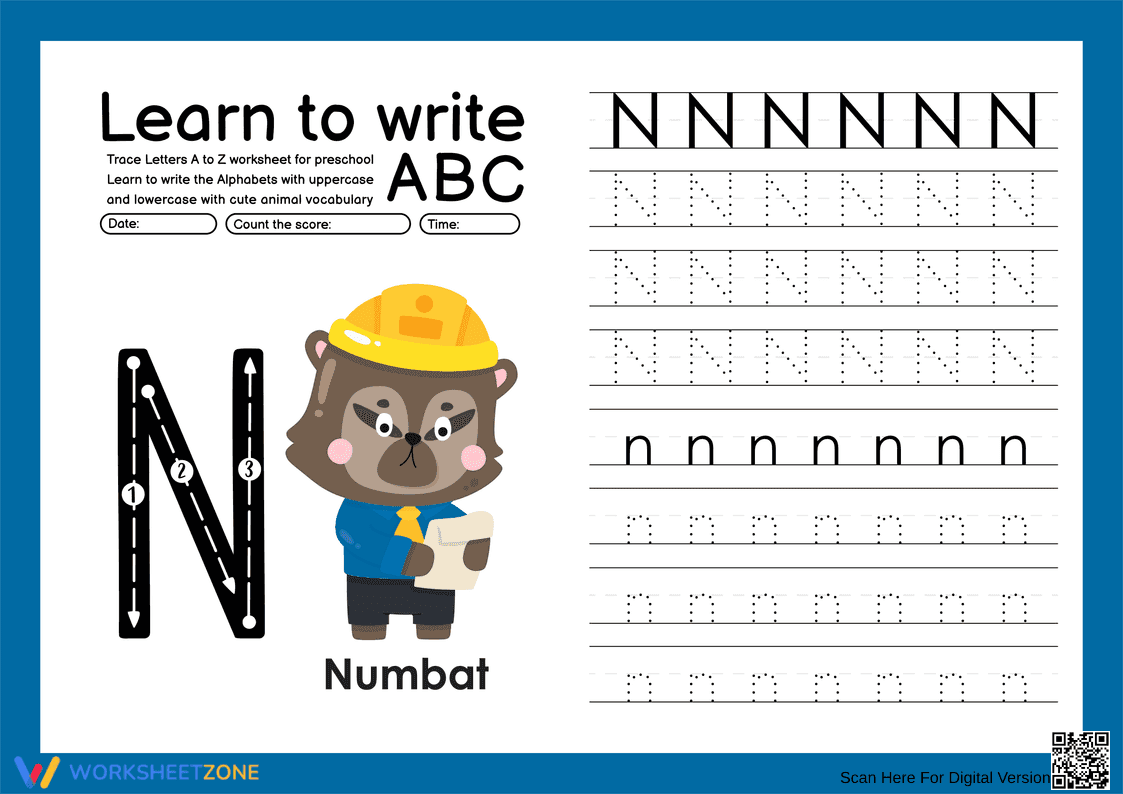

Learn to Write Letter N | Essential Kindergarten Worksheet

Paste this activity's link or code into your existing LMS (Google Classroom, Canvas, Teams, Schoology, Moodle, etc.).
Students can open and work on the activity right away, with no student login required.
You'll still be able to track student progress and results from your teacher account.
This letter N tracing worksheet provides early learners with a structured path to mastering letter formation. By combining visual stroke-order guides with repetitive tracing practice, students develop the muscle memory needed for fluent handwriting. This resource ensures students can confidently recognize and produce both uppercase and lowercase versions of the letter N.
At a Glance
- Grade: Kindergarten · Subject: ELA
- Standard:
CCSS.ELA-LITERACY.RF.K.1.D— Recognize and name all upper- and lowercase letters of the alphabet- Skill Focus: Letter N formation
- Format: 1 page · 53 tasks · No answer key needed · PDF
- Best For: Daily morning work or literacy centers
- Time: 10–15 minutes
The worksheet features a comprehensive layout designed for independent student use. It includes a large "N" with numbered arrows indicating proper stroke direction, helping to prevent common reversal errors. Below the guide, students find four rows dedicated to uppercase "N" and four rows for lowercase "n," providing over 50 individual tracing opportunities. A friendly Numbat illustration reinforces the letter-sound connection.
Zero-Prep Workflow
- Print: Generate the single-page PDF in less than 30 seconds for your entire class.
- Distribute: Hand out the sheets during morning transitions or literacy block rotations.
- Review: Because the stroke-order guide is self-explanatory, students can begin working immediately with minimal teacher intervention.
Total teacher preparation time is under 2 minutes, making this an ideal resource for sub plans or busy morning routines.
Standards Alignment
This activity is specifically aligned with `CCSS.ELA-LITERACY.RF.K.1.D`, which requires students to recognize and name all upper- and lowercase letters of the alphabet. By physically tracing the letter, students bridge the gap between visual recognition and motor production. This standard code can be copied directly into lesson plans, IEP goals, or district curriculum mapping tools.
How to Use It
Use this worksheet as a formative assessment during the "You Do" phase of a handwriting lesson. Observe students as they trace to ensure they follow the numbered stroke order rather than drawing the letter from the bottom up. It also serves as an excellent quiet-time activity for students who finish other literacy tasks early. Expected completion time ranges from 10 to 15 minutes.
Who It's For
This worksheet is ideal for preschool and kindergarten students beginning their literacy journey. It is also highly effective for English Language Learners (ELLs) who need explicit practice with the Latin alphabet. Pair this resource with a letter-sound anchor chart or a tactile sand-tray activity to provide a multi-sensory learning experience for diverse student populations.
Effective handwriting instruction in early childhood is a critical predictor of later writing success, as noted in the RAND AIRS 2024 report on foundational literacy. This worksheet targets CCSS.ELA-LITERACY.RF.K.1.D by providing 53 specific tracing tasks that reinforce the orthographic mapping of the letter N. Research by Fisher & Frey (2014) emphasizes the importance of guided practice in the gradual release of responsibility model, which this worksheet supports through its clear stroke-order scaffolding. By focusing on both uppercase and lowercase forms, the resource helps students achieve the automaticity required for higher-level composition tasks. According to NAEP data, students who master letter formation early demonstrate significantly higher engagement with complex texts in later grades. This printable resource offers a high-dosage practice opportunity that fits easily into any evidence-based literacy block, ensuring that every student develops the fine motor control necessary for academic achievement.


