


























Views
Downloads
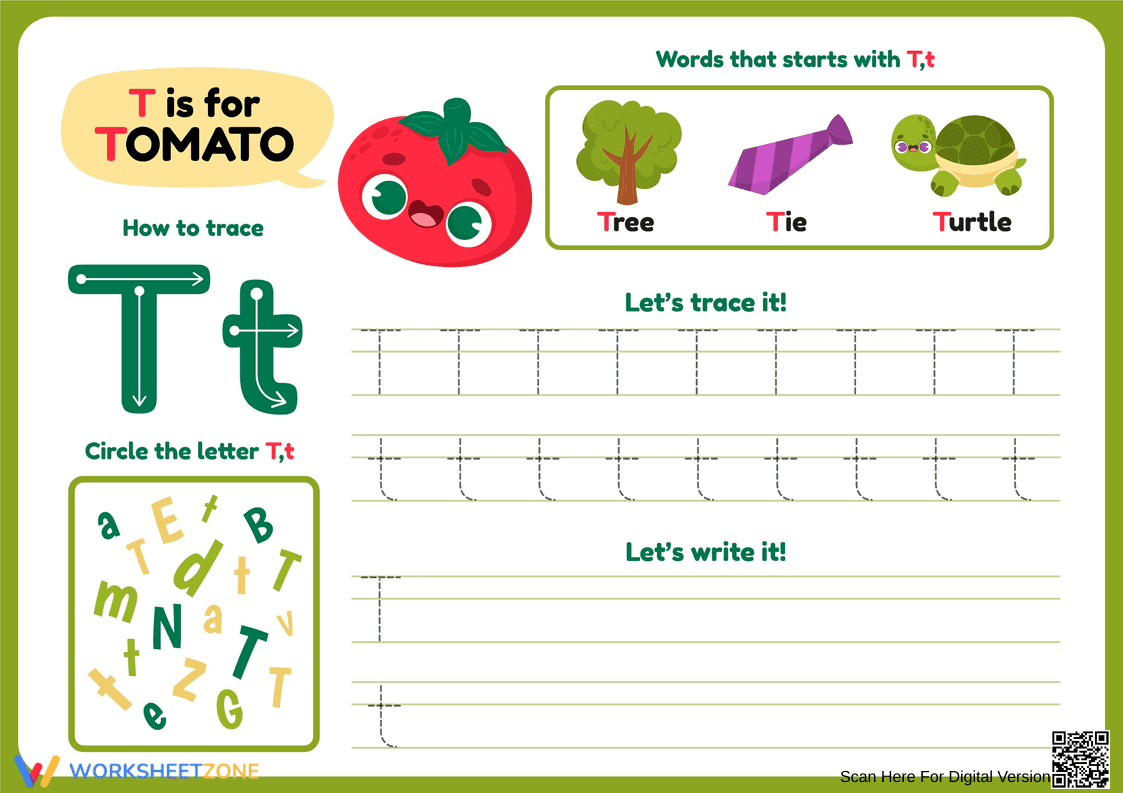

Grade 1 Letter T Tracing — Essential Printable Worksheet
Paste this activity's link or code into your existing LMS (Google Classroom, Canvas, Teams, Schoology, Moodle, etc.).
Students can open and work on the activity right away, with no student login required.
You'll still be able to track student progress and results from your teacher account.
This Grade 1 letter T worksheet provides students with a structured path to mastering uppercase and lowercase letter formation. By combining tracing exercises with independent writing and visual discrimination tasks, students build the foundational motor skills and phonics awareness needed for early literacy success. This resource ensures students can identify and produce the letter T with confidence.
At a Glance
- Grade: 1 · Subject: English
- Standard:
CCSS.ELA-LITERACY.L.1.1.A— Print all upper- and lowercase letters accurately and legibly- Skill Focus: Letter T formation and identification
- Format: 1 page · 40 tasks · Answer key included · PDF
- Best For: Independent morning work or literacy centers
- Time: 10–15 minutes
The worksheet features a comprehensive layout designed for young learners. It includes a large guide with directional arrows, two rows of dotted-line tracing for "Tt," and two rows of blank primary lines for independent writing practice. A dedicated "Circle the letter T,t" box contains 15 different letters to sharpen visual discrimination skills. Additionally, four vocabulary illustrations—a tomato, tree, tie, and turtle—provide context for the letter's sound.
The zero-prep design allows for immediate classroom implementation. First, print the single-page PDF (30 seconds). Second, distribute to students during your phonics block or as a transition activity (1 minute). Third, review the letter search and vocabulary words as a whole group to check for understanding (2 minutes). Total teacher preparation time is under two minutes, making this an ideal resource for busy mornings or unexpected substitute plans.
This resource is directly aligned with `CCSS.ELA-LITERACY.L.1.1.A`, which requires students to "Print all upper- and lowercase letters." It specifically isolates the letter T to ensure mastery before progressing to complex word construction. A supporting standard, CCSS.ELA-LITERACY.RF.1.1, is addressed through the reinforcement of print concepts. Both standard codes can be copied directly into lesson plans, IEP goals, or district curriculum mapping tools.
Use this worksheet during the "You Do" phase of a gradual release lesson on the alphabet. After demonstrating the stroke order on the whiteboard, assign this page for independent practice. It also functions as a quick formative assessment; observe students as they complete the letter search box to identify those struggling with visual letter reversals. Completion typically takes 10 to 15 minutes.
This resource is designed for first-grade students but is equally effective for kindergarteners or English Language Learners (ELLs) who need extra support with the Roman alphabet. It pairs naturally with an alphabet anchor chart or a short reading passage featuring "T" words. The clear visual cues make it accessible for students working at various levels of fine motor development.
According to the RAND AIRS 2024 report, explicit instruction in letter formation is a critical predictor of later writing fluency. This worksheet targets CCSS.ELA-LITERACY.L.1.1.A by providing structured opportunities for students to print upper- and lowercase letters, specifically focusing on the letter T. By integrating visual vocabulary cues like "tomato" and "turtle" with motor-skill practice, the resource reinforces the phoneme-grapheme connection. Research indicates that multisensory approaches—combining visual identification, auditory naming, and tactile tracing—accelerate the transition from letter recognition to automaticity. This printable resource serves as a high-leverage tool for Tier 1 instruction, ensuring students develop the precise muscle memory required for legible handwriting. The inclusion of a letter-search task further strengthens visual discrimination, a key component of the NAEP framework for early childhood literacy development and academic readiness.


