


























Views
Downloads
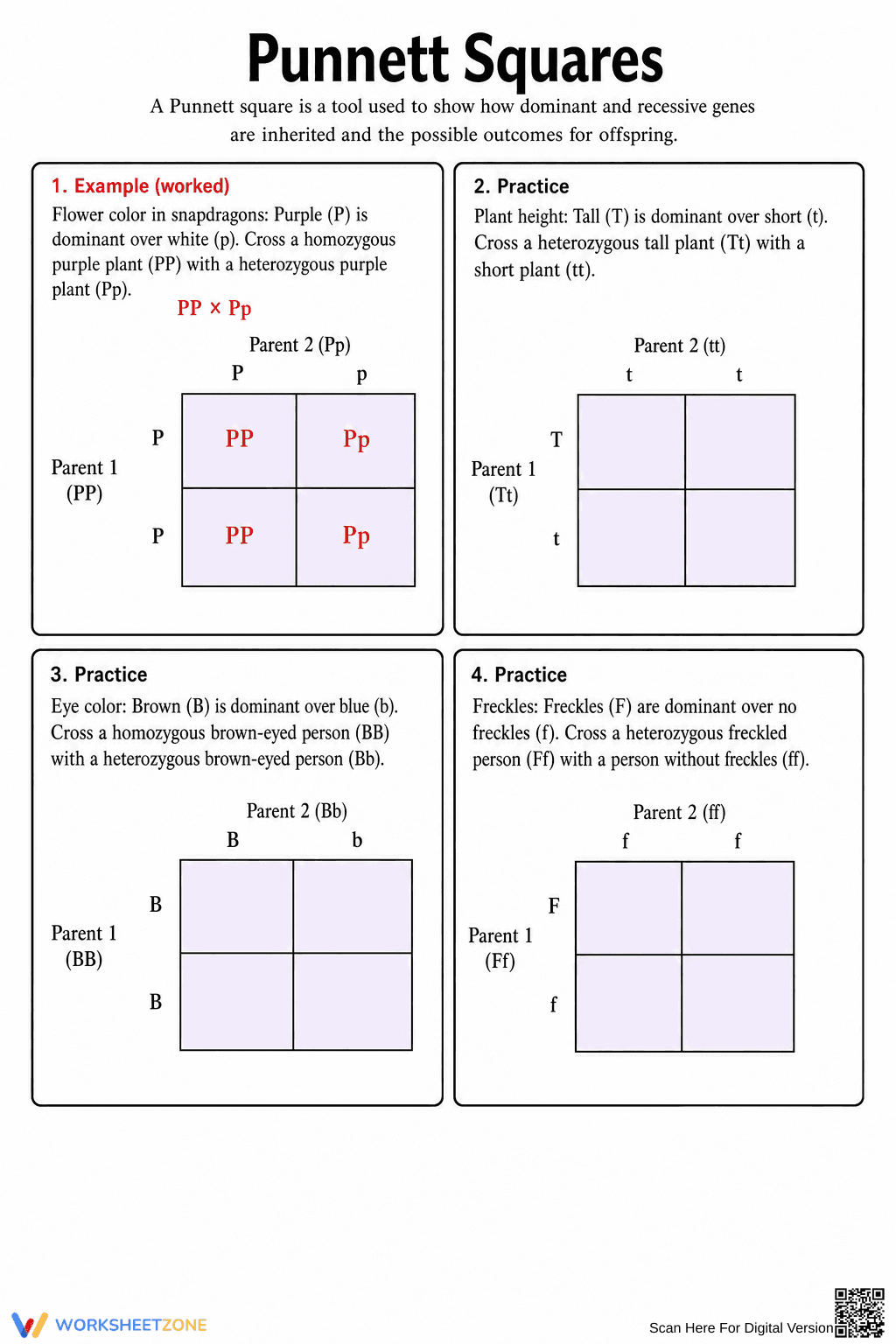

Grade 9-11 Punnett Squares — Printable No-Prep Worksheet
Paste this activity's link or code into your existing LMS (Google Classroom, Canvas, Teams, Schoology, Moodle, etc.).
Students can open and work on the activity right away, with no student login required.
You'll still be able to track student progress and results from your teacher account.
This high school biology worksheet helps students master monohybrid crosses by predicting offspring genotypes and phenotypes. By completing these targeted Punnett square problems, learners will apply their understanding of dominant and recessive alleles to determine the probability of specific genetic traits.
At a Glance
- Grade: 9-11 · Subject: Biology
- Standard:
HS-LS3-3— Apply probability to explain trait variation- Skill Focus: Punnett Squares and Inheritance
- Format: 1 page · 3 problems · Answer key included · PDF
- Best For: Independent practice or review
- Time: 10–15 minutes
This single-page resource features a clear, worked example followed by three distinct practice scenarios. Students will read short prompts about plant height, eye color, and freckles to set up their genetic crosses. The layout provides pre-drawn two-by-two grids and designated spaces for parental alleles, ensuring students format their work correctly. A complete answer key is included in the PDF download for quick grading.
Zero-Prep Workflow
- Print (1 minute): The single-page layout is optimized for standard black-and-white printing, requiring no special formatting or cutting.
- Distribute (1 minute): Hand out the worksheet as a quick warm-up, exit ticket, or emergency sub plan activity. The built-in worked example means students can start immediately.
- Review (3 minutes): Use the provided answer key to quickly check student grids or project the key on the board for self-correction.
Total teacher prep time is under two minutes, making this an ideal resource for busy biology educators needing reliable, ready-to-use genetics practice.
Standards Alignment
This worksheet is aligned to HS-LS3-3: Apply concepts of statistics and probability to explain the variation and distribution of expressed traits in a population. It also supports foundational understanding of Mendelian genetics and allele segregation. Both standard codes can be copied directly into lesson plans, IEP goals, or district curriculum mapping tools.
How to Use It
Integrate this worksheet during your genetics unit immediately following direct instruction on monohybrid crosses. It serves as an excellent formative assessment tool; as students work, observe whether they correctly place the parental alleles on the outside of the grid before filling in the intersecting boxes. Expected completion time is 10 to 15 minutes. Alternatively, assign this as a focused homework task to reinforce classroom learning.
Who It's For
This resource is designed for high school biology students in grades 9 through 11. The inclusion of a fully worked example makes it highly accessible for students who need visual scaffolds or those reviewing the concept after an absence. Pair this worksheet with a visual anchor chart on dominant and recessive traits to provide comprehensive support for diverse learners.
Mastering genetic inheritance requires repeated exposure to probability models. According to ScienceDirect TpT Analysis (2023), providing students with structured, visual frameworks like pre-drawn grids significantly reduces cognitive load, allowing them to focus on the underlying biological concepts rather than formatting. This resource directly supports HS-LS3-3 by requiring learners to apply probability to explain trait variation through concrete examples. When students actively manipulate dominant and recessive alleles to predict outcomes, they build a more robust understanding of heredity. The clear progression from a worked example to independent practice ensures that learners internalize the mechanics of genetic crosses. Utilizing targeted, brief practice sessions has been shown to improve long-term retention of complex scientific mechanisms, making this worksheet a highly effective tool for reinforcing foundational genetics principles in the secondary science classroom.


