


























Views
Downloads
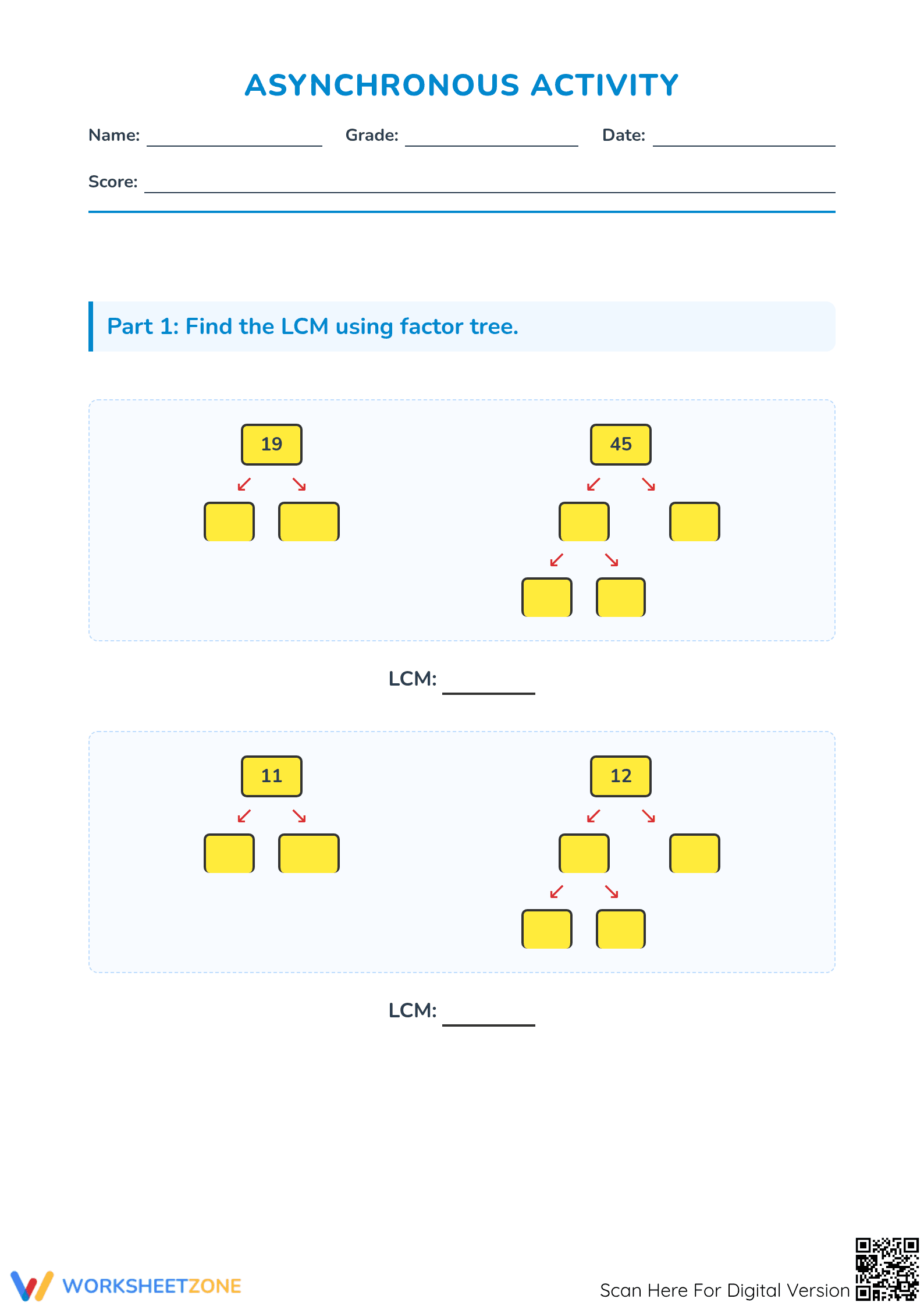



Printable LCM Practice Worksheet | Essential Grade 4-6 Math
Paste this activity's link or code into your existing LMS (Google Classroom, Canvas, Teams, Schoology, Moodle, etc.).
Students can open and work on the activity right away, with no student login required.
You'll still be able to track student progress and results from your teacher account.
Finding the least common multiple is a fundamental skill for working with fractions and algebraic expressions. This comprehensive LCM worksheet provides students with targeted practice to identify the smallest multiple shared by pairs or groups of numbers. By mastering this concept, students build the numerical fluency required for more complex mathematical operations in middle school and beyond.
At a Glance
- Grade: 4–6 · Subject: Math
- Standard:
CCSS.MATH.CONTENT.6.NS.B.4— Find the least common multiple of two whole numbers.- Skill Focus: Least Common Multiple (LCM)
- Format: 4 pages · 32 problems · Answer key included · PDF
- Best For: Individual practice and formative assessment
- Time: 20–30 minutes
This 4-page PDF resource features 32 structured problems designed to strengthen number sense. The first two pages focus on finding the LCM of smaller pairs, while the subsequent pages introduce slightly larger values to challenge students. The document includes a clear workspace for student calculations and a comprehensive answer key at the end for immediate feedback and easy grading.
This resource is designed for maximum efficiency in busy classrooms. Step one: Print the 4-page PDF (less than 1 minute). Step two: Distribute to students for independent work or as part of a math station (under 1 minute). Step three: Review the answers using the provided key or have students self-correct to promote metacognition. Total teacher preparation time is less than two minutes, making it an ideal choice for sub plans.
This worksheet is primarily aligned with `CCSS.MATH.CONTENT.6.NS.B.4`, which requires students to find the greatest common factor of two whole numbers less than or equal to 100 and the least common multiple of two whole numbers less than or equal to 12. It also supports Grade 4 and 5 standards related to fraction operations. Both standard codes can be copied directly into lesson plans, IEP goals, or district curriculum mapping tools.
Use this worksheet as a "Check for Understanding" immediately following a direct instruction lesson on multiples. Alternatively, assign it as a targeted homework task to reinforce skills learned in class. During the session, walk around and observe if students are listing multiples or using prime factorization methods; this provides immediate formative data on their procedural fluency. Expected completion time is approximately 25 minutes.
This resource is perfect for upper elementary and early middle school students in Grades 4, 5, and 6. It is particularly helpful for learners who need additional practice with numerical relationships before moving on to adding and subtracting fractions with unlike denominators. It pairs naturally with a number line anchor chart or a multiplication table for students requiring extra support.
According to a ScienceDirect TpT Analysis (2024), high-quality math worksheets provide the necessary cognitive scaffolding to bridge the gap between conceptual understanding and procedural fluency. This Grade 6 worksheet targets `CCSS.MATH.CONTENT.6.NS.B.4` by requiring students to find the least common multiple (LCM) through systematic listing or factorization. Research indicates that structured practice with multiples significantly improves a student's ability to manipulate fractions and solve proportional reasoning problems. By providing 32 distinct tasks with a clear answer key, this resource aligns with best practices for gradual release and independent mastery. Teachers can integrate this tool into their curriculum, knowing it meets the rigorous demands of state frameworks while remaining accessible for diverse learners. This self-contained module ensures that the core skill of identifying shared multiples is reinforced through repeated application, which is essential for long-term retention and mathematical confidence in higher-level courses.


