


























Views
Downloads
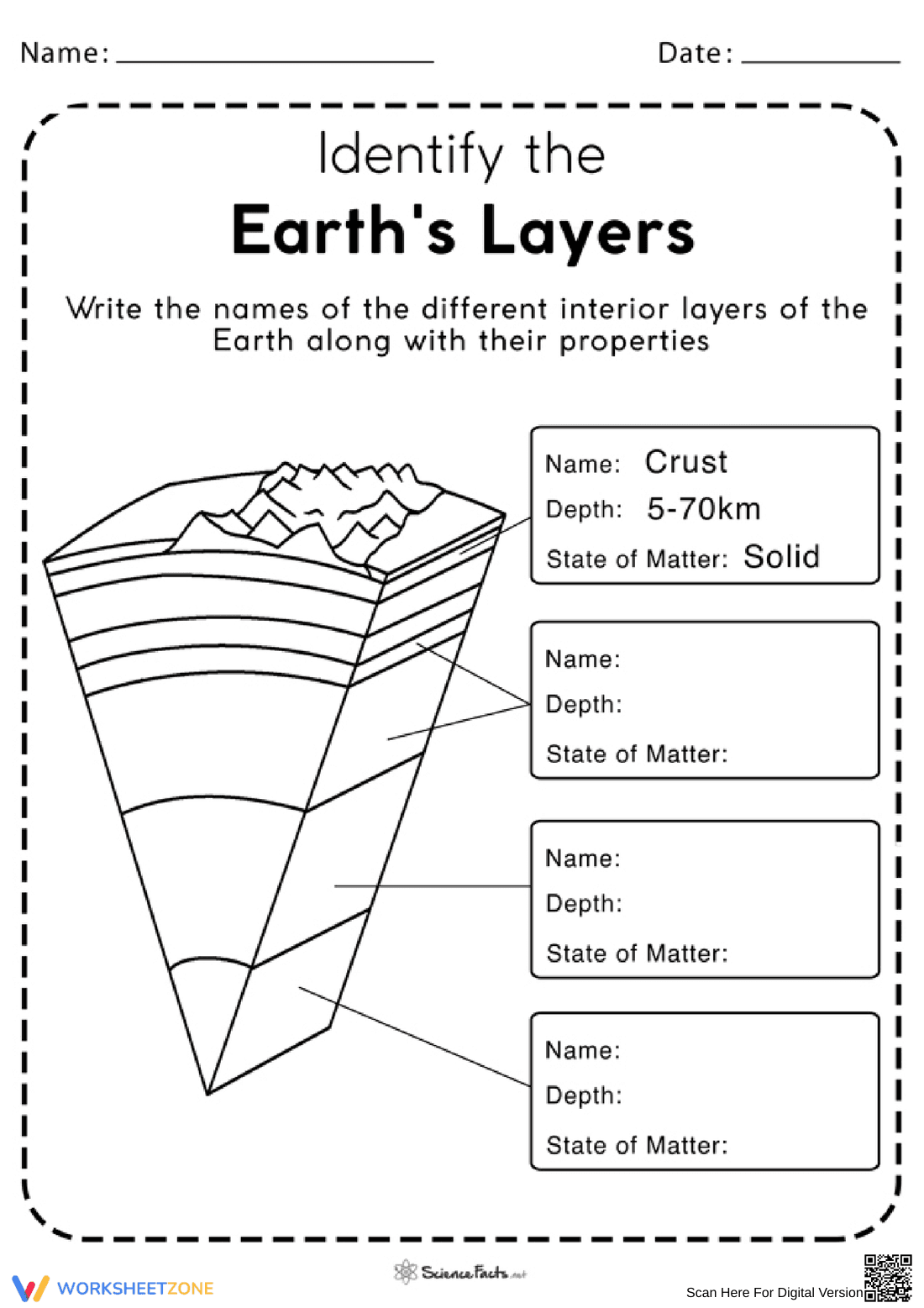

Grade 6 Earth's Layers — Printable No-Prep Worksheet
Paste this activity's link or code into your existing LMS (Google Classroom, Canvas, Teams, Schoology, Moodle, etc.).
Students can open and work on the activity right away, with no student login required.
You'll still be able to track student progress and results from your teacher account.
This Grade 6 Earth science worksheet helps students identify and describe the interior layers of the Earth. By analyzing a cross-section diagram, learners will determine the name, depth, and state of matter for the mantle, outer core, and inner core, building a foundational understanding of our planet's structure.
At a Glance
- Grade: 6 · Subject: Science
- Standard:
MS-ESS2-1— Develop a model describing the cycling of Earth's materials.- Skill Focus: Identifying Earth's interior layers
- Format: 1 page · 3 problems · Answer key included · PDF
- Best For: Independent practice or review
- Time: 10–15 minutes
This single-page diagram features a detailed cross-section of the Earth. It includes one fully worked example for the crust, followed by three blank callout boxes for the remaining layers. Students fill in the specific name, estimated depth, and state of matter for each section. A complete answer key is provided for quick reference.
Enjoy a streamlined workflow:
- Print (1 minute): The single-page PDF ensures rapid printing for an entire class.
- Distribute (1 minute): Hand out the diagram as a bell-ringer or independent assignment. Clear instructions let students begin immediately.
- Review (3 minutes): Use the included answer key to quickly check student responses or project it on the board for self-correction.
With under two minutes of total teacher prep time, this activity is highly suitable for emergency sub plans or quick transitions between science units.
This activity aligns with MS-ESS2-1, requiring students to develop a model to describe the cycling of Earth's materials and the flow of energy that drives this process. Understanding the physical properties of the mantle and core is essential for grasping convection currents and plate tectonics. Both standard codes can be copied directly into lesson plans, IEP goals, or district curriculum mapping tools.
Deploy this worksheet during direct instruction as a guided note-taking tool. As you introduce each layer, students fill in the corresponding boxes, creating a personalized reference sheet. Alternatively, assign it as a formative assessment after a lecture. While students work, observe whether they correctly identify the outer core as the only liquid layer. Most students complete this task within 10 to 15 minutes.
This resource is primarily designed for sixth-grade science students studying geology and Earth's systems. The visual nature of the diagram provides built-in scaffolding, making it highly accessible for visual learners and English Language Learners (ELLs) who benefit from graphic organizers. For a complete lesson, pair this diagram with a hands-on modeling activity, such as creating a cross-section of the Earth using different colors of modeling clay, to reinforce the concepts of depth and state of matter.
Mastering the structural composition of our planet is a critical stepping stone for middle school science students. According to a ScienceDirect TpT Analysis, visual models and diagrams significantly improve retention of complex spatial concepts in geology. By practicing with this specific format, learners actively engage with MS-ESS2-1, developing a model describing the cycling of Earth's materials. When students accurately identify the depth and state of matter for each layer, they build the necessary cognitive framework to understand broader geological processes like plate tectonics and magnetic field generation. This targeted practice ensures that foundational knowledge is solidified before moving on to more dynamic Earth systems. Providing clear, structured diagrams with worked examples reduces cognitive load, allowing students to focus entirely on mastering the core scientific content required by modern educational standards.


