




























Views
Downloads

Grade 4-6 Layers of the Earth — Printable No-Prep Worksheet

Paste this activity's link or code into your existing LMS (Google Classroom, Canvas, Teams, Schoology, Moodle, etc.).
Students can open and work on the activity right away, with no student login required.
You'll still be able to track student progress and results from your teacher account.
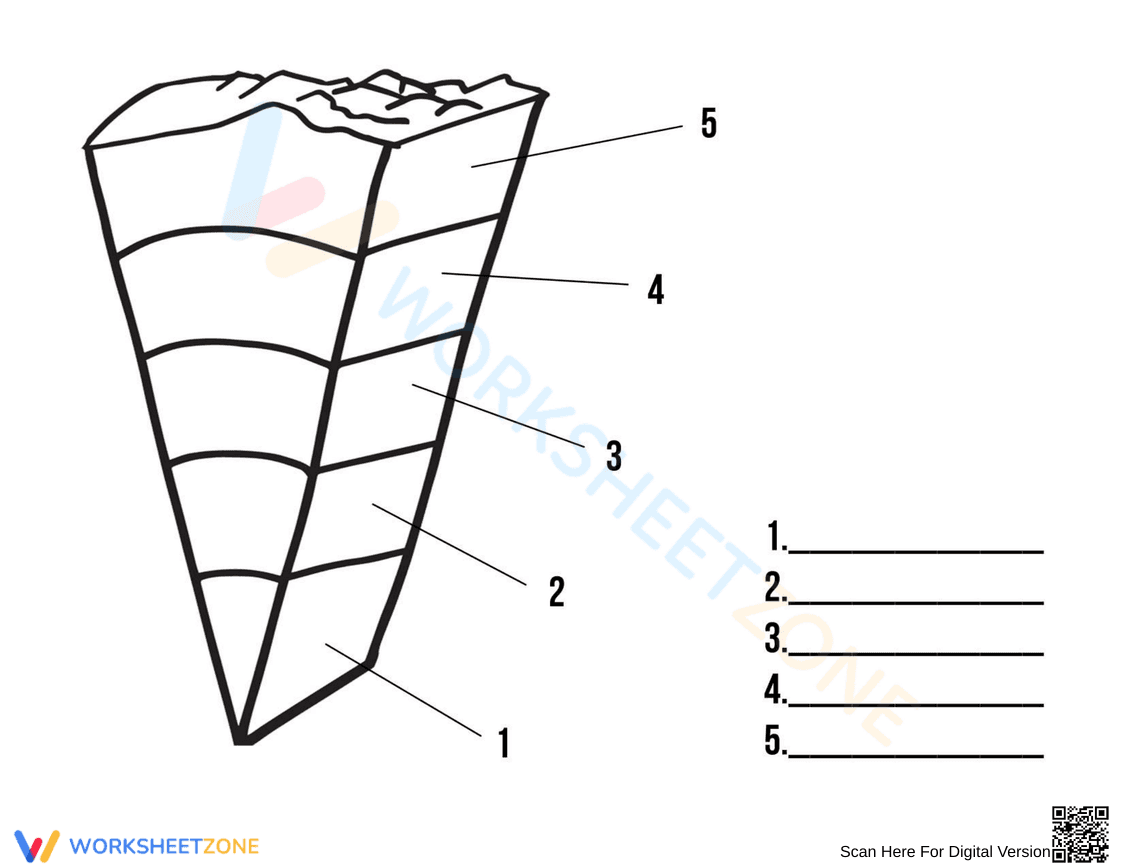
This Earth Science worksheet provides a clear, printable diagram for students to identify and label the five primary layers of the Earth. By completing this visual model, learners demonstrate their understanding of the planet's internal structure and composition. It serves as a foundational exercise for units on geology and plate tectonics.
At a Glance
- Grade: 4-6 · Subject: Earth Science
- Standard:
MS-ESS2-1— Develop a model to describe the cycling of Earth materials- Skill Focus: Earth layer identification
- Format: 1 page · 5 problems · Answer key included · PDF
- Best For: Quick formative assessment or bell-ringer
- Time: 5–10 minutes
The resource features a high-resolution cross-sectional wedge diagram of the Earth. It includes five numbered leader lines pointing to specific internal regions, from the surface to the center. The layout is clean and distraction-free, providing ample space for students to write the names of the crust, mantle, and core divisions. A comprehensive answer key is provided.
Zero-Prep Workflow
The zero-prep workflow is designed for maximum efficiency. First, print the single-page PDF (30 seconds). Second, distribute the diagram to students as a bell-ringer or formative check (1 minute). Third, review the five layers using the included answer key to provide immediate feedback (1 minute). Total teacher preparation time is under two minutes, making this an ideal resource for substitute plans.
Standards Alignment
This worksheet aligns with MS-ESS2-1: "Develop a model to describe the cycling of Earth's materials and the flow of energy that drives this process." By identifying the distinct layers, students establish the structural framework required to understand how heat transfer within the mantle drives tectonic activity. This standard code can be copied directly into lesson plans, IEP goals, or district curriculum mapping tools.
How to Use It
Use this worksheet as a formative assessment immediately following a lecture on Earth's composition. It is particularly effective when paired with a physical model or a video demonstration of Earth's interior. Teachers should observe whether students can distinguish between the upper and lower mantle, as this indicates a higher level of detail-oriented learning. Completion typically takes 5 to 10 minutes.
Who It's For
This resource is designed for upper elementary and middle school students (Grades 4-6) studying Earth Science. It is highly effective for English Language Learners (ELLs) and students with IEPs who benefit from visual aids and reduced writing demands. It pairs naturally with an anchor chart or a textbook chapter on the geosphere and planetary structure.
According to the RAND AIRS 2024 report on science literacy, visual modeling is a critical component of conceptual mastery in Earth Science. This worksheet utilizes a cross-sectional diagram to help students visualize the internal structure of the planet, moving beyond abstract definitions to spatial recognition. Research by Fisher & Frey (2014) emphasizes that labeling tasks serve as essential scaffolds in the gradual release of responsibility model, allowing students to demonstrate knowledge of the MS-ESS2-1 standard before engaging in complex systems analysis. By identifying the crust, mantle, and core divisions, learners build the foundational vocabulary necessary for understanding plate tectonics and geothermal energy. The 5-task structure ensures that students focus on the primary chemical and physical boundaries of the Earth. This resource provides a high-utility assessment tool that aligns with national trends toward evidence-based modeling in middle school science curricula.


