


























Views
Downloads
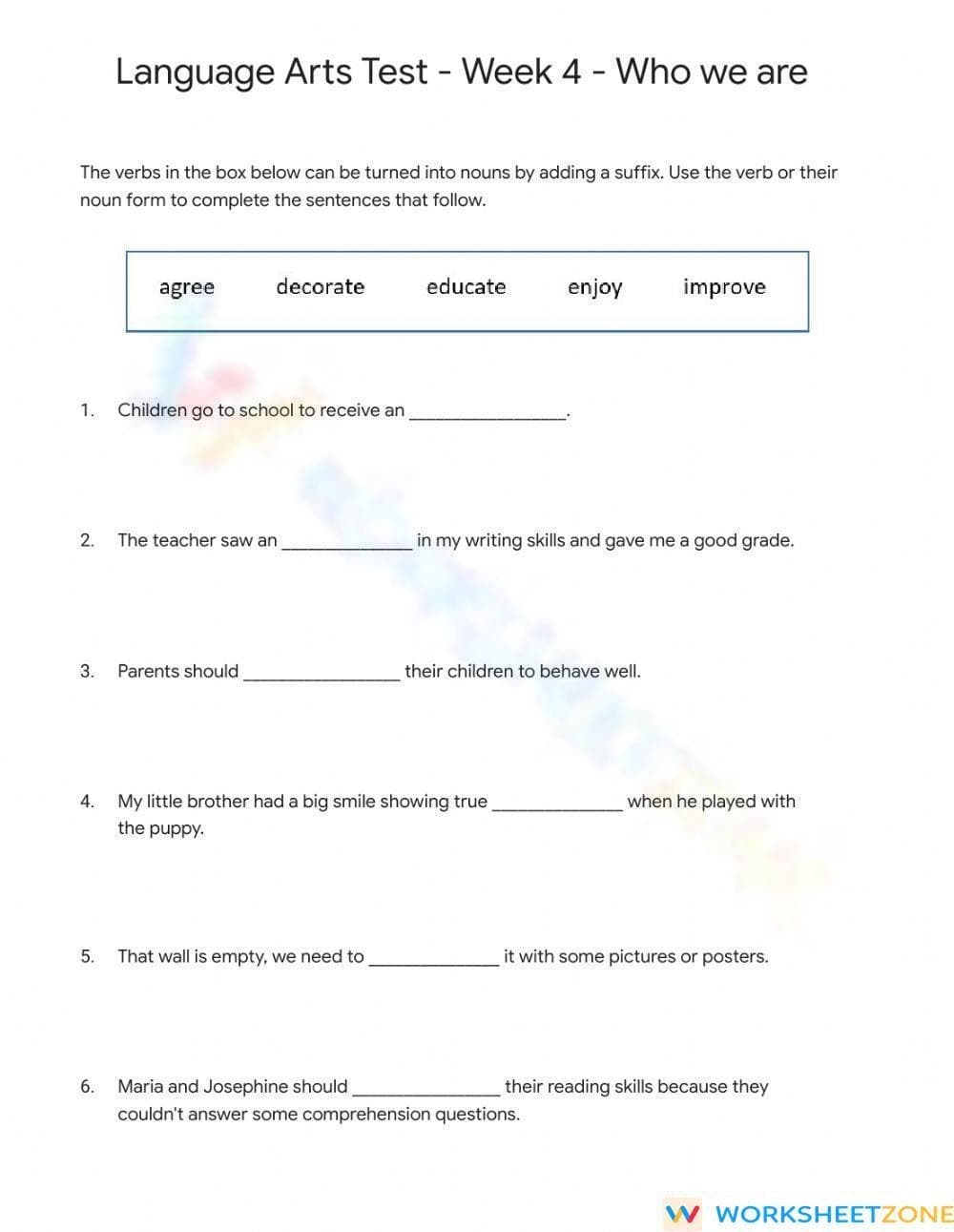



CCSS.L.3.4.B Worksheet: Word Formation — Grade 3 Aligned
Paste this activity's link or code into your existing LMS (Google Classroom, Canvas, Teams, Schoology, Moodle, etc.).
Students can open and work on the activity right away, with no student login required.
You'll still be able to track student progress and results from your teacher account.
Comprehensive Language Arts Assessment for Grade 3
This comprehensive language arts assessment helps third-grade students demonstrate understanding of word formation and vocabulary. It provides practice with suffixes, root words, and grammar through 30 tasks, building a foundation for complex literacy skills. Students will apply morphological knowledge to create and understand new words to improve overall reading comprehension.
At a Glance
- Grade: 3 · Subject: English Language Arts (ELA)
- Standard:
CCSS.ELA-LITERACY.L.3.4.B— Determine the meaning of a new word when an affix is added.- Skill Focus: Word Formation and Suffixes
- Format: 3 pages · 30 problems · Answer key included · PDF
- Best For: Unit Assessment, Test Prep, and Review
- Time: 25–35 minutes
What's Inside
This three-page PDF includes varied question formats to assess essential language skills. Students will encounter fill-in-the-blank sentences for suffixes and grammar rules, a matching section for root words and their derivatives, and an audio-based activity for phonics and spelling. A complete answer key is provided to ensure efficient grading and immediate student feedback during the review process.
Evidence of Mastery for Gradebook Data
This assessment provides clear evidence of student mastery against language standards. Tasks directly map to key sub-skills in vocabulary acquisition, ranging from basic identification to complex application. The suffix section specifically assesses the application of affix meanings to root words. These scores from 30 varied problems provide clear, actionable data for standards-based gradebooks, IEP progress notes, or parent-teacher conferences regarding literacy growth.
Standards Alignment for Lesson Planning
This worksheet is principally aligned to CCSS.ELA-LITERACY.L.3.4.B, requiring students to "Determine the meaning of the new word formed when a known affix is added to a known word." It also provides practice for supporting standard CCSS.ELA-LITERACY.L.3.4.C, involving root words as a clue to meaning. Both standard codes can be copied directly into lesson plans, IEP goals, or curriculum mapping tools for efficient documentation.
How to Use It in Your Classroom
This resource is ideal as a summative assessment at the end of a word study or grammar unit. Administer it after students have received direct instruction and practice with suffixes and root words. For a formative check, observe students during the first section to identify struggles with verb-to-noun conversion. This reveals critical misunderstandings about parts of speech before the final grade is recorded. Completion time is 25-35 minutes.
Who It's For
This test is designed for third-grade students working toward grade-level language standards. The varied tasks make it accessible for most learners in a general education classroom. For supported students, consider completing the audio-based phonics section as a whole group to reduce cognitive load. This resource pairs naturally with a vocabulary anchor chart or a reading passage focused on morphological patterns during the instructional phase.
This Grade 3 language arts assessment evaluates student proficiency with CCSS.ELA-LITERACY.L.3.4.B through a series of 30 rigorous word analysis tasks. By applying suffixes to verbs and matching root words, students demonstrate the morphological awareness necessary to decode complex text and expand their academic vocabulary. According to Fisher & Frey (2014), explicit instruction in word parts is a critical component of the gradual release of responsibility model in literacy. This standards-aligned tool helps educators gather essential data on student progress, informing future instructional decisions and ensuring all learners meet core literacy benchmarks. By isolating specific affixes and roots, the worksheet provides a granular view of student understanding, allowing for targeted intervention where needed. The inclusion of an answer key supports immediate feedback, which research suggests is vital for reinforcing correct morphological patterns in developing readers and writers.


