


























Views
Downloads
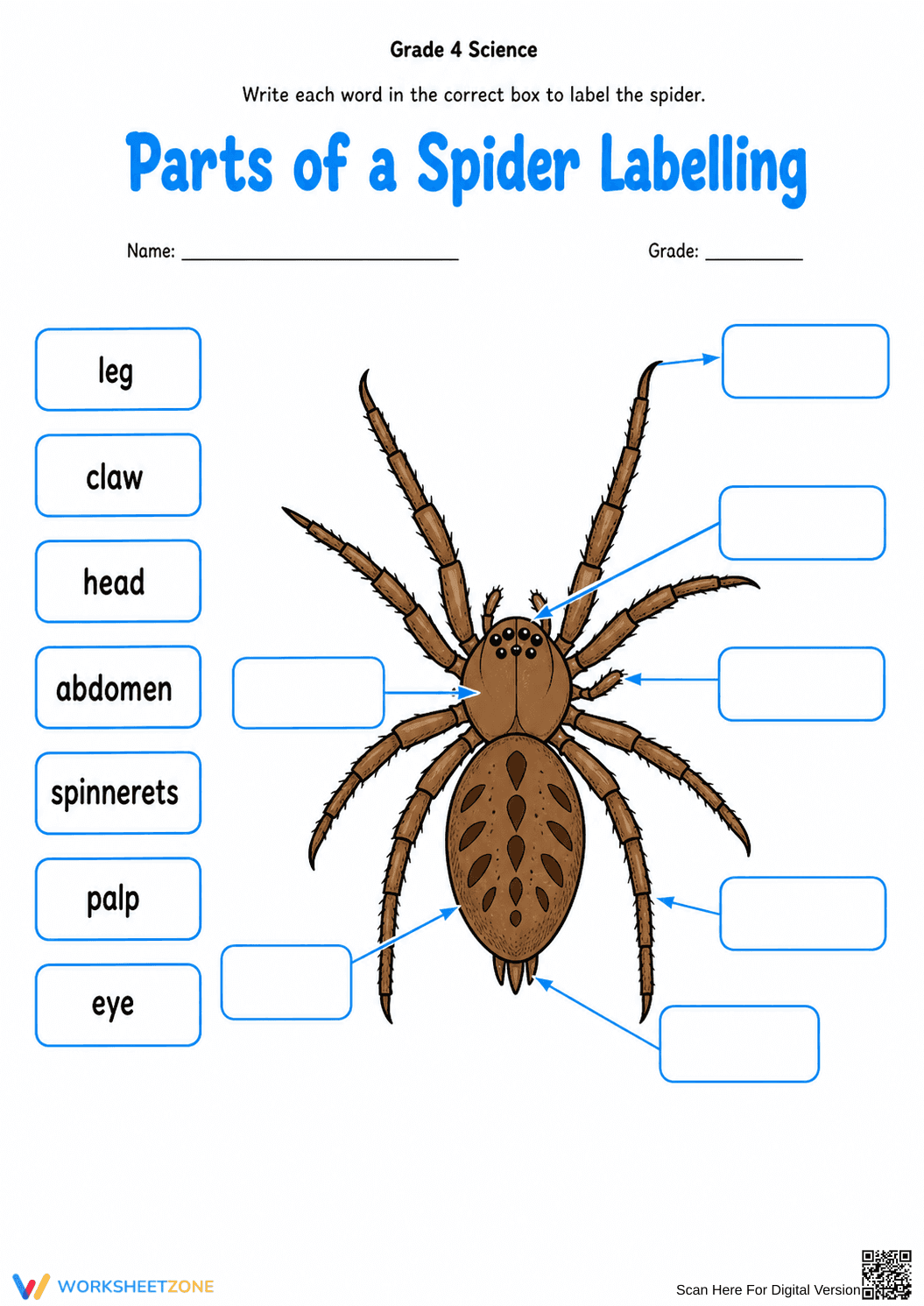

Grade 4 Spider Anatomy — Printable No-Prep Worksheet
Paste this activity's link or code into your existing LMS (Google Classroom, Canvas, Teams, Schoology, Moodle, etc.).
Students can open and work on the activity right away, with no student login required.
You'll still be able to track student progress and results from your teacher account.
This Grade 4 science worksheet helps students identify and label the external structures of a spider. By matching vocabulary words to a detailed anatomical diagram, learners reinforce their understanding of arthropod biology and how specific body parts function to support survival in the natural environment.
At a Glance
- Grade: 4 · Subject: Science
- Standard:
4-LS1-1— Identify external animal structures that support survival.- Skill Focus: Labeling spider anatomy
- Format: 1 page · 7 problems · Answer key included · PDF
- Best For: Independent practice or homework
- Time: 10–15 minutes
This single-page resource features a clear, high-quality illustration of a spider alongside a helpful word bank. Students are tasked with placing seven specific anatomical terms—including the abdomen, spinnerets, palp, and claw—into the correct blank boxes pointing to the corresponding body parts. The straightforward layout minimizes confusion, while the included answer key ensures accurate grading for educators or self-checking for students.
Zero-Prep Workflow
This resource is designed for immediate classroom implementation with minimal teacher setup:
- Print (1 minute): Simply download the PDF and print a class set. The black-and-white friendly design saves ink.
- Distribute (1 minute): Hand out the worksheets along with pencils. No scissors or glue required.
- Review (3 minutes): Go over the word bank terms briefly as a class, then let students work independently.
With prep time under two minutes, it is an excellent addition to any sub plan.
Standards Alignment
This activity aligns directly with Next Generation Science Standard 4-LS1-1: Construct an argument that plants and animals have internal and external structures that function to support survival, growth, behavior, and reproduction. Identifying structures like spinnerets builds foundational vocabulary for discussing how spiders hunt and survive. Both standard codes can be copied directly into lesson plans, IEP goals, or district curriculum mapping tools.
How to Use It
This labeling activity works perfectly as an independent practice assignment following direct instruction on arthropods or animal classifications. Teachers can also use it as a quick formative assessment at the end of a life science unit to check for vocabulary retention. While students are working, walk around the room and observe whether they can correctly distinguish between the head and the abdomen, which is a common point of confusion. The entire activity should take most students between 10 and 15 minutes to complete.
Who It's For
This worksheet is primarily designed for fourth-grade science students studying animal life cycles and anatomy. The included word bank provides built-in differentiation, making it accessible for English Language Learners and students who need spelling support. It pairs naturally with an introductory lesson on arachnids or a nonfiction reading passage about how spiders build their webs.
Integrating visual diagrams with targeted vocabulary practice is a highly effective method for teaching foundational life science concepts in the elementary classroom. According to a ScienceDirect TpT Analysis, students who engage with labeled anatomical models demonstrate significantly higher retention of domain-specific vocabulary compared to those who only read text descriptions. This worksheet directly supports standard 4-LS1-1 by requiring learners to identify external animal structures that support survival. By actively mapping specialized terms like "spinnerets" and "abdomen" to a clear visual representation, fourth graders solidify their mental models of arthropod biology. This dual-coding approach—combining linguistic and visual information—reduces cognitive load and helps students transition from basic recognition to deeper comprehension of how physical traits enable organisms to thrive in their environments. Consistent practice with these diagrams builds essential scientific literacy.


