


























Views
Downloads
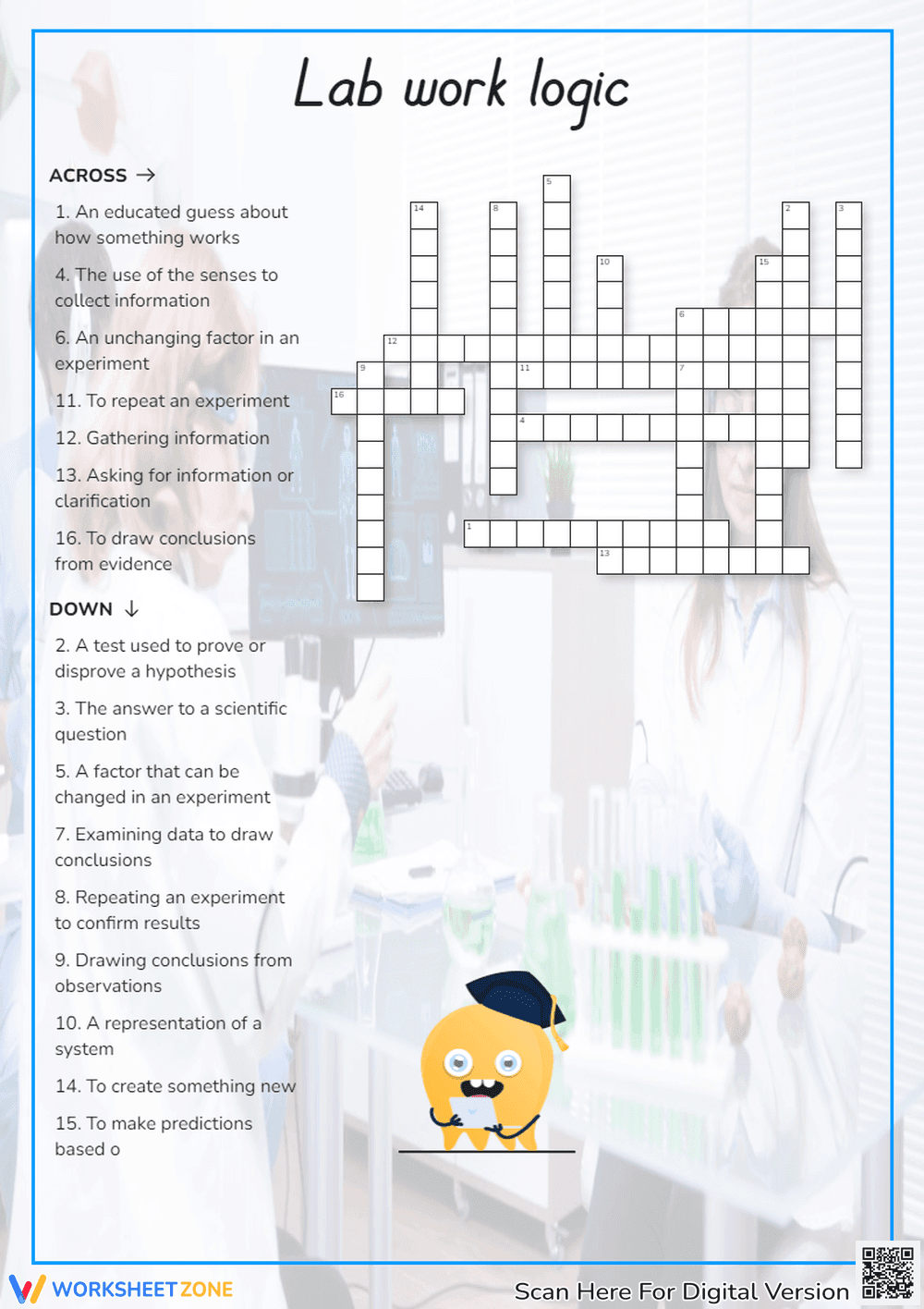

Lab Work Logic Crossword | Grade 4 Science Essential
Paste this activity's link or code into your existing LMS (Google Classroom, Canvas, Teams, Schoology, Moodle, etc.).
Students can open and work on the activity right away, with no student login required.
You'll still be able to track student progress and results from your teacher account.
This Grade 4 science worksheet reinforces critical lab vocabulary through a logic-based crossword puzzle. Students engage with 16 essential terms related to the scientific method, helping them internalize the language of inquiry before conducting hands-on experiments. It provides a structured way to bridge the gap between abstract concepts and practical application in a chemistry or general science setting.
At a Glance
- Grade: 4 · Subject: Science
- Standard:
3-5-ETS1-3— Plan and conduct fair tests where variables are controlled and trials considered- Skill Focus: Scientific Method Terminology
- Format: 1 page · 16 problems · Answer key included · PDF
- Best For: Bell-ringers or pre-lab vocabulary review
- Time: 15–20 minutes
The worksheet features a 16-word crossword grid with clear, descriptive clues for terms like hypothesis, variable, and inference. The single-page layout is designed for clarity, ensuring students can focus on the definitions without visual clutter. A full answer key is included to facilitate quick grading or student self-correction during independent work time.
Zero-Prep Workflow
- Print: Select the PDF and print enough copies for your class in under 30 seconds.
- Distribute: Hand out the sheets as a bell-ringer or transition activity to settle the class (1 minute).
- Review: Use the included answer key to check for understanding as a whole group or for individual feedback (5 minutes).
This resource is a perfect sub-plan addition, requiring zero teacher setup or specialized materials beyond a pencil.
Standards Alignment
Primary Standard: 3-5-ETS1-3. This standard requires students to plan and conduct an investigation collaboratively to produce data to serve as the basis for evidence, using fair tests in which variables are controlled. This worksheet ensures students understand the terminology required to meet this standard. Both standard codes can be copied directly into lesson plans, IEP goals, or district curriculum mapping tools.
How to Use It
Use this as a pre-lab warm-up to ensure students understand the difference between a constant and a variable before starting a physical experiment. It also serves as an excellent formative assessment at the end of a unit on the scientific method. Expected completion time ranges from 15 to 20 minutes depending on student familiarity with the terms.
Who It's For
This resource is ideal for Grade 4 students but is also appropriate for Grade 3 enrichment or Grade 5 review. It is particularly helpful for English Language Learners (ELL) who need explicit vocabulary support. Pair this with a physical lab equipment scavenger hunt or an anchor chart for a comprehensive introductory science lesson.
According to the RAND AIRS 2024 report on science literacy, explicit vocabulary instruction is a foundational component of successful inquiry-based learning. This worksheet addresses the linguistic demands of the 3-5-ETS1-3 standard by requiring students to synthesize definitions into a cohesive logic puzzle. By mastering terms like replicate and inference in a low-stakes format, students build the cognitive schema necessary for complex data analysis. Research from Fisher & Frey (2014) suggests that word-play activities like crosswords can increase engagement with technical terminology by 40% compared to rote memorization. This resource provides the necessary scaffolding for students to transition from passive observers to active participants in the scientific process. The inclusion of 16 distinct tasks ensures broad coverage of the scientific method, making it a reliable tool for classroom teachers and curriculum specialists seeking to improve student outcomes in elementary science.


