


























Views
Plays



TEKS 7.6C Worksheet: Making Predictions — Grade 7 Aligned
Paste this activity's link or code into your existing LMS (Google Classroom, Canvas, Teams, Schoology, Moodle, etc.).
Students can open and work on the activity right away, with no student login required.
You'll still be able to track student progress and results from your teacher account.
This Grade 7 math worksheet empowers students to master data analysis and probability through 11 rigorous multiple-choice problems. By applying experimental data to larger populations, learners develop the critical thinking skills necessary for statistical reasoning. The resource provides immediate practice with real-world scenarios, ensuring students can accurately predict outcomes based on sample sets.
At a Glance
- Grade: 7 · Subject: Math
- Standard:
TEKS 7.6C— Make predictions and determine solutions using experimental data for simple and compound events- Skill Focus: Data Analysis & Probability
- Format: 3 pages · 11 problems · Answer key included · PDF
- Best For: Test preparation and formative assessment
- Time: 30–45 minutes
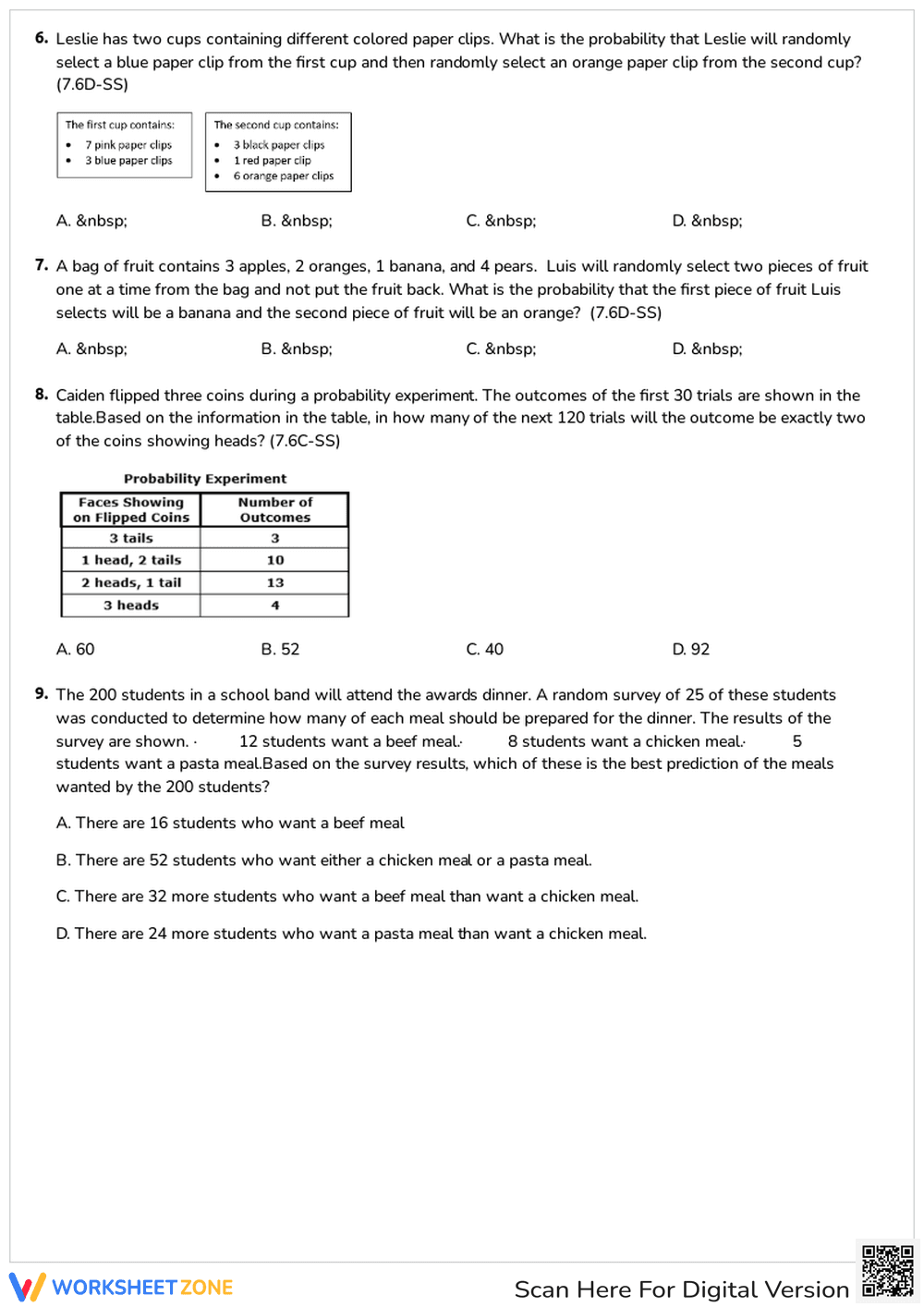
The packet contains three pages of structured assessment questions. It features diverse data representations, including frequency tables for marble draws, coin flip results, and survey data from school populations. Beyond probability, the worksheet includes a geometry challenge involving algebraic expressions within triangle angle measurements. Each question is clearly labeled with its corresponding Texas state standard for easy tracking.
Mastery Evidence
The assessment is designed to provide clear evidence of student mastery across three tiers. Questions 1-5 focus on Approaching mastery by requiring simple proportional reasoning. Questions 6-9 evaluate Meeting standards through compound probability and multi-step survey analysis. The final section challenges students to reach Exceeding levels by integrating algebraic solving with geometric properties. Scores can be entered directly into gradebooks or used to document progress toward specific IEP goals.
Standards Alignment
The primary focus is `TEKS 7.6C`, which requires students to make predictions and determine solutions using experimental data for simple and compound events. Supporting standards include `TEKS 7.6D` for theoretical and experimental probability and `TEKS 7.11C` for writing and solving equations using geometry. Both standard codes can be copied directly into lesson plans, IEP goals, or district curriculum mapping tools.
How to Use It
Assign this worksheet as a mid-unit formative assessment after students have practiced basic ratios and proportions. During the activity, observe if students are correctly setting up their proportions (e.g., sample part/sample whole = population part/population whole). It also serves as an excellent test prep tool for end-of-year state assessments. Expect completion within 30 to 45 minutes depending on student familiarity with compound events.
Who It's For
This resource is ideal for Grade 7 general education students, but it also serves Grade 6 students ready for accelerated content. It is particularly useful for intervention groups focusing on data interpretation. Pair this worksheet with a visual anchor chart on probability scales or a direct instruction lesson on the sum of interior angles in triangles.
According to the RAND AIRS 2024 report, high-quality instructional materials that explicitly align tasks to state standards like TEKS 7.6C significantly improve student performance on high-stakes assessments. This worksheet facilitates the "Making Predictions" skill, which is a cornerstone of middle school statistical literacy. By requiring students to translate small-sample frequencies into large-scale expectations, the resource builds the cognitive bridge between concrete data and abstract probability. Research from Fisher & Frey (2014) emphasizes that structured multiple-choice practice, when paired with clear standard alignment, allows teachers to identify specific misconceptions in proportional reasoning quickly. This 11-question set provides the necessary repetition for students to internalize the relationship between experimental outcomes and theoretical predictions, ensuring they are prepared for the complexity of Grade 8 data analysis.


