


























Views
Downloads

Printable Pumpkin Life Cycle Worksheet | K Science
Paste this activity's link or code into your existing LMS (Google Classroom, Canvas, Teams, Schoology, Moodle, etc.).
Students can open and work on the activity right away, with no student login required.
You'll still be able to track student progress and results from your teacher account.
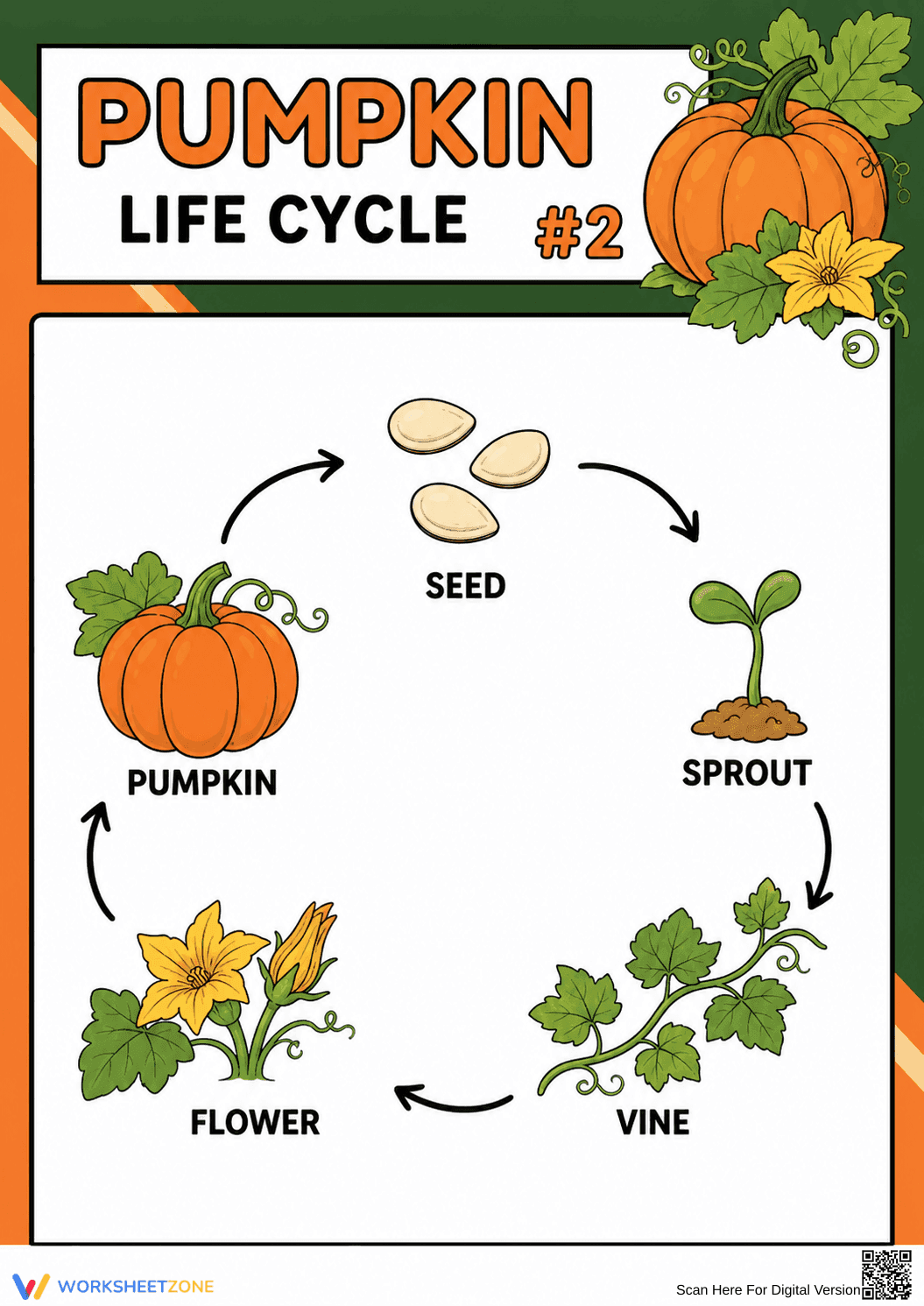
This Kindergarten pumpkin life cycle worksheet provides a clear visual framework for students to identify and sequence the five primary stages of plant growth. By observing the transition from seed to sprout, vine, flower, and finally the mature fruit, young learners develop essential scientific observation skills and a foundational understanding of biological patterns.
At a Glance
- Grade: Kindergarten · Subject: Science
- Standard:
K-LS1-1— Use observations to describe patterns of what plants and animals need to survive- Skill Focus: Plant life cycle sequencing
- Format: 1 page · 5 stages · Visual guide included · PDF
- Best For: Fall science centers and seasonal lessons
- Time: 10–15 minutes
What's Inside: This single-page PDF features a high-contrast circular diagram illustrating the pumpkin's journey. It includes five distinct, labeled illustrations: the seed, the sprout emerging from soil, the spreading vine, the yellow blossom, and the final orange pumpkin. The clean layout and bold text make it accessible for early readers and English Language Learners (ELLs) to follow the directional arrows easily.
Zero-Prep Workflow: Teachers can integrate this resource into their morning routine in under 2 minutes. First, print the single-sheet PDF for each student or display it on a smartboard. Second, distribute the page during your science block for immediate visual engagement. Third, review the stages as a whole group, using the arrows to guide the discussion on chronological growth without any additional setup or materials required.
Standards Alignment: This resource aligns with `K-LS1-1`, which requires students to use observations to describe patterns in the natural world. By identifying the repeating stages of the pumpkin life cycle, students demonstrate an understanding of how organisms change and grow over time. This standard code can be copied directly into lesson plans, IEP goals, or district curriculum mapping tools.
How to Use It: Use this worksheet during the "Explore" phase of a 5E lesson plan to introduce plant biology. It serves as an excellent formative assessment tool; ask students to point to the stage that comes after the flower to check for understanding. It is also ideal for a fall-themed science center where students can color the stages while practicing the vocabulary words "seed" and "sprout."
Who It's For: This resource is designed for Kindergarten classrooms, homeschool environments, and early childhood science programs. It is particularly effective for students who benefit from visual scaffolds and clear, uncluttered instructional materials. Pair this worksheet with a real pumpkin carving activity or a seed-planting experiment to provide a hands-on connection to the abstract diagram.
Research from the RAND AIRS 2024 report emphasizes that high-quality visual aids in early childhood science significantly improve the retention of complex biological concepts like life cycles. By providing a structured, directional diagram, this worksheet reduces cognitive load for Kindergarteners, allowing them to focus on the chronological relationship between growth stages. The inclusion of the K-LS1-1 standard ensures that the activity remains grounded in rigorous academic expectations rather than just seasonal craft. Fisher & Frey (2014) highlight that such visual scaffolds are essential for gradual release of responsibility, moving students from teacher-led observation to independent identification. This resource provides the necessary visual support to anchor classroom discussions. Using this worksheet helps bridge the gap between abstract scientific theory and observable natural patterns, making it a reliable tool for meeting early life science benchmarks in any standard-aligned curriculum.


