


























Views
Downloads
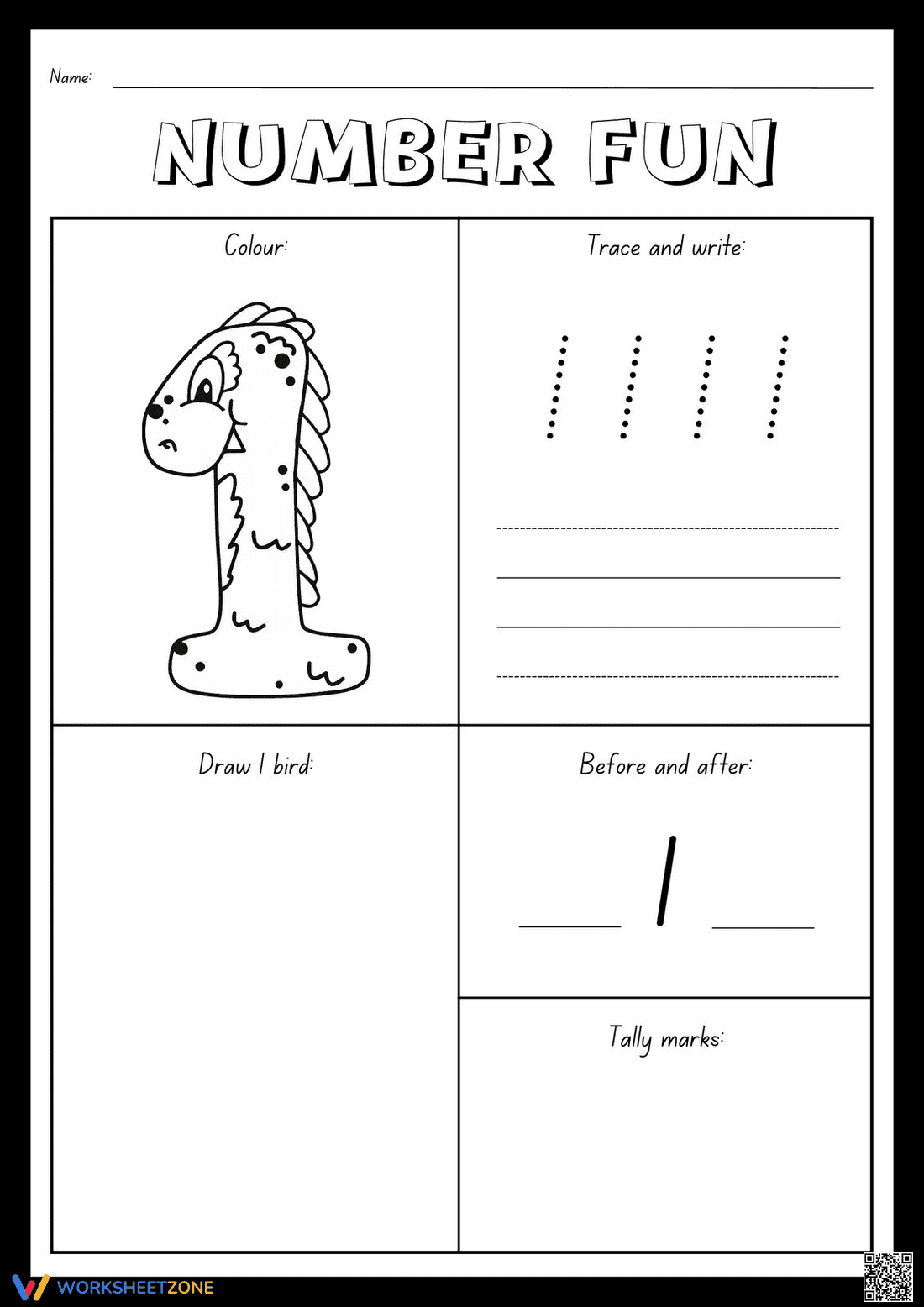

Kindergarten Numbers 1-10 Printable Worksheet
Paste this activity's link or code into your existing LMS (Google Classroom, Canvas, Teams, Schoology, Moodle, etc.).
Students can open and work on the activity right away, with no student login required.
You'll still be able to track student progress and results from your teacher account.
This Kindergarten numbers 1-10 worksheet provides foundational practice for early learners to master numeral recognition and formation. Students engage in multi-sensory activities including tracing, drawing, and tallying to solidify their understanding of quantity. This resource ensures students can confidently identify and write numbers while connecting numerals to physical representations.
At a Glance
- Grade: Kindergarten · Subject: Math
- Standard:
CCSS.MATH.CONTENT.K.CC.A.3— Write numbers from 0 to 20 and represent objects with numerals- Skill Focus: Number formation and representation
- Format: 10 pages · 50 problems · Answer key included · PDF
- Best For: Morning work or independent math centers
- Time: 10–15 minutes
What's Inside: The packet contains 10 dedicated pages, one for each number from 1 to 10. Each page features five distinct task types: a coloring section for visual recognition, a tracing and writing area for fine motor development, a drawing box for one-to-one correspondence, a "before and after" sequence for numerical order, and a tally mark section for alternative representation. A complete answer key is provided for quick verification.
Zero-Prep Workflow
- Print (30 seconds): Select the specific number page needed for the day's lesson or print the entire 10-page set for a workbook.
- Distribute (30 seconds): Hand out the single-page sheets to students along with crayons and pencils.
- Review (1 minute): Use the included answer key to quickly check student drawings and number sequences during independent work time.
This workflow requires less than two minutes of total teacher preparation, making it an ideal choice for emergency sub plans or transition periods.
Standards Alignment
The primary focus is `CCSS.MATH.CONTENT.K.CC.A.3`, which requires students to "Write numbers from 0 to 20. Represent a number of objects with a written numeral 0-20 (with 0 representing a count of no objects)." This worksheet directly supports this by requiring both the physical writing of the numeral and the creation of a set (drawing birds) to match the number. Both standard codes can be copied directly into lesson plans, IEP goals, or district curriculum mapping tools.
How to Use It
Use this worksheet during the "You Do" phase of a gradual release lesson on number sense. After introducing a number using manipulatives, assign the page as a formative assessment to gauge individual mastery of numeral formation. Alternatively, place these pages in a dry-erase sleeve within a math center for repeated practice. Teachers should observe the "before and after" section to identify students struggling with number sequence logic. Expected completion time is 10 to 15 minutes.
Who It's For
This resource is designed for Kindergarten students beginning their journey with formal mathematics. It is also highly effective for Pre-K students ready for enrichment or first-grade students requiring intervention in number formation. Pair this worksheet with a counting song or a set of physical counters to provide a comprehensive learning experience for tactile and auditory learners.
According to the RAND AIRS 2024 report, high-quality math materials for early childhood must integrate multiple representations of number to build deep conceptual understanding. This worksheet aligns with those findings by requiring students to interact with the standard CCSS.MATH.CONTENT.K.CC.A.3 through three distinct modalities: symbolic (writing), pictorial (drawing), and abstract (tallying). By practicing the plain-English skill of representing quantities with numerals, students develop the cognitive flexibility necessary for later operations. Research from Fisher & Frey (2014) emphasizes that structured, independent practice following direct instruction is critical for the retention of fine motor skills like number formation. This 10-page set provides the necessary repetition to move students toward automaticity in early numeracy, ensuring they meet grade-level benchmarks for mathematical fluency and readiness for more complex algebraic thinking in subsequent grades.


