


























Views
Downloads

Printable Name Tracing Worksheet | Kindergarten Writing
Paste this activity's link or code into your existing LMS (Google Classroom, Canvas, Teams, Schoology, Moodle, etc.).
Students can open and work on the activity right away, with no student login required.
You'll still be able to track student progress and results from your teacher account.
This Kindergarten writing practice worksheet provides immediate handwriting support for early learners. By focusing on name recognition and basic sentence structure, students develop the fine motor control necessary for legible print. This resource ensures that young writers gain confidence through repetitive, guided tracing of familiar personal information and age-related phrases.
At a Glance
- Grade: Kindergarten · Subject: Handwriting
- Standard:
CCSS.ELA-LITERACY.L.K.1.A— Print many upper- and lowercase letters during guided writing practice- Skill Focus: Name tracing and letter formation
- Format: 1 page · 5 problems · Answer key included · PDF
- Best For: Morning work or daily writing centers
- Time: 5–10 minutes
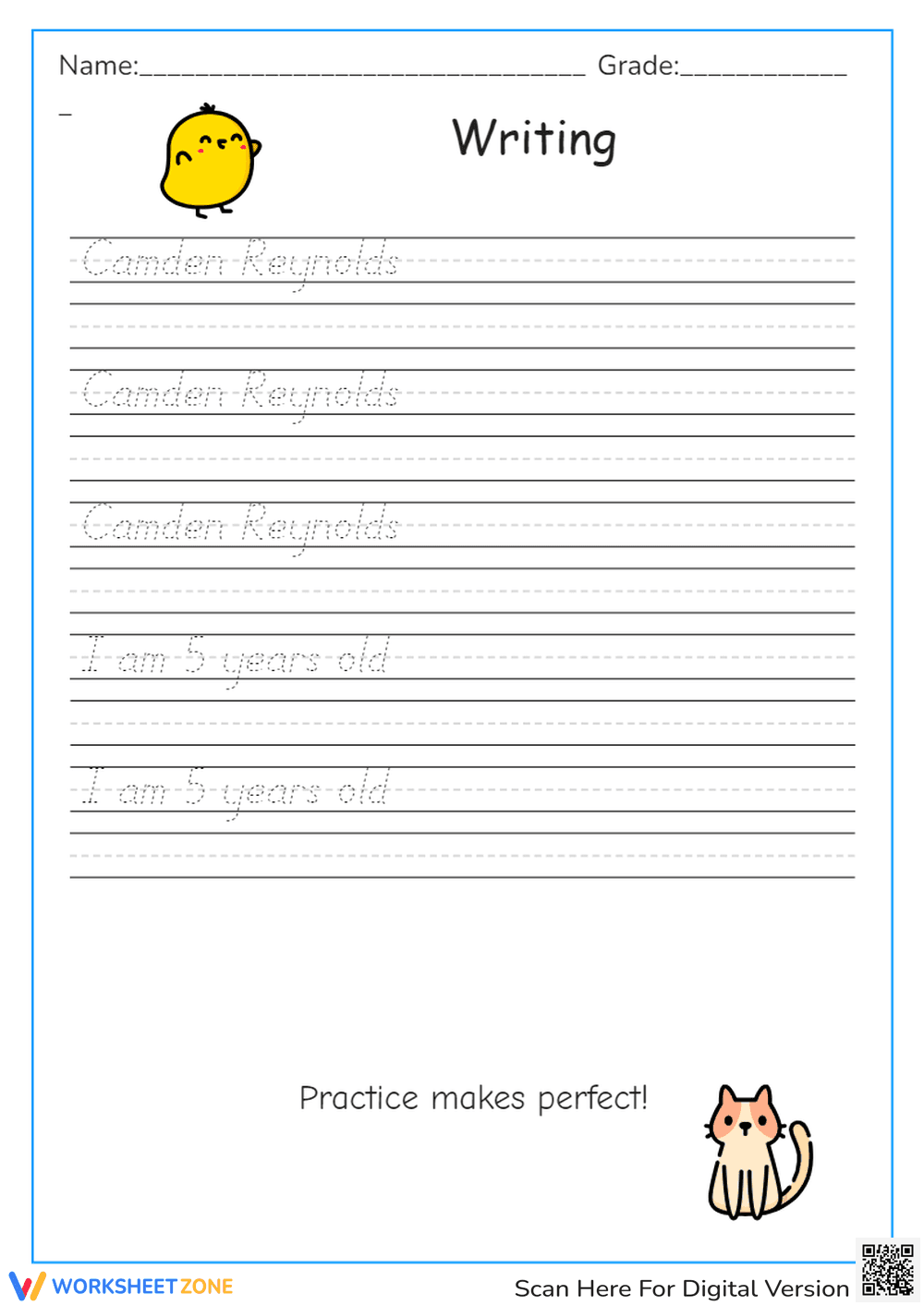
Inside this single-page PDF, you will find a structured layout featuring five distinct tracing lines. The first three lines focus on the student's full name, while the final two lines introduce a simple sentence regarding their age. The worksheet utilizes standard primary dotted lines to guide letter height and placement, accompanied by friendly illustrations to engage young learners.
The zero-prep workflow for this resource is designed for maximum efficiency in busy classrooms. First, print the required number of copies for your small group or whole class (30 seconds). Second, distribute the sheets during morning arrival or as a transition activity (1 minute). Finally, provide immediate verbal feedback as you circulate the room to check for proper pencil grip and stroke direction (2 minutes).
This resource aligns with CCSS.ELA-LITERACY.L.K.1.A, which requires students to print many upper- and lowercase letters. It also supports the foundational writing skills found in Grade 1 standards regarding legibility and spacing. Both standard codes can be copied directly into lesson plans, IEP goals, or district curriculum mapping tools.
Use this worksheet as a formative assessment tool during the first weeks of school to gauge baseline fine motor skills. It is particularly effective during Writer's Workshop as a warm-up activity. Teachers should observe whether students start letters from the top and maintain consistent pressure. Expect completion within 5 to 10 minutes depending on individual student dexterity.
This practice page is ideal for preschool, kindergarten, and first-grade students who require repetitive motion to solidify letter shapes. It serves as an excellent scaffold for English Language Learners (ELLs) and students with occupational therapy goals. Pair this with a tactile alphabet tray or a letter formation anchor chart for a comprehensive literacy experience.
Research from Fisher & Frey (2014) emphasizes the importance of the gradual release of responsibility, which begins with highly supported tasks like tracing. This worksheet targets CCSS.ELA-LITERACY.L.K.1.A by providing a clear visual path for letter formation, reducing the cognitive load on novice writers. By focusing on the student's own name, the activity increases personal relevance and engagement, which are critical factors in early literacy development. According to NAEP data, early mastery of handwriting is a strong predictor of later compositional fluency, as it allows students to focus on content rather than the mechanics of writing. This 1-page resource provides the necessary 5 lines of practice to bridge the gap between letter recognition and independent production. Utilizing such structured tracing tools ensures that students develop the muscle memory required for standardized writing expectations in primary education.


