


























Views
Downloads


Karate Count by 2s Worksheet | Essential Grade 2 Math
Paste this activity's link or code into your existing LMS (Google Classroom, Canvas, Teams, Schoology, Moodle, etc.).
Students can open and work on the activity right away, with no student login required.
You'll still be able to track student progress and results from your teacher account.
This Karate Count by 2s worksheet empowers second-grade students to master skip counting through a martial-arts theme. By practicing forward and backward sequences, learners build the numerical fluency required for multiplication. This resource ensures students gain confidence in patterns before moving to complex arithmetic and higher-order mathematical operations.
At a Glance
- Grade: 2 · Subject: Mathematics
- Standard:
2.NBT.A.2— Skip-count by multiples to build number sense and pattern recognition- Skill Focus: Skip counting by 2s (Forward & Backward)
- Format: 3 pages · 24 problems · Answer key included · PDF
- Best For: Independent practice or math center rotation
- Time: 15–25 minutes
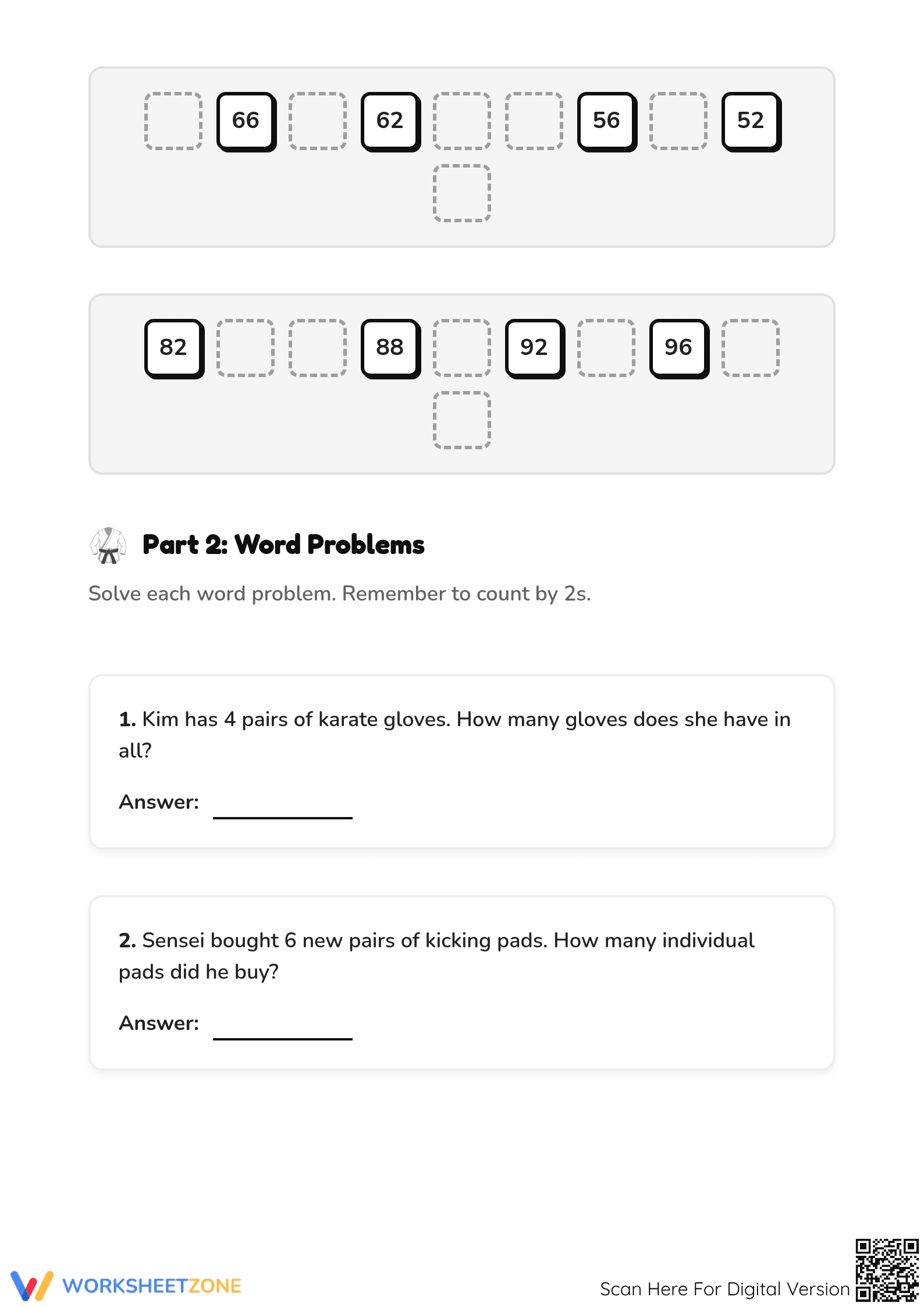
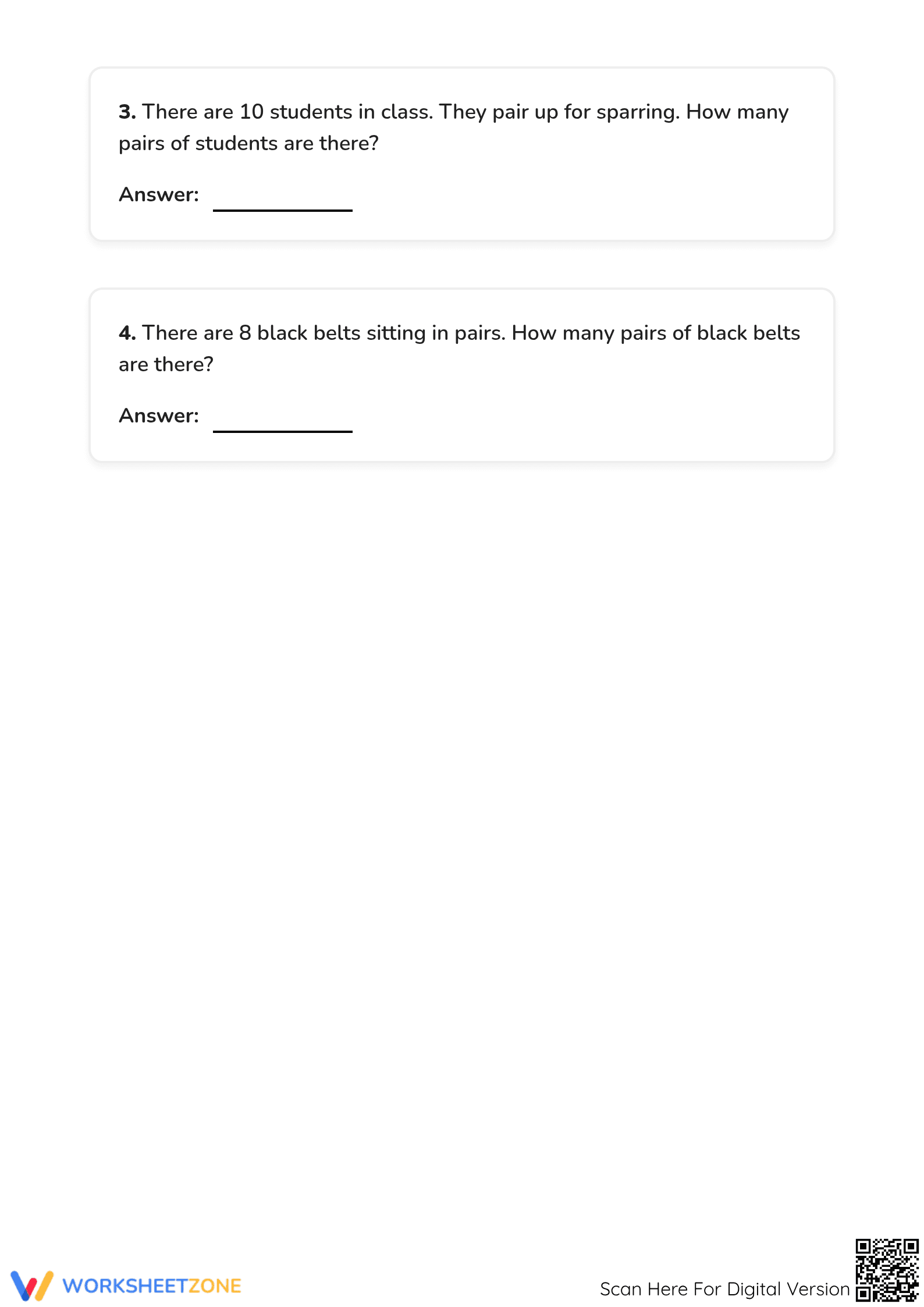
The packet contains three pages designed to move students from computation to application. Part 1 features five number sequences where students fill in missing boxes in ascending and descending order. Part 2 transitions to karate-themed word problems, requiring calculations for gloves, pads, and student pairs. A full answer key is provided for immediate feedback.
Skill Progression
- Guided Practice: The first number line provides significant support with four anchor numbers, helping students establish the "count by two" pattern immediately using visual boxes.
- Supported Practice: Subsequent number lines introduce backward counting and fewer anchors, challenging students to maintain the pattern while filling in 4 to 5 missing values per row.
- Independent Practice: The final word problems remove all visual aids, asking students to apply skip counting to scenarios involving pairs and groups without a provided number line.
This gradual-release model follows the instructional framework to ensure mastery through decreasing scaffolds.
Standards Alignment
This worksheet is primarily aligned with 2.NBT.A.2, focusing on skip-counting as a core competency for Grade 2 number sense. It additionally supports algebraic thinking by reinforcing the concept of pairs and even numbers. Both standard codes can be copied directly into lesson plans, IEP goals, or district curriculum mapping tools to document student progress toward targets.
How to Use It
Use this worksheet as a formative assessment after introducing skip counting. Assign the first page during direct instruction to check for immediate understanding of the number pattern. The word problem pages serve as an excellent homework assignment or a task during small-group rotations. Teachers should observe if students use mental math to identify common errors during the backward sequences.
Who It's For
This resource is ideal for Grade 2 students or as a remediation tool for Grade 3 learners needing a refresher. It provides natural differentiation for ESL students through simple, repetitive vocabulary and clear visual boxes. Pair this worksheet with a 100s chart or physical counters for students who require additional tactile support during the word problem section.
Research from RAND AIRS 2024 emphasizes that skip counting is not merely a rote memorization task but a foundational cognitive step toward multiplicative reasoning and proportional thinking. By engaging with both forward and backward sequences, students develop a more robust internal number line, which is critical for mental subtraction and higher-level arithmetic. This karate-themed resource utilizes situated learning principles, where mathematical concepts are embedded in a recognizable context to increase student engagement and retention. The inclusion of word problems involving pairs directly maps to early algebraic thinking, allowing educators to bridge the gap between simple counting and the operational logic required for multiplication. According to the 2024 analysis, structured worksheets that incorporate varied task types significantly improve the transfer of skip-counting skills to unfamiliar mathematical contexts in early elementary settings.


