




























Views
Downloads
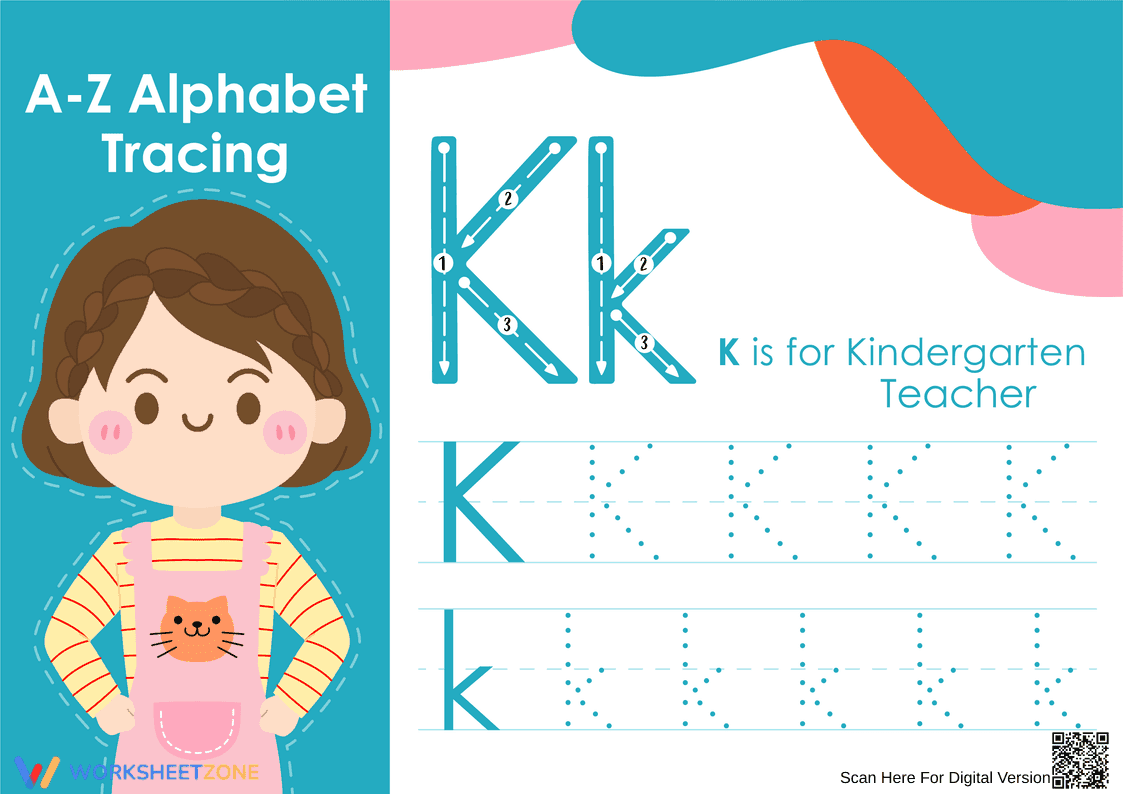

Letter K Tracing Worksheet | Essential Kindergarten Prep

Paste this activity's link or code into your existing LMS (Google Classroom, Canvas, Teams, Schoology, Moodle, etc.).
Students can open and work on the activity right away, with no student login required.
You'll still be able to track student progress and results from your teacher account.
This Letter K tracing worksheet helps early learners master uppercase and lowercase letter formation through structured penmanship practice. Students develop the fine motor control necessary for legible writing by following numbered stroke guides. This resource ensures children recognize the visual differences between cases while building muscle memory for the eleventh letter of the alphabet.
At a Glance
- Grade: Kindergarten · Subject: ELA Alphabet
- Standard:
CCSS.ELA-LITERACY.RF.K.1.D— Recognize and name all upper- and lowercase letters of the alphabet- Skill Focus: Letter K formation and tracing
- Format: 1 page · 10 tracing tasks · Stroke guides included · PDF
- Best For: Daily morning work or literacy centers
- Time: 10–15 minutes
What's Inside
The worksheet features large "K" and "k" models with numbered arrows to demonstrate proper stroke order. Below the models, students find two rows of dotted-line letters for repetitive practice, totaling 10 specific tracing tasks. The clean layout includes a "K is for Kindergarten Teacher" mnemonic to reinforce letter-sound association alongside the primary writing task, all contained on a single printable page.
Skill Progression
- Guided Practice: Students begin by tracing large-scale models that feature explicit directional arrows and numbered steps to establish correct motor patterns.
- Supported Practice: Learners transition to 10 dotted-line repetitions that maintain baseline and midline constraints to ensure consistent letter sizing.
- Independent Practice: The final tasks encourage students to maintain the established stroke order without the aid of directional arrows, moving toward automaticity.
This sequence follows the gradual-release model, moving from high-support visual cues to independent execution.
Standards Alignment
This resource aligns with `CCSS.ELA-LITERACY.RF.K.1.D`, which requires students to recognize and name all upper- and lowercase letters of the alphabet. By physically constructing the letter, students deepen their orthographic mapping skills and visual discrimination. Both standard codes can be copied directly into lesson plans, IEP goals, or district curriculum mapping tools.
How to Use It
Use this worksheet during the independent practice phase of a direct instruction lesson on the letter K. It serves as an excellent formative assessment tool; teachers can observe pencil grip and stroke directionality in real-time to correct common errors like bottom-up writing. Expected completion time ranges from 10 to 15 minutes depending on the student's fine motor development.
Who It's For
This is designed for preschool and kindergarten students who are transitioning from pre-writing patterns to formal letter construction. It is particularly helpful for students requiring extra repetition or those working on early literacy goals. Pair this with a letter K anchor chart or a tactile sensory bin activity for a comprehensive instructional approach.
According to the RAND AIRS 2024 report, explicit instruction in letter formation is a foundational component of early literacy that directly impacts later writing fluency and reading speed. This worksheet targets CCSS.ELA-LITERACY.RF.K.1.D by providing the repetitive, high-frequency practice necessary for students to recognize and name all upper- and lowercase letters of the alphabet. Research from Fisher & Frey (2014) emphasizes that the gradual release of responsibility—moving from numbered stroke guides to independent tracing—is essential for developing the fine motor precision required in the primary grades. By isolating the letter K, this resource allows for focused mastery without overwhelming the learner. Educators can use the 10 specific tracing tasks to track progress in penmanship and letter identification, ensuring that students meet the rigorous expectations of modern kindergarten standards while building the physical stamina needed for longer writing assignments in subsequent grades.


