


























Views
Downloads

Grade 3 Jellyfish Lifecycle — Printable No-Prep Worksheet
Paste this activity's link or code into your existing LMS (Google Classroom, Canvas, Teams, Schoology, Moodle, etc.).
Students can open and work on the activity right away, with no student login required.
You'll still be able to track student progress and results from your teacher account.
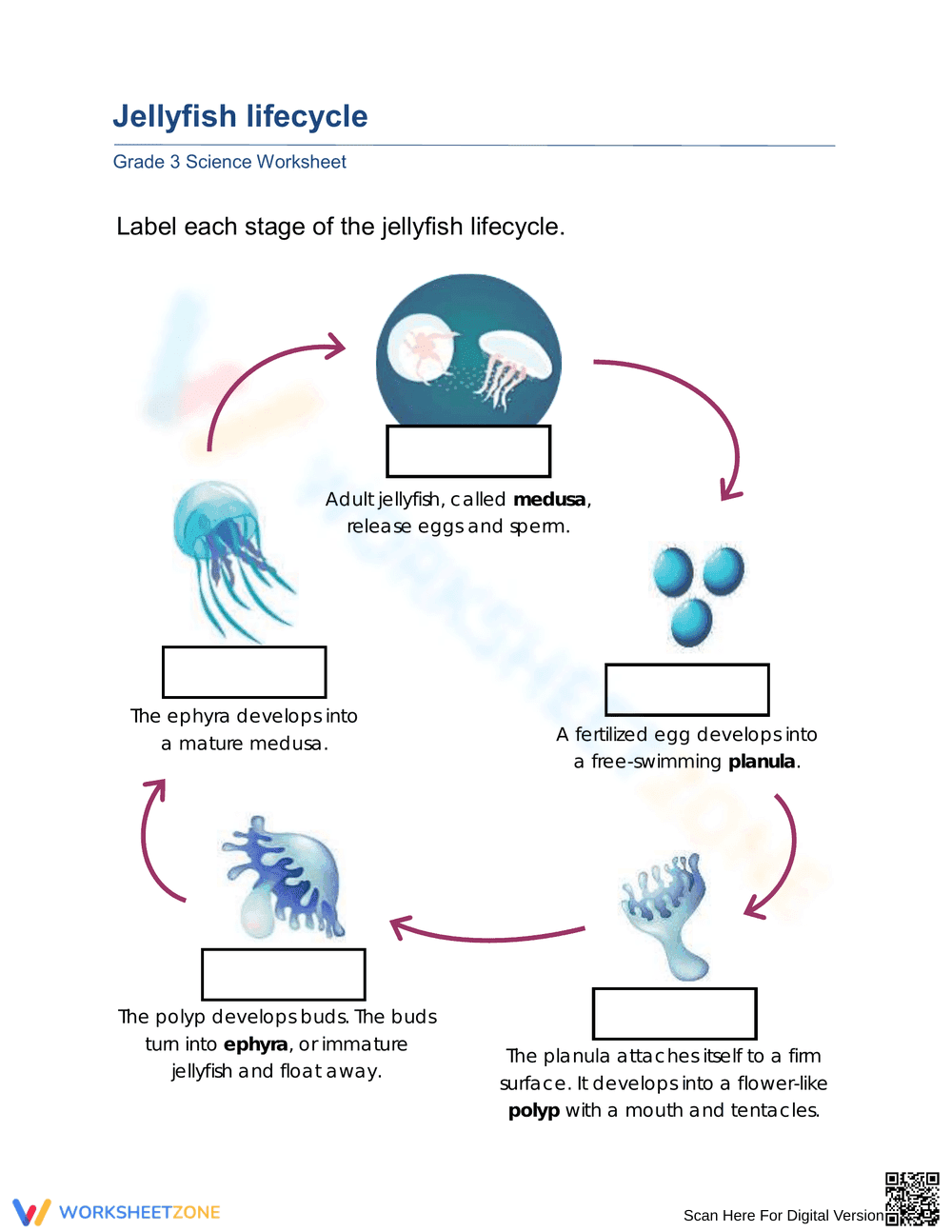
This Grade 3 science worksheet helps students master the complex lifecycle of the jellyfish through a focused labeling activity. By identifying stages like the medusa, planula, and polyp, learners develop a concrete understanding of marine life cycles. This resource ensures students can visualize growth and reproduction in aquatic environments efficiently.
At a Glance
- Grade: 3 · Subject: Living Things
- Standard:
3-LS1-1— Develop models to describe that organisms have unique and diverse life cycles- Skill Focus: Identifying stages of a marine lifecycle
- Format: 1 page · 5 problems · Answer key included · PDF
- Best For: Independent practice or quick formative assessment
- Time: 10–15 minutes
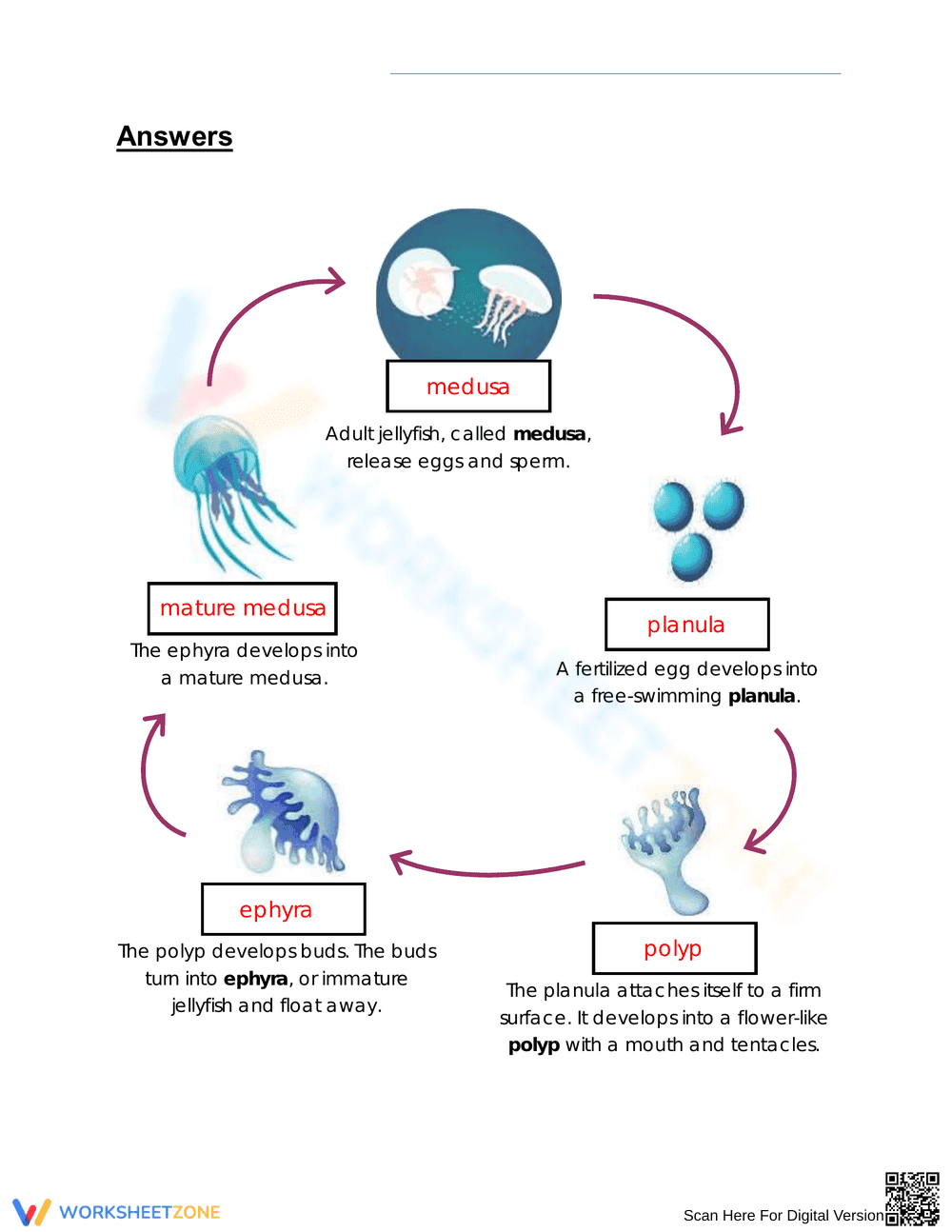
This single-page PDF features a clear, circular diagram of the jellyfish life cycle. It includes five specific labeling tasks accompanied by descriptive text for each stage, such as the ephyra and medusa. A complete answer key is provided on the second page, allowing for immediate feedback and easy grading.
Zero-Prep Workflow
- Print: One minute to print class sets of this single-page diagram.
- Distribute: Thirty seconds to hand out worksheets for individual or pair work.
- Review: Two minutes to check student labels using the provided answer key.
Total teacher preparation time is under two minutes, making this an ideal resource for substitute plans, bell-ringers, or supplemental practice during a life science unit.
Standards Alignment
This resource is aligned to 3-LS1-1, requiring students to develop models that describe unique and diverse life cycles. By labeling the specific stages of jellyfish growth, students satisfy the core requirement of understanding how organisms change over time. This standard code can be copied directly into lesson plans, IEP goals, or district curriculum mapping tools.
How to Use It
Use this worksheet as a summative check after a lesson on marine biology. Alternatively, assign it as a hook activity where students use the provided descriptions to infer the correct order of the life cycle. Observe if students can distinguish between the free-swimming planula and the stationary polyp stage to gauge their conceptual depth. Completion time: 10–15 minutes.
Who It's For
This activity is designed for third-grade students exploring life science and the diversity of living things. It is particularly effective for visual learners and can be paired with a reading passage about cnidarians or a video showing jellyfish in motion to provide a multi-sensory experience.
The jellyfish life cycle serves as a primary example of biological diversity within the 3-LS1-1 standard. Research from ScienceDirect TpT Analysis indicates that visual labeling tasks significantly improve long-term retention of biological terminology in elementary students. By engaging with the specific sequence of medusa, egg, planula, polyp, and ephyra, students build a mental model of metamorphosis that extends beyond terrestrial animals. This worksheet facilitates the modeling requirement of the Next Generation Science Standards by providing a structured framework for observation and classification. Understanding these phases is essential for meeting Grade 3 life science benchmarks regarding growth and reproduction. This resource is optimized for classroom use, ensuring that the plain-English skill of identifying lifecycle stages is accessible to all learners. Educators can rely on this validated approach to demonstrate student mastery of marine biological processes effectively.


