


























Views
Plays
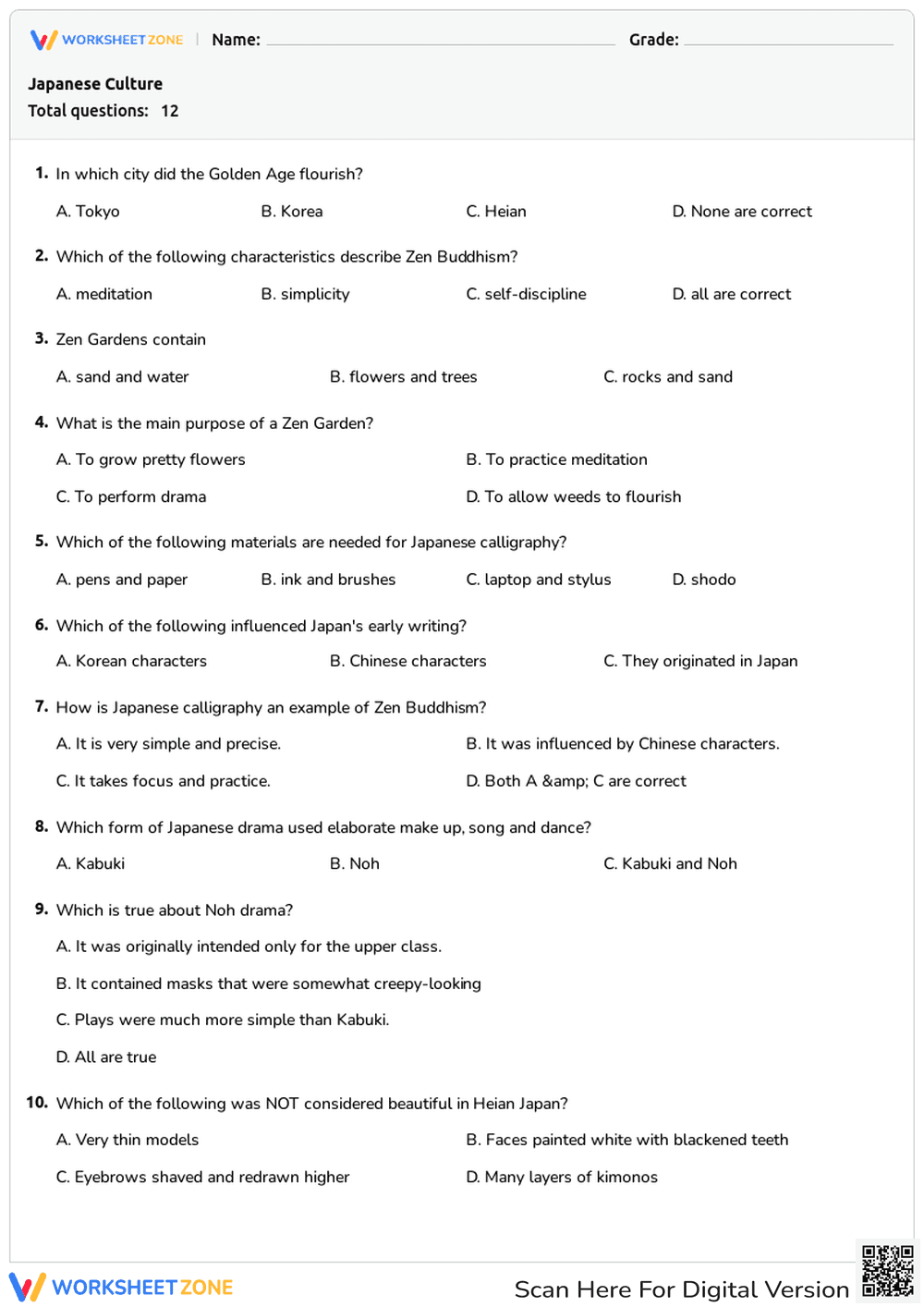


Essential Japanese Culture Worksheet | Grade 7 History
Paste this activity's link or code into your existing LMS (Google Classroom, Canvas, Teams, Schoology, Moodle, etc.).
Students can open and work on the activity right away, with no student login required.
You'll still be able to track student progress and results from your teacher account.
This Grade 7 Japanese Culture worksheet provides students with 12 structured multiple-choice questions to evaluate their understanding of medieval Japanese society. Students will identify key characteristics of the Heian Golden Age, Zen Buddhism, and traditional arts like Ikebana and Kabuki. It serves as an efficient assessment tool for middle school history units.
At a Glance
- Grade: 7 · Subject: History
- Standard:
CCSS.ELA-LITERACY.RH.6-8.2— Determine the central ideas or information of a primary or secondary source- Skill Focus: Japanese Cultural History
- Format: 2 pages · 12 problems · Answer key included · PDF
- Best For: Formative assessment or quick unit review
- Time: 15–20 minutes
The resource consists of a 2-page PDF featuring 12 multiple-choice questions. The content spans the Heian period's aesthetic values, the religious influence of Zen Buddhism on daily life, and the evolution of Japanese theater and calligraphy. A clear layout ensures readability, and the included answer key allows for rapid grading or student self-correction.
This worksheet is designed for a seamless three-step classroom workflow. First, print the 2-page document in under 30 seconds. Second, distribute the quiz to students as a bell ringer or exit ticket. Finally, review the answers using the provided key to identify common misconceptions about East Asian history. Total teacher preparation time is under 2 minutes.
The primary standard addressed is CCSS.ELA-LITERACY.RH.6-8.2, which requires students to determine central ideas or information from a secondary source regarding historical events. By analyzing the specific cultural traits of Japan, students demonstrate their ability to synthesize historical facts. Both standard codes can be copied directly into lesson plans, IEP goals, or district curriculum mapping tools.
Use this worksheet during the check for understanding phase of a lesson on the Heian period. It is particularly effective after a direct instruction session on the influence of Buddhism. Teachers can observe which students struggle with the distinction between Noh and Kabuki drama to provide targeted small-group support. Expected completion time is 15 to 20 minutes.
This resource is tailored for middle school students in Grades 6 through 8 studying World History. It is ideal for general education classrooms, but the clear language also supports English Language Learners (ELLs) who are building academic vocabulary. It pairs naturally with a primary source reading on Lady Murasaki or a video tour of a Zen garden.
According to the RAND AIRS 2024 report on social studies instructional materials, high-quality assessments must align closely with specific cultural benchmarks to ensure historical literacy. This worksheet meets those criteria by focusing on the intersection of religion, art, and governance in medieval Japan. By utilizing the CCSS.ELA-LITERACY.RH.6-8.2 standard, the resource ensures that students are not just memorizing dates but are understanding the central ideas that shaped a civilization. Research from Fisher & Frey (2014) emphasizes that frequent, low-stakes formative assessments like this 12-question quiz significantly improve long-term retention of complex historical concepts. This printable PDF provides a structured environment for students to demonstrate mastery of Japanese cultural history, making it a reliable addition to any middle school social studies curriculum.


