


























Views
Downloads

Grade 2 Elasticity — Printable No-Prep Science Worksheet
Paste this activity's link or code into your existing LMS (Google Classroom, Canvas, Teams, Schoology, Moodle, etc.).
Students can open and work on the activity right away, with no student login required.
You'll still be able to track student progress and results from your teacher account.
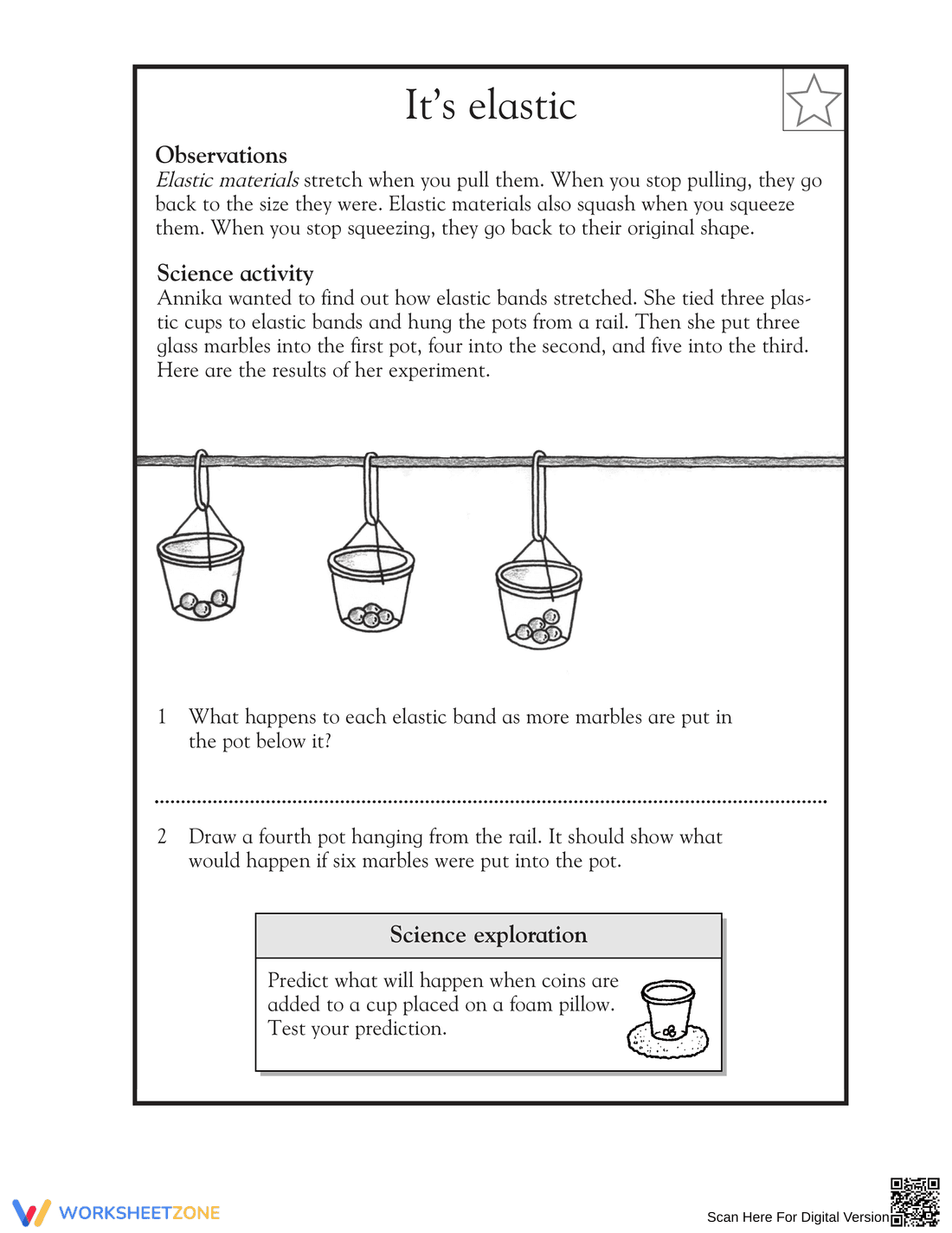
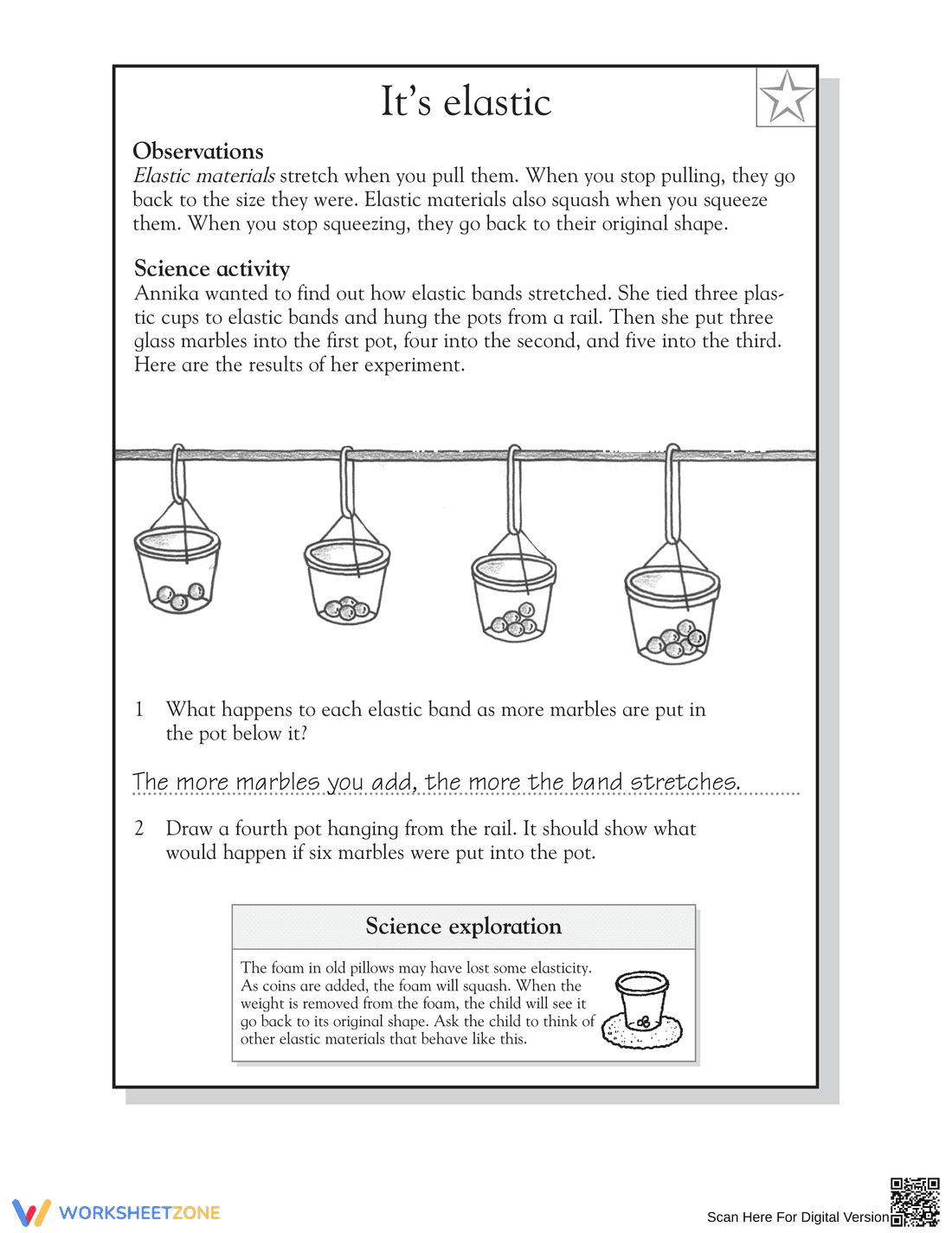
Students explore the physical properties of matter by observing how elastic materials respond to force and weight. This Grade 2 science worksheet guides learners through a structured experiment involving elastic bands and marbles, helping them visualize cause-and-effect relationships. By interpreting experimental data, children develop foundational scientific inquiry skills while mastering the concept of elasticity.
At a Glance
- Grade: 2 · Subject: Science
- Standard:
2-PS1-1— Plan and conduct investigations to describe and classify materials by their observable properties- Skill Focus: Elasticity and material property observation
- Format: 1 page · 3 problems · Answer key included · PDF
- Best For: Physical science introduction or quick sub plan
- Time: 15–20 minutes
What's Inside
This single-page PDF includes a detailed "Observations" section that defines elastic materials and their behavior when pulled or squeezed. The core activity features a visual experiment where students analyze how many marbles cause specific amounts of stretch in elastic bands. It concludes with a creative drawing task to demonstrate prediction skills and an extension prompt involving coins and foam pillows for hands-on exploration.
Zero-Prep Workflow
The zero-prep design allows teachers to implement this lesson in under two minutes. Simply print the worksheet (30 seconds), distribute it to the class (1 minute), and facilitate a 10-minute review session to discuss the observations. Because the instructions are self-explanatory and the visual aids are clear, this resource serves as an ideal emergency sub plan or independent station activity.
Standards Alignment
Aligned to 2-PS1-1, this resource requires students to "plan and conduct an investigation to describe and classify different kinds of materials by their observable properties." Specifically, it focuses on the property of elasticity—the ability of a material to return to its original shape. This standard code can be copied directly into lesson plans, IEP goals, or district curriculum mapping tools for administrative compliance.
How to Use It
Use this worksheet as a "hook" during a direct instruction lesson on the states of matter or physical properties. Alternatively, use it as a formative assessment after a hands-on lab where students play with actual rubber bands. Observe whether students can correctly predict the "stretch" of the sixth marble to gauge their understanding of linear patterns in physical science.
Who It's For
This activity is designed for second-grade students but is accessible for first-grade enrichment or third-grade review. It supports diverse learners through clear visual representations of the experiment. Naturally pair this resource with a physical demonstration using various rubber bands and weights to solidify the connection between the worksheet data and real-world scientific phenomena.
This Grade 2 science resource focuses on the NGSS standard 2-PS1-1, emphasizing the observation of physical properties in materials like elastic bands. Students practice the plain-English skill of describing how materials change shape under force and return to their original state. Research in ScienceDirect TpT Analysis indicates that structured visual aids in primary science worksheets significantly improve a student's ability to interpret data and make accurate predictions. By engaging with Annika's marble experiment, learners move from passive reading to active analysis of cause-and-effect relationships. The inclusion of an extension task ensures that high-ability learners can apply their knowledge to new contexts, such as the foam pillow exploration. This approach ensures that the concept of elasticity is mastered through both visual evidence and logical extrapolation, preparing students for more complex physical science investigations in subsequent grade levels.


