




























Views
Downloads

Loud and Soft Sounds Worksheet | Grade 1 Essential

Paste this activity's link or code into your existing LMS (Google Classroom, Canvas, Teams, Schoology, Moodle, etc.).
Students can open and work on the activity right away, with no student login required.
You'll still be able to track student progress and results from your teacher account.
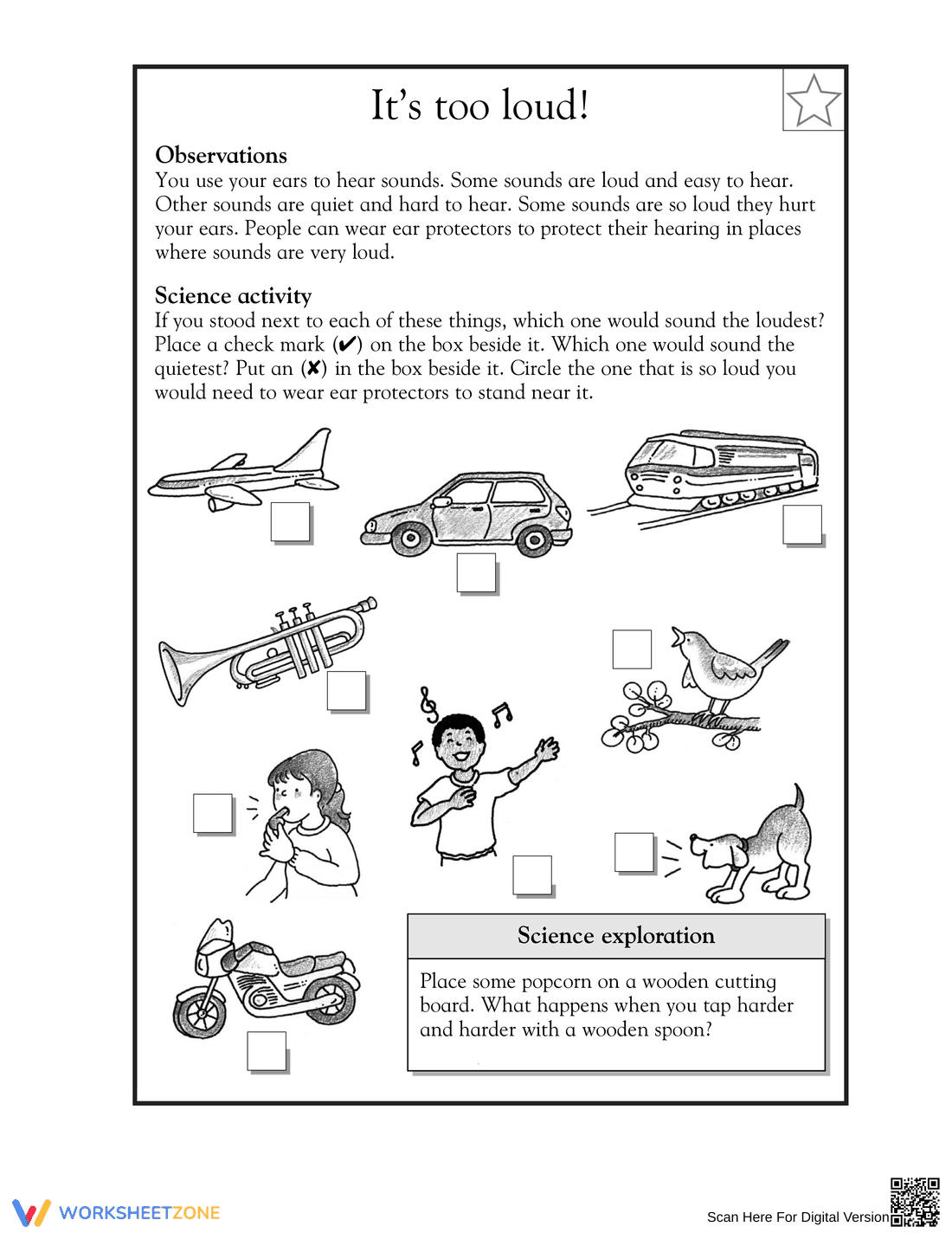
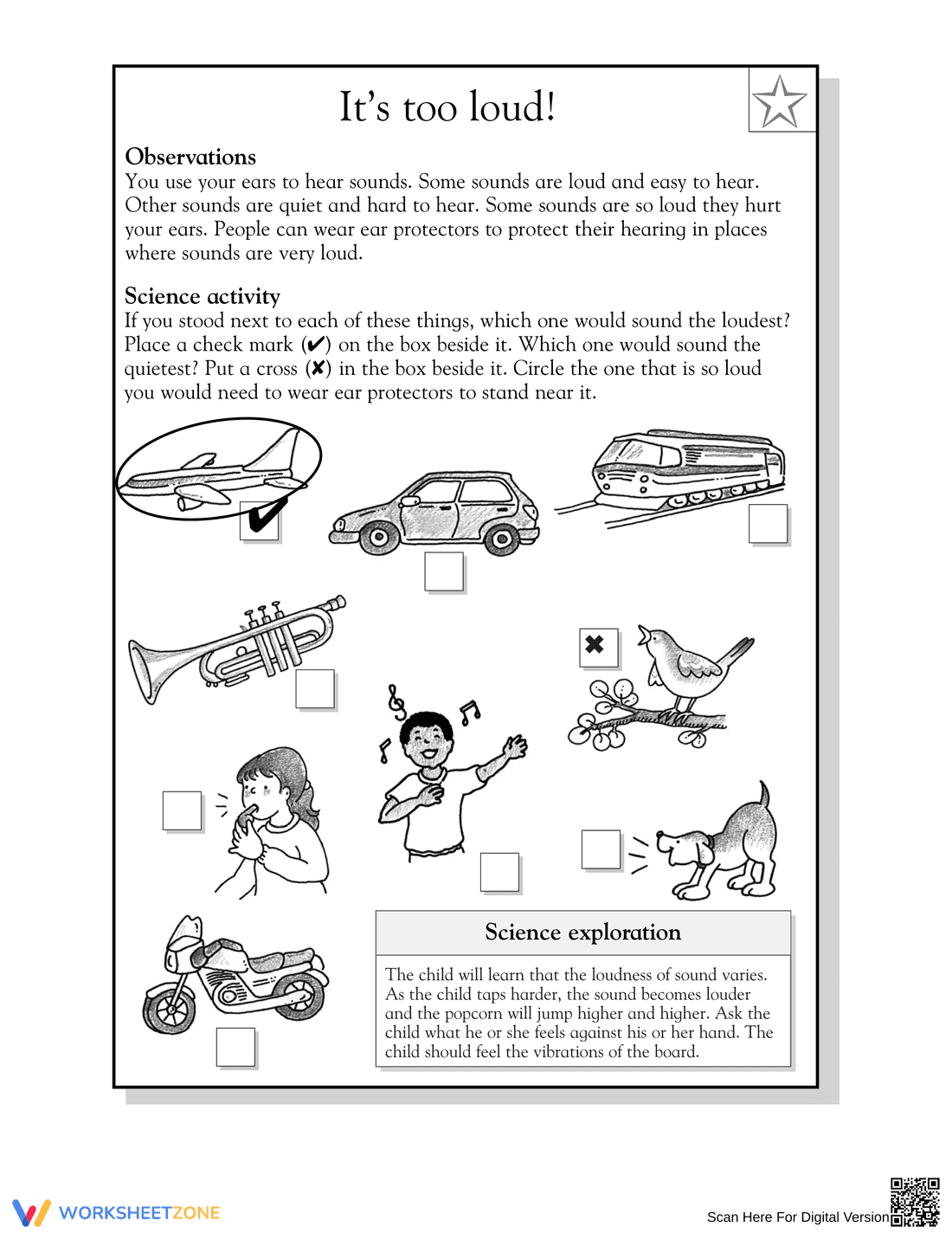
This Grade 1 science worksheet helps students distinguish between different volumes of sound while introducing the concept of auditory safety. By evaluating common objects like airplanes and birds, learners develop the observational skills necessary to categorize environmental stimuli. The activity concludes with a hands-on exploration of how vibrations create sound, ensuring a concrete understanding of physical science concepts.
At a Glance
- Grade: 1 · Subject: Science
- Standard:
1-PS4-1— Investigate how vibrating materials make sound and sound makes materials vibrate- Skill Focus: Volume comparison and vibration
- Format: 1 page · 10 tasks · Answer key included · PDF
- Best For: Introductory sound unit or sub plan
- Time: 15–20 minutes
Inside this resource, you will find a structured observation guide that defines loud and quiet sounds in simple terms. The primary activity features nine high-quality illustrations of objects ranging from musical instruments to vehicles. Students use specific symbols to mark the loudest and quietest items, while a circling task identifies sounds that require ear protection. A dedicated "Science Exploration" box provides instructions for a simple classroom experiment using popcorn and a wooden board.
This worksheet follows a zero-prep workflow designed for busy educators. First, print the single-page PDF (30 seconds). Second, distribute the sheets to students and read the introductory observations aloud to build context (1 minute). Third, allow students to complete the categorization independently before reviewing the answers as a group to clarify misconceptions about sound intensity (5 minutes). Total teacher preparation time is under two minutes, making it an ideal choice for emergency sub plans or quick formative assessments.
The content is strictly aligned to 1-PS4-1, focusing on the relationship between physical actions and sound production. By tapping a board harder to make popcorn jump, students gather evidence that sound and vibration are linked. This standard code can be copied directly into lesson plans, IEP goals, or district curriculum mapping tools to ensure compliance with national science frameworks.
To maximize the impact of this worksheet, use it during the "Explore" phase of a 5E instructional model. After students complete the popcorn experiment, ask them to touch their own throats while humming to feel the vibrations they just observed on the board. This creates a personal connection to the abstract concept of sound waves. Expect most first-grade students to complete the entire page within a 20-minute science block.
This resource is specifically designed for first-grade learners but serves as an excellent review for kindergarteners or a scaffolded entry point for second-grade students. It pairs naturally with a classroom "sound walk" where students record the volumes they hear in the hallway or playground. The clear visual cues support English Language Learners in identifying vocabulary words like "trumpet," "motorcycle," and "ear protectors."
Research by Fisher & Frey (2014) emphasizes that early science instruction is most effective when it bridges the gap between everyday observations and scientific principles. This worksheet achieves that by using familiar objects to teach the standard 1-PS4-1, which requires students to provide evidence that vibrating materials can make sound. By requiring students to categorize sounds based on intensity and then observe the physical movement of popcorn during a vibration test, the resource supports the development of evidence-based reasoning. The inclusion of auditory safety awareness aligns with modern health and science integration strategies, ensuring students understand the biological impact of high-decibel environments. This structured approach to sensory data collection provides a foundational step toward more complex physics concepts in later grades, making it a reliable tool for achieving early mastery in physical science curriculum units.


