


























Views
Downloads
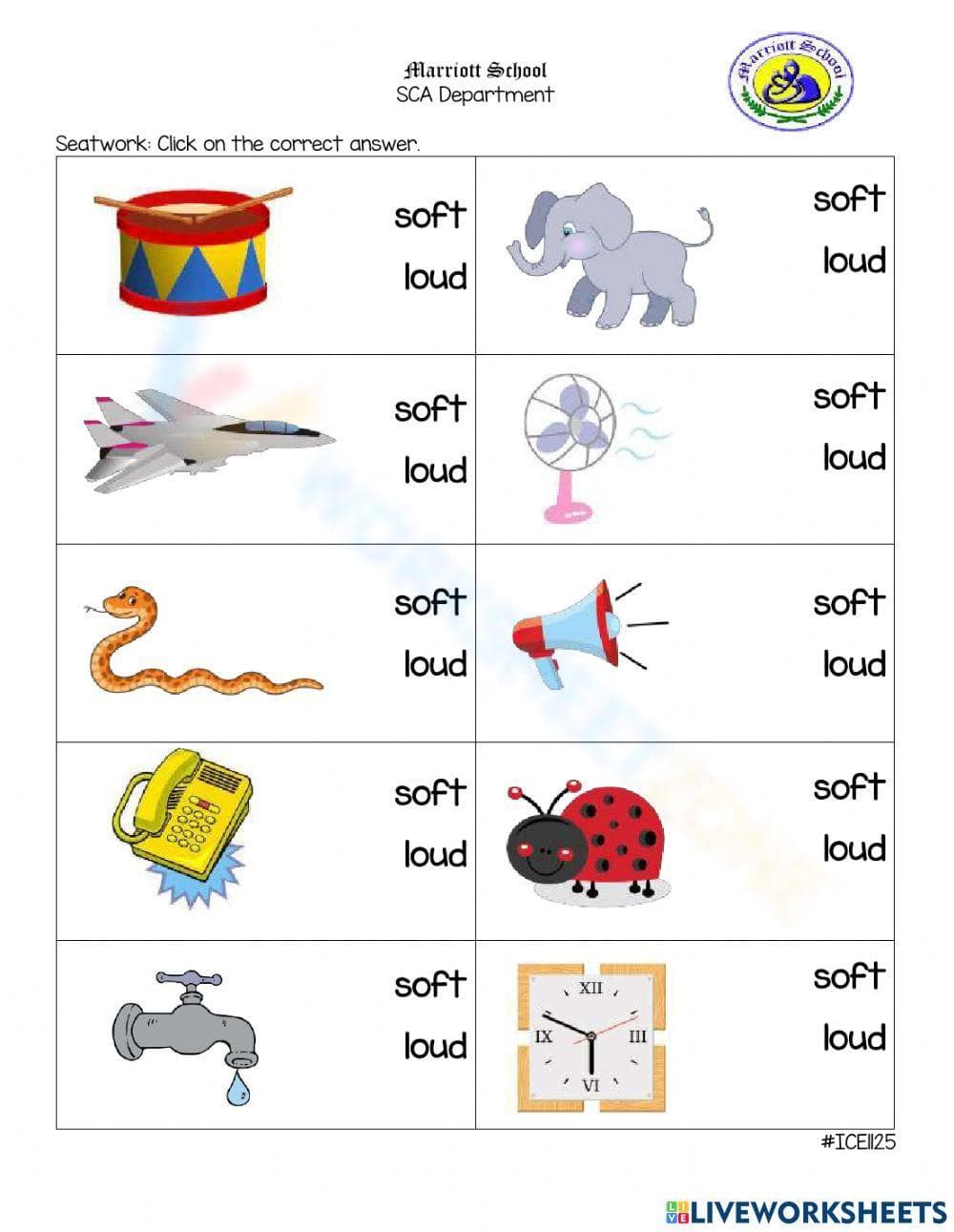

Loud and Soft Sounds Worksheet | Grade 4 Essential
Paste this activity's link or code into your existing LMS (Google Classroom, Canvas, Teams, Schoology, Moodle, etc.).
Students can open and work on the activity right away, with no student login required.
You'll still be able to track student progress and results from your teacher account.
This Grade 4 science worksheet helps students master the concept of volume by classifying common environmental sounds. By distinguishing between loud and soft auditory stimuli, learners develop a foundational understanding of sound energy and wave properties. This resource provides immediate practice in identifying how different objects produce varying levels of intensity.
At a Glance
- Grade: 4 · Subject: Science
- Standard:
4-PS4-1— Develop a model of waves to describe patterns in terms of amplitude- Skill Focus: Sound volume classification
- Format: 1 page · 10 problems · Answer key included · PDF
- Best For: Independent seatwork or quick formative assessment
- Time: 5–10 minutes
Inside this single-page PDF, you will find 10 high-quality visual prompts ranging from a jet engine to a ladybug. Each image is paired with a binary choice between "soft" and "loud." The layout is clean and distraction-free, making it ideal for students who benefit from clear visual cues. A full answer key is provided for rapid grading and immediate feedback.
The zero-prep workflow for this resource is designed for maximum efficiency. First, print the single-page PDF (30 seconds). Second, distribute the sheets to your students for independent seatwork (1 minute). Third, review the answers as a whole group to clarify any misconceptions about sound intensity (5 minutes). Total teacher preparation time is under 2 minutes, making it a perfect sub-plan addition or morning work activity.
This worksheet aligns with 4-PS4-1, focusing on the observable properties of sound waves. While the standard emphasizes amplitude and patterns, identifying volume is the critical first step in understanding how energy relates to wave height. This standard code can be copied directly into lesson plans, IEP goals, or district curriculum mapping tools.
Use this worksheet as a "ticket out the door" after a lesson on sound energy. It serves as an excellent formative assessment to check if students can apply vocabulary to real-world objects. Expected completion time is 5 to 10 minutes. Observe if students struggle with the "fan" or "clock" to identify subtle differences in soft sounds versus ambient noise.
This resource is designed for Grade 4 students but is also appropriate for Grade 3 review or English Language Learners (ELL) who need visual support for vocabulary acquisition. It pairs naturally with a hands-on "sound walk" around the school or an anchor chart detailing the relationship between energy and volume.
According to the RAND AIRS 2024 report, high-quality visual classification tasks are essential for bridging the gap between abstract physical science concepts and concrete student observations. This worksheet targets the 4-PS4-1 standard by requiring students to evaluate the intensity of 10 distinct sound sources, a process that reinforces the conceptual link between energy and amplitude. Research from Fisher & Frey (2014) suggests that such focused, independent practice helps solidify the "You Do" phase of the gradual release of responsibility model. By providing clear, recognizable images, the resource reduces cognitive load, allowing students to focus specifically on the scientific property of volume. This alignment ensures that the activity is not merely a filler but a targeted instructional tool that supports long-term retention of energy-related vocabulary and concepts in the elementary science classroom.


