


























Views
Plays
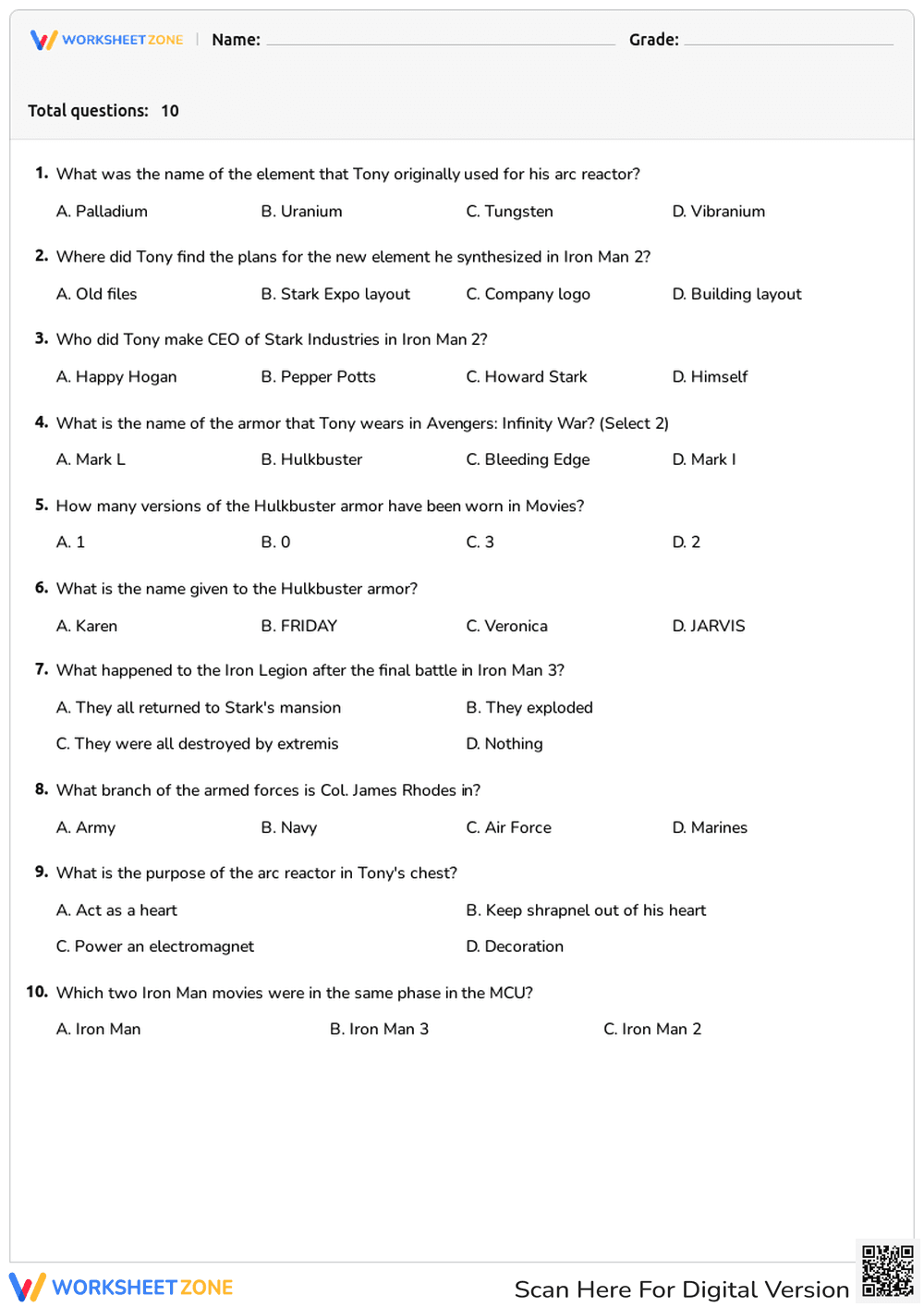

Iron Man Trivia Quiz | Grade 6 Essential Worksheet
Paste this activity's link or code into your existing LMS (Google Classroom, Canvas, Teams, Schoology, Moodle, etc.).
Students can open and work on the activity right away, with no student login required.
You'll still be able to track student progress and results from your teacher account.
This Grade 6 Iron Man trivia worksheet provides students with 10 structured multiple-choice questions to assess their recall of specific details from informational media. Students demonstrate comprehension by identifying key plot points, character roles, and technical details from the Marvel Cinematic Universe. It serves as an engaging reading comprehension check that bridges the gap between entertainment and academic analysis.
At a Glance
- Grade: 6 · Subject: ELA
- Standard:
CCSS.ELA-LITERACY.RI.6.1— Cite textual evidence to support analysis of what the text says explicitly- Skill Focus: Detail Recall & Media Literacy
- Format: 1 page · 10 problems · Answer key included · PDF
- Best For: Quick comprehension check or bell ringer
- Time: 10–15 minutes
The worksheet contains 10 multiple-choice questions formatted on a single page for easy distribution. It covers specific facts such as the elements used in the arc reactor, character names like Pepper Potts, and military branches. The layout is clean with clear question numbering and a dedicated space for student names and grades. A digital version is accessible via the included QR code for flexible classroom implementation.
Zero-Prep Workflow
- Print: Generate the single-page PDF and send it to the printer in under 30 seconds.
- Distribute: Hand out the 10-question quiz to a standard class in approximately 1 minute.
- Review: Grade or review the answers using the included key in less than 2 minutes.
This streamlined process makes the resource an ideal choice for emergency sub-plans or as a transition activity between lessons.
This resource aligns with CCSS.ELA-LITERACY.RI.6.1, which requires students to cite evidence to support analysis of what a text says explicitly. While the source material is a film narrative, the skill of identifying specific, explicit details is identical to informational text analysis. Both standard codes can be copied directly into lesson plans, IEP goals, or district curriculum mapping tools.
Use this worksheet as a formative assessment after a media literacy unit to gauge how well students retain specific details from a viewed source. Alternatively, assign it as a high-interest activity to reward focused work during independent study time. Expected completion time ranges from 10 to 15 minutes depending on student familiarity with the subject matter.
This is designed for Grade 5-7 students who benefit from high-interest content to practice detail-oriented reading. It is particularly effective for reluctant readers who find traditional informational texts challenging. Pair this with a short biography of Stan Lee or a technical article on real-world robotics for a complete literacy block.
According to the RAND AIRS 2024 report, high-interest materials significantly increase student engagement with standard-aligned tasks. This worksheet targets CCSS.ELA-LITERACY.RI.6.1 by requiring students to recall explicit details from a narrative source, a foundational skill for evidence-based writing. By focusing on the Iron Man franchise, the resource leverages popular culture to build the cognitive habit of precise information retrieval. Research from Fisher & Frey (2014) suggests that using familiar media contexts allows students to practice complex literacy skills without the cognitive load of unfamiliar vocabulary, leading to higher mastery of the underlying standard. This 10-question assessment provides a clear data point for teachers tracking student progress in explicit detail identification and media literacy.


