


























0
Views
0
Downloads

Save
0 Likes
Investigating Mysteries: An Engaging Worksheet
0 Views
0 Downloads
Paste this activity's link or code into your existing LMS (Google Classroom, Canvas, Teams, Schoology, Moodle, etc.).
Students can open and work on the activity right away, with no student login required.
You'll still be able to track student progress and results from your teacher account.
Information
Description
What It Is:
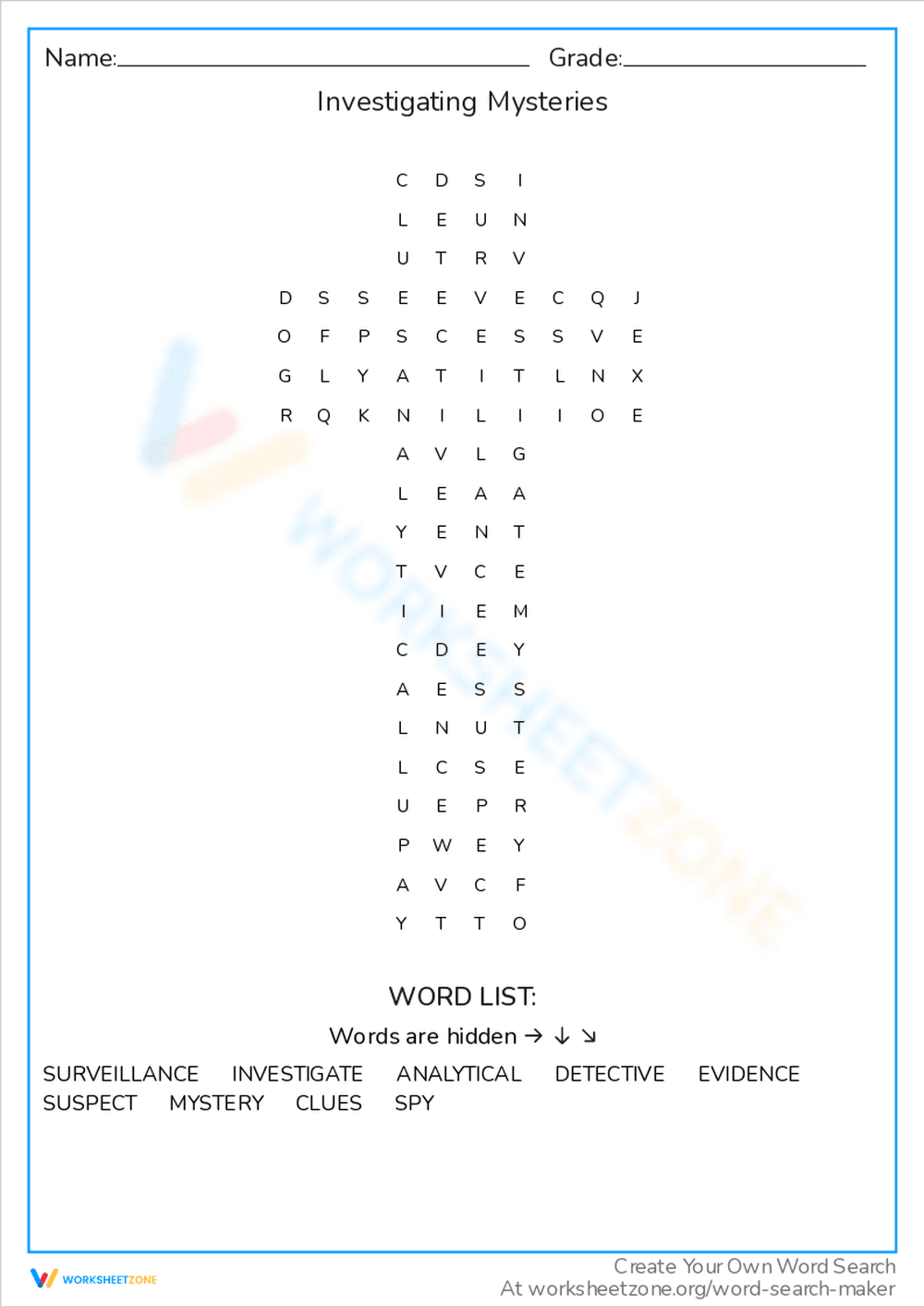
This is an educational word search worksheet titled 'Investigating Mysteries'. The puzzle contains a grid of letters with hidden words related to investigation and mystery themes. A word list at the bottom includes words like 'SURVEILLANCE', 'INVESTIGATE', 'ANALYTICAL', 'DETECTIVE', 'EVIDENCE', 'SUSPECT', 'MYSTERY', 'CLUES', and 'SPY'. The words are hidden vertically and diagonally as indicated by the arrows.
Grade Level Suitability:
This worksheet is suitable for grades 3-6. The vocabulary is accessible to this age group, and the word search format is a familiar and engaging activity for building vocabulary and reinforcing spelling skills.
Why Use It:
This worksheet helps improve vocabulary related to mysteries and investigations. It reinforces spelling skills, enhances visual scanning abilities, and promotes problem-solving skills as students search for the hidden words. It can also introduce students to terms they may encounter in mystery stories or real-life investigations.
How to Use It:
Students should begin by reviewing the word list at the bottom of the worksheet. Then, they should carefully scan the letter grid to find the hidden words, remembering that the words are hidden vertically and diagonally. As they find each word, they can circle or highlight it in the grid and cross it off the word list.
Target Users:
This worksheet is designed for elementary and middle school students, particularly those interested in mysteries or detective stories. It can be used in a classroom setting, as a homework assignment, or as a fun activity for individual learning. It can also be used for ESL/ELL students to expand their vocabulary.
This is an educational word search worksheet titled 'Investigating Mysteries'. The puzzle contains a grid of letters with hidden words related to investigation and mystery themes. A word list at the bottom includes words like 'SURVEILLANCE', 'INVESTIGATE', 'ANALYTICAL', 'DETECTIVE', 'EVIDENCE', 'SUSPECT', 'MYSTERY', 'CLUES', and 'SPY'. The words are hidden vertically and diagonally as indicated by the arrows.
Grade Level Suitability:
This worksheet is suitable for grades 3-6. The vocabulary is accessible to this age group, and the word search format is a familiar and engaging activity for building vocabulary and reinforcing spelling skills.
Why Use It:
This worksheet helps improve vocabulary related to mysteries and investigations. It reinforces spelling skills, enhances visual scanning abilities, and promotes problem-solving skills as students search for the hidden words. It can also introduce students to terms they may encounter in mystery stories or real-life investigations.
How to Use It:
Students should begin by reviewing the word list at the bottom of the worksheet. Then, they should carefully scan the letter grid to find the hidden words, remembering that the words are hidden vertically and diagonally. As they find each word, they can circle or highlight it in the grid and cross it off the word list.
Target Users:
This worksheet is designed for elementary and middle school students, particularly those interested in mysteries or detective stories. It can be used in a classroom setting, as a homework assignment, or as a fun activity for individual learning. It can also be used for ESL/ELL students to expand their vocabulary.


