


























Views
Plays

Heat Transfer Quiz | Essential College Science
Paste this activity's link or code into your existing LMS (Google Classroom, Canvas, Teams, Schoology, Moodle, etc.).
Students can open and work on the activity right away, with no student login required.
You'll still be able to track student progress and results from your teacher account.
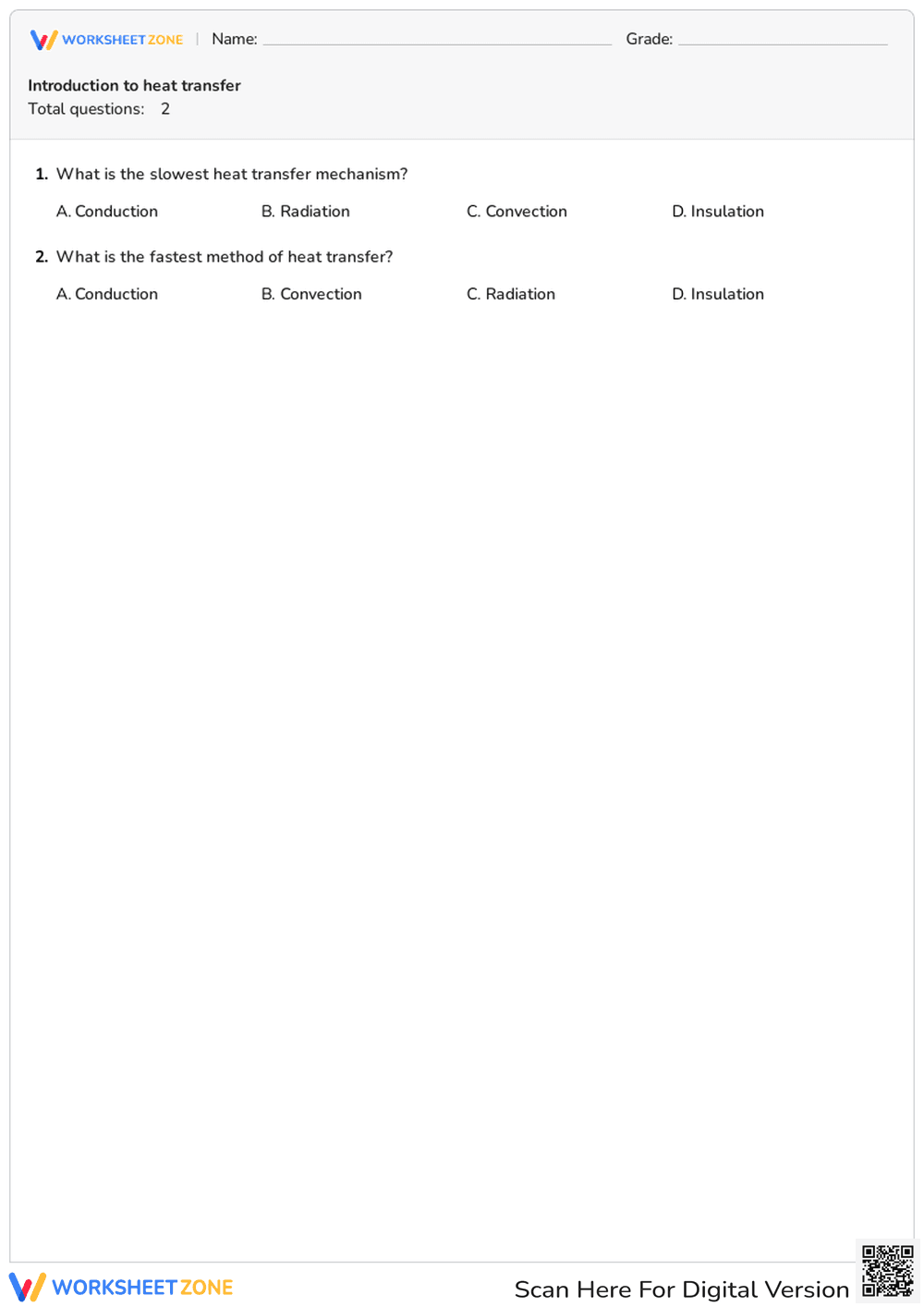
This college-level science worksheet provides a focused assessment of heat transfer mechanisms. Students evaluate the relative speeds of conduction, convection, and radiation to demonstrate conceptual mastery of thermal dynamics. By isolating these specific variables, the resource ensures students can distinguish between particle-based and wave-based energy movement effectively.
At a Glance
- Grade: College · Subject: Science
- Standard:
HS-PS3-4— Identify and compare mechanisms of thermal energy transfer in physical systems- Skill Focus: Heat Transfer Mechanisms
- Format: 1 page · 2 problems · Answer key included · PDF
- Best For: Quick formative assessment or exit ticket
- Time: 5–10 minutes
The PDF contains a single-page assessment featuring two high-impact multiple-choice questions. These questions target the fundamental physical properties of thermal energy movement, specifically focusing on the velocity and efficiency of different mechanisms. The layout is clean and distraction-free, making it ideal for rapid data collection during a lecture or lab session.
This resource is designed for immediate implementation. Teachers can print the single-sheet PDF in under 30 seconds. Distribution takes less than a minute at the start or end of a class period. Reviewing the two questions as a whole-group discussion requires only 2 minutes, providing instant feedback on student misconceptions regarding radiation versus conduction speeds without any teacher setup.
Aligned to HS-PS3-4, which requires students to provide evidence for the transfer of thermal energy within a closed system. While labeled for college use, it bridges the gap between high school physics and introductory university thermodynamics. Both standard codes can be copied directly into lesson plans, IEP goals, or district curriculum mapping tools.
Use this as a "Do Now" activity to activate prior knowledge before a lecture on thermodynamics. Alternatively, assign it as an exit ticket to gauge if students understand that radiation travels at the speed of light while conduction relies on molecular collisions. Formative observation tip: Watch for students who confuse insulation with a transfer mechanism during the selection process.
This is designed for introductory college physics or chemistry students. It serves as an excellent scaffold for learners who need a clear, concise refresher on thermal properties before moving into complex mathematical calculations involving heat capacity or entropy. It pairs naturally with an anchor chart on the kinetic molecular theory.
According to Fisher & Frey (2014), frequent formative checks are vital for ensuring that students do not carry fundamental misconceptions into higher-order problem-solving tasks. This worksheet addresses the core requirements of HS-PS3-4 by forcing a direct comparison between conduction, convection, and radiation. Research from the NAEP indicates that students often struggle with the abstract nature of radiation compared to the tangible nature of conduction. By providing a low-stakes environment to test these concepts, educators can identify gaps in conceptual frameworks before they impact summative assessment performance. The two-question format is specifically optimized for high-retention retrieval practice, a technique proven to strengthen the neural pathways associated with long-term memory in scientific disciplines. This resource provides the necessary data points for instructors to adjust their pacing in real-time, ensuring that the foundational principles of energy transfer are solidified before advancing to the Second Law of Thermodynamics.


