




























Views
Downloads

MS-LS2-2 Worksheet: Ecosystems — Grade 7 Aligned

Paste this activity's link or code into your existing LMS (Google Classroom, Canvas, Teams, Schoology, Moodle, etc.).
Students can open and work on the activity right away, with no student login required.
You'll still be able to track student progress and results from your teacher account.
This Grade 7 science assessment evaluates student understanding of ecosystem dynamics and species relationships. By analyzing food chains and defining symbiotic interactions, students demonstrate their ability to trace energy flow and predict population impacts. This comprehensive test provides educators with clear data on life science proficiency.
At a Glance
- Grade: 7 · Subject: Science
- Standard:
MS-LS2-2— Predict patterns of interactions among organisms in ecosystems- Skill Focus: Ecosystem Interactions and Energy Flow
- Format: 4 pages · 29 problems · Answer key included · PDF
- Best For: Summative assessment or test prep
- Time: 35–45 minutes
What's Inside
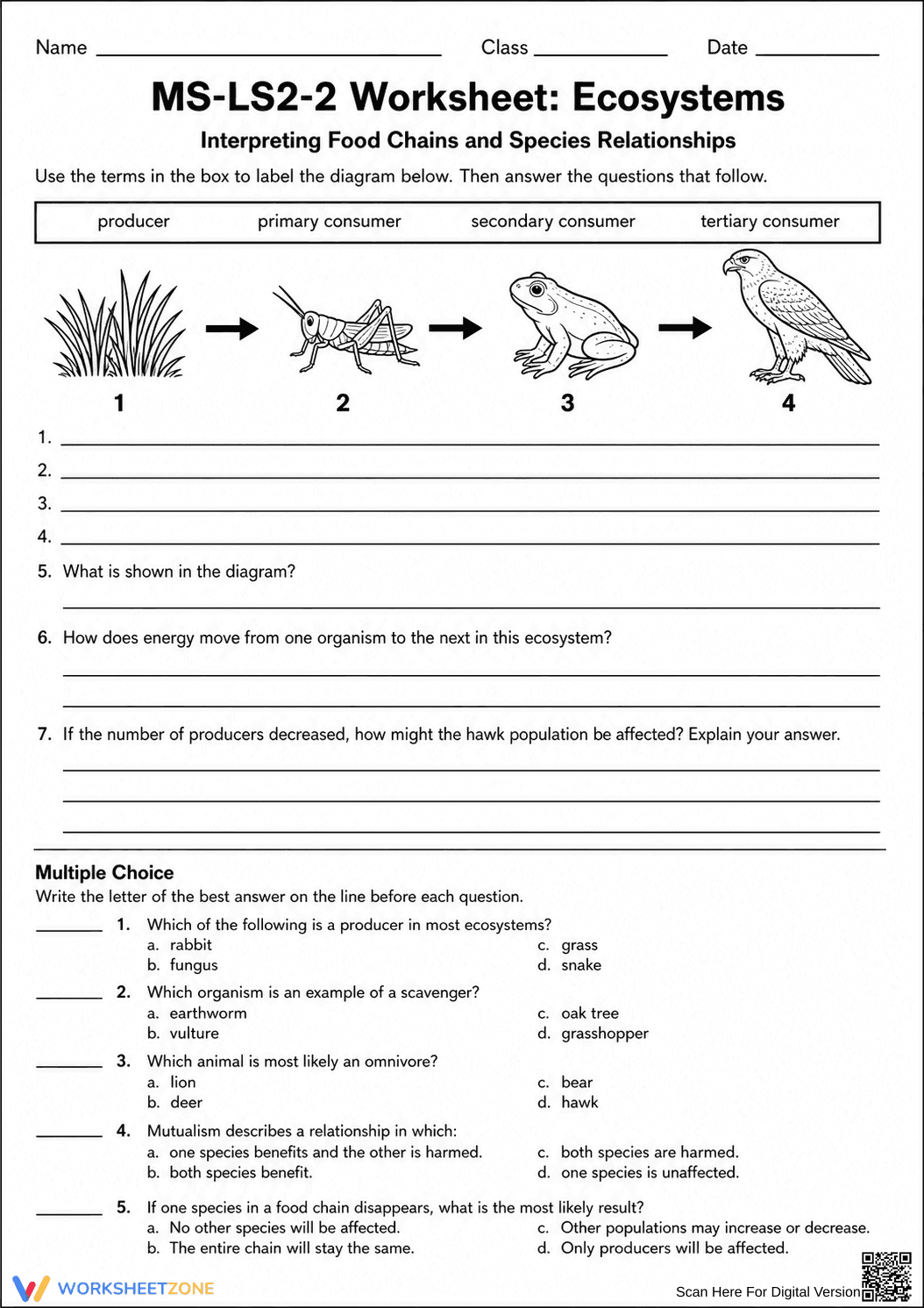
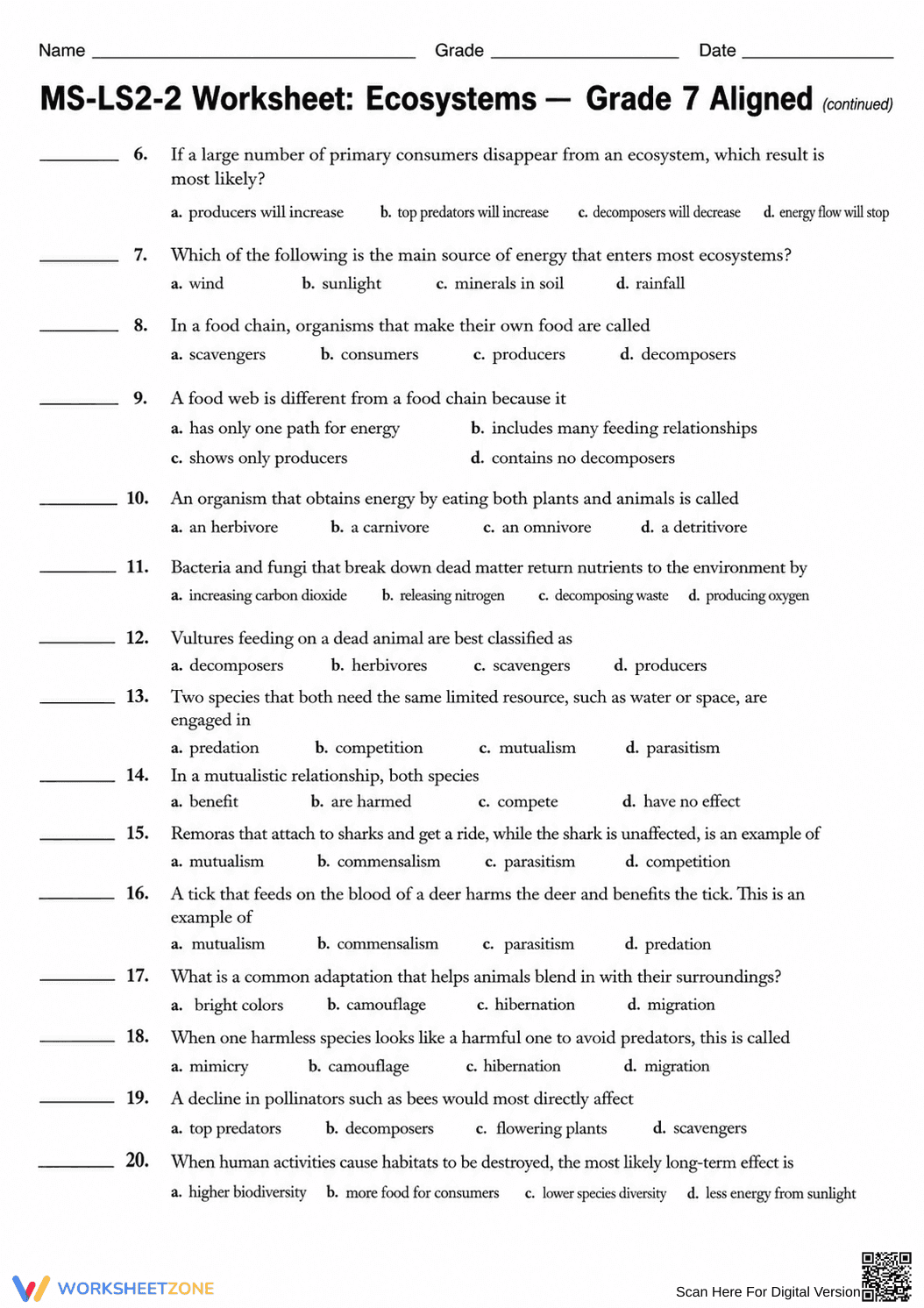
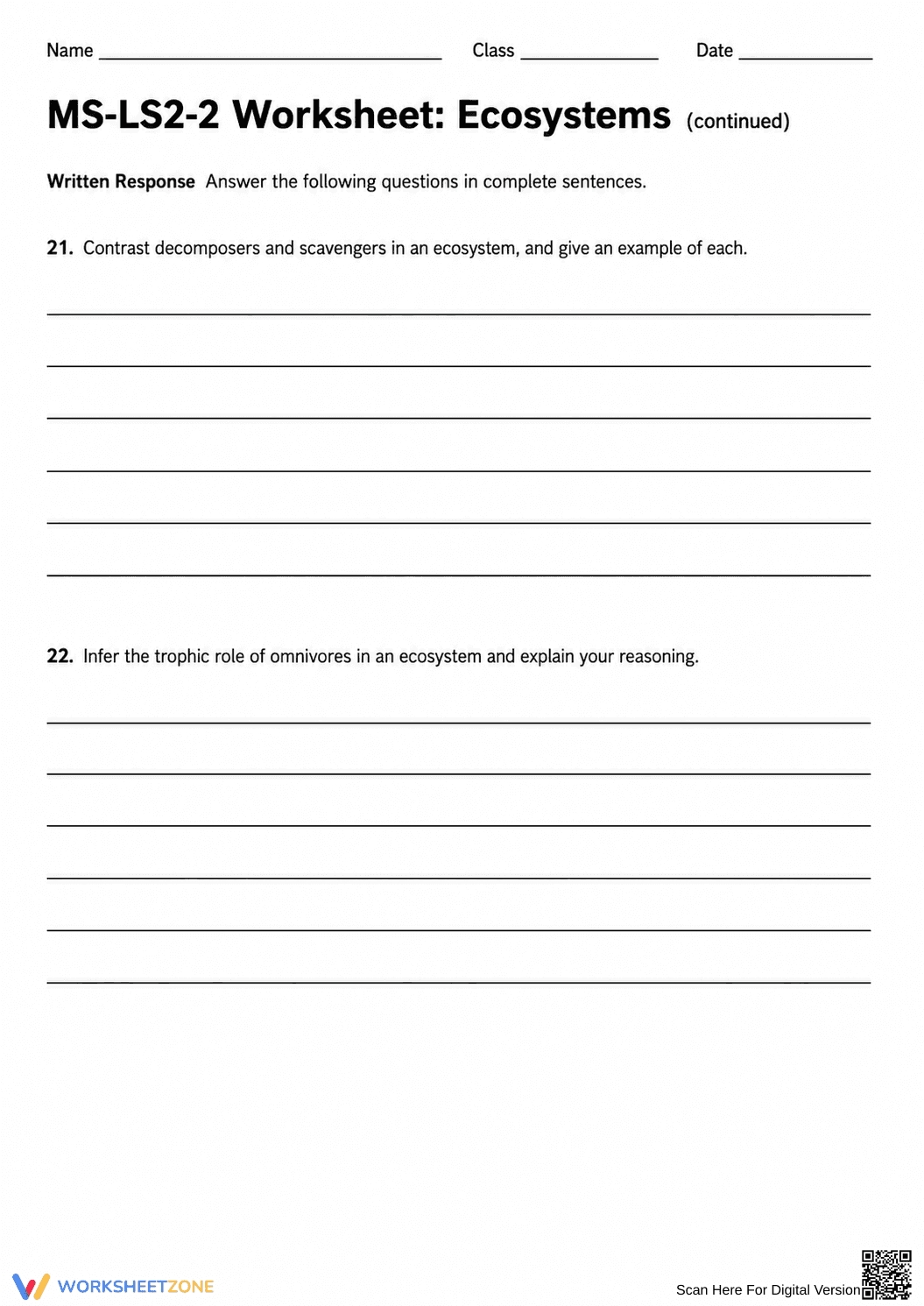
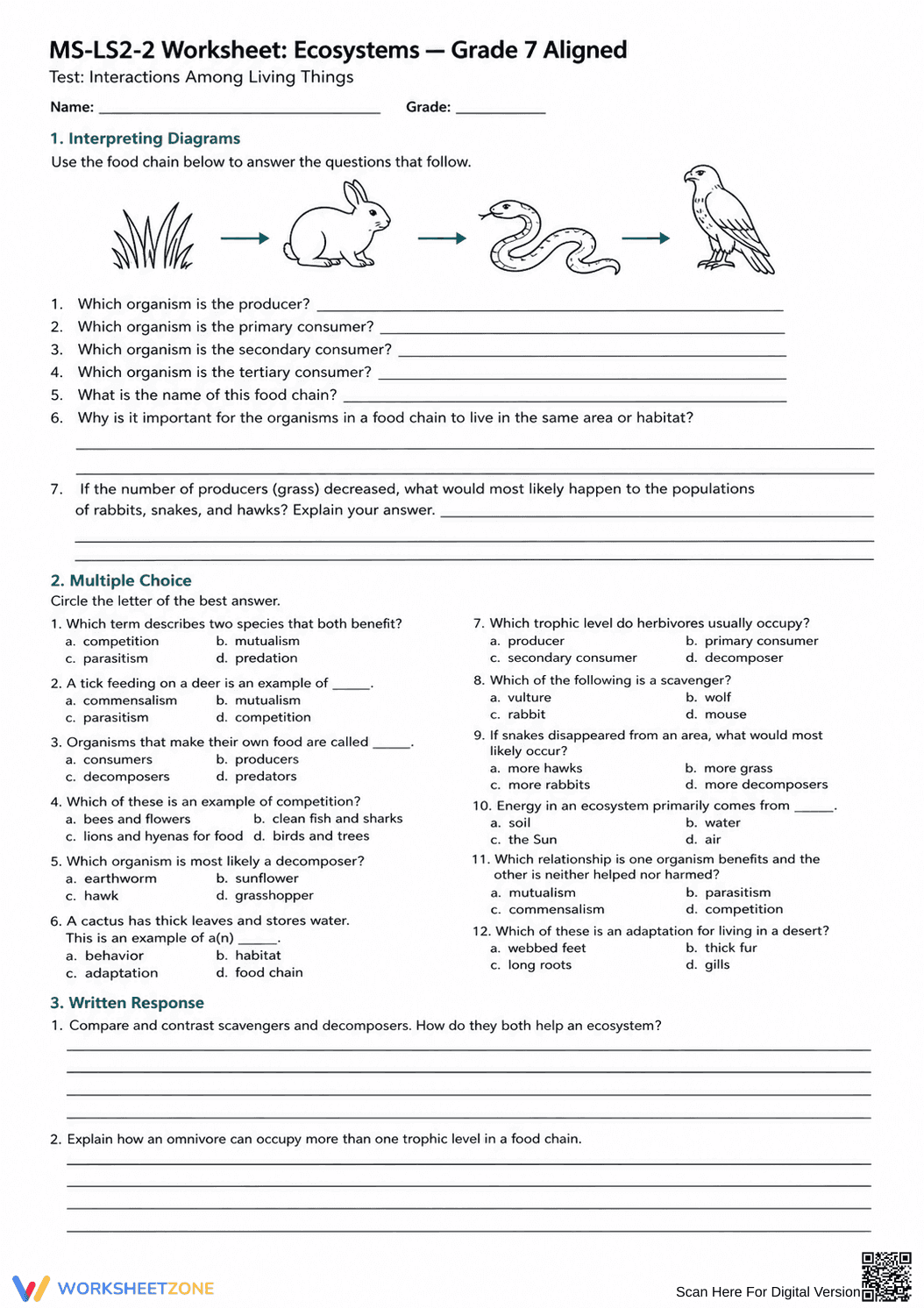
This robust assessment features 29 carefully structured questions spread across three student pages, plus a comprehensive one-page answer key. The test includes a diagram interpretation section where students label consumer levels in a food chain, followed by 20 multiple-choice questions covering symbiosis, competition, and adaptations. It concludes with two written response prompts requiring students to contrast decomposers and scavengers, and infer the ecological roles of omnivores.
Mastery Evidence
To support standards-based grading, this assessment includes a built-in framework for evaluating mastery. The rubric tiers are easily mapped to the 29-point scale: students scoring 0 to 17 are Approaching mastery, 18 to 25 are Meeting expectations, and 26 to 29 are Exceeding the standard. The diagram tasks map directly to energy flow sub-skills, while the multiple-choice and written responses assess vocabulary and conceptual application. These scores can be entered directly into gradebooks or IEP progress notes to document specific life science competencies.
Standards Alignment
Aligned to primary standard MS-LS2-2: Construct an explanation that predicts patterns of interactions among organisms across multiple ecosystems. The questions also support understanding of energy cycling and matter flow within food webs. Both standard codes can be copied directly into lesson plans, IEP goals, or district curriculum mapping tools.
How to Use It
Deploy this resource as a formal end-of-unit summative assessment after completing direct instruction on ecosystems and symbiosis. Alternatively, use it as a diagnostic test prep tool before state science exams to identify knowledge gaps. As a formative assessment observation tip, review students' written responses to question 22 to ensure they fully grasp how omnivores occupy multiple trophic levels simultaneously. Expected completion time is 35 to 45 minutes.
Who It's For
This test is designed for Grade 7 general science students, though it serves as excellent review material for high school biology foundations. For differentiation, teachers can allow students requiring accommodations to skip the written response section or use a provided word bank for the diagram. It pairs perfectly with an anchor chart detailing mutualism, commensalism, and parasitism.
Assessing student comprehension of ecological relationships through structured evaluation is a critical component of middle school science instruction. This resource directly aligns with standard MS-LS2-2, requiring students to predict patterns of interactions among organisms in ecosystems. According to a ScienceDirect TpT Analysis, explicit assessment of scientific vocabulary and diagram interpretation significantly improves the long-term retention of complex biological concepts. By combining visual models, such as energy pyramids and food chains, with targeted multiple-choice and constructed-response questions, educators can accurately measure how well students understand the delicate balance of natural habitats. Evaluating these specific competencies ensures learners can identify the cascading effects of environmental changes on both producer and consumer populations. Furthermore, consistent formative and summative testing on these topics builds a strong, evidence-based foundation for advanced environmental science coursework in high school and beyond.


