


























Views
Downloads

Essential Integumentary System Worksheet | Grade 7 Science
Paste this activity's link or code into your existing LMS (Google Classroom, Canvas, Teams, Schoology, Moodle, etc.).
Students can open and work on the activity right away, with no student login required.
You'll still be able to track student progress and results from your teacher account.
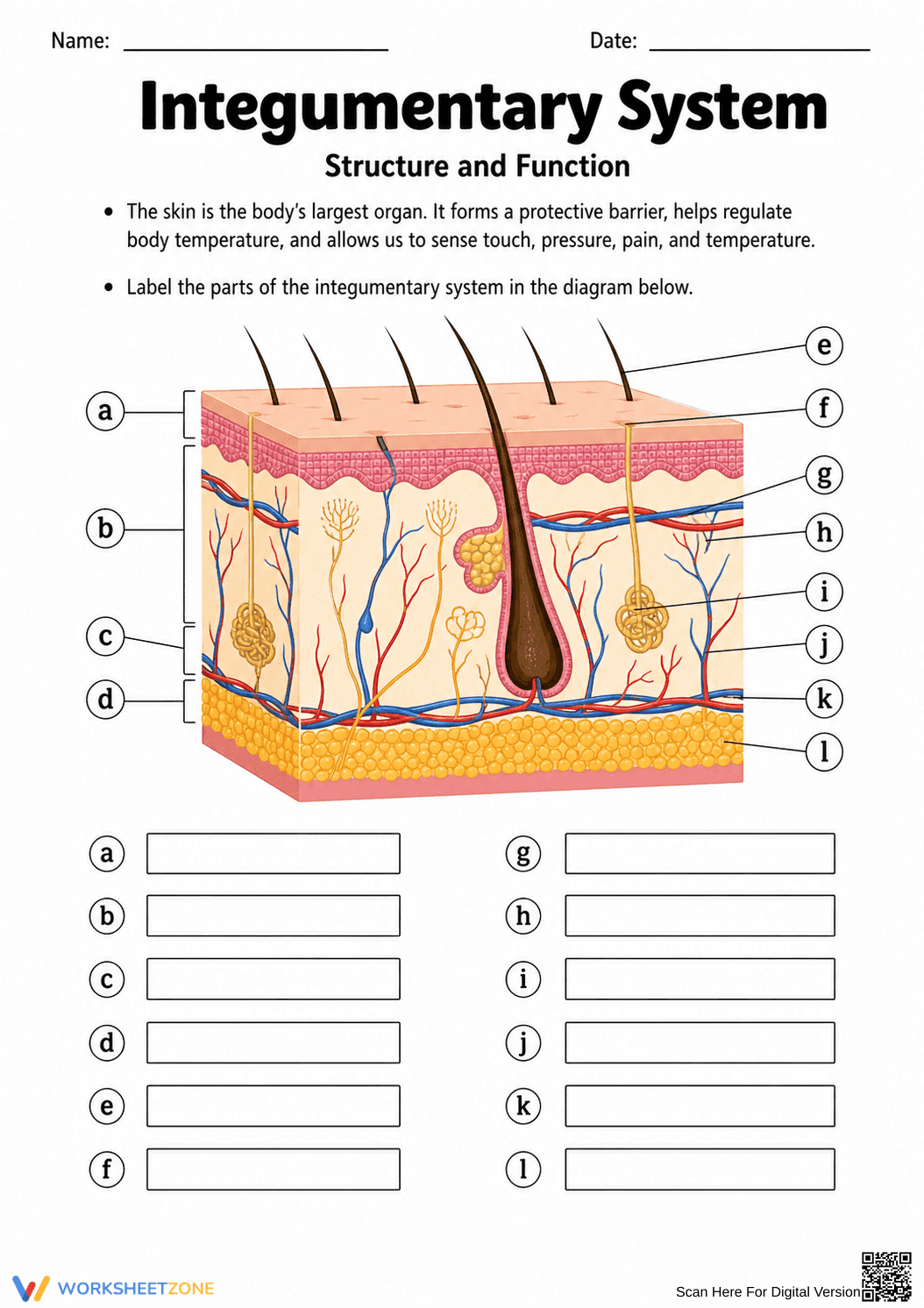
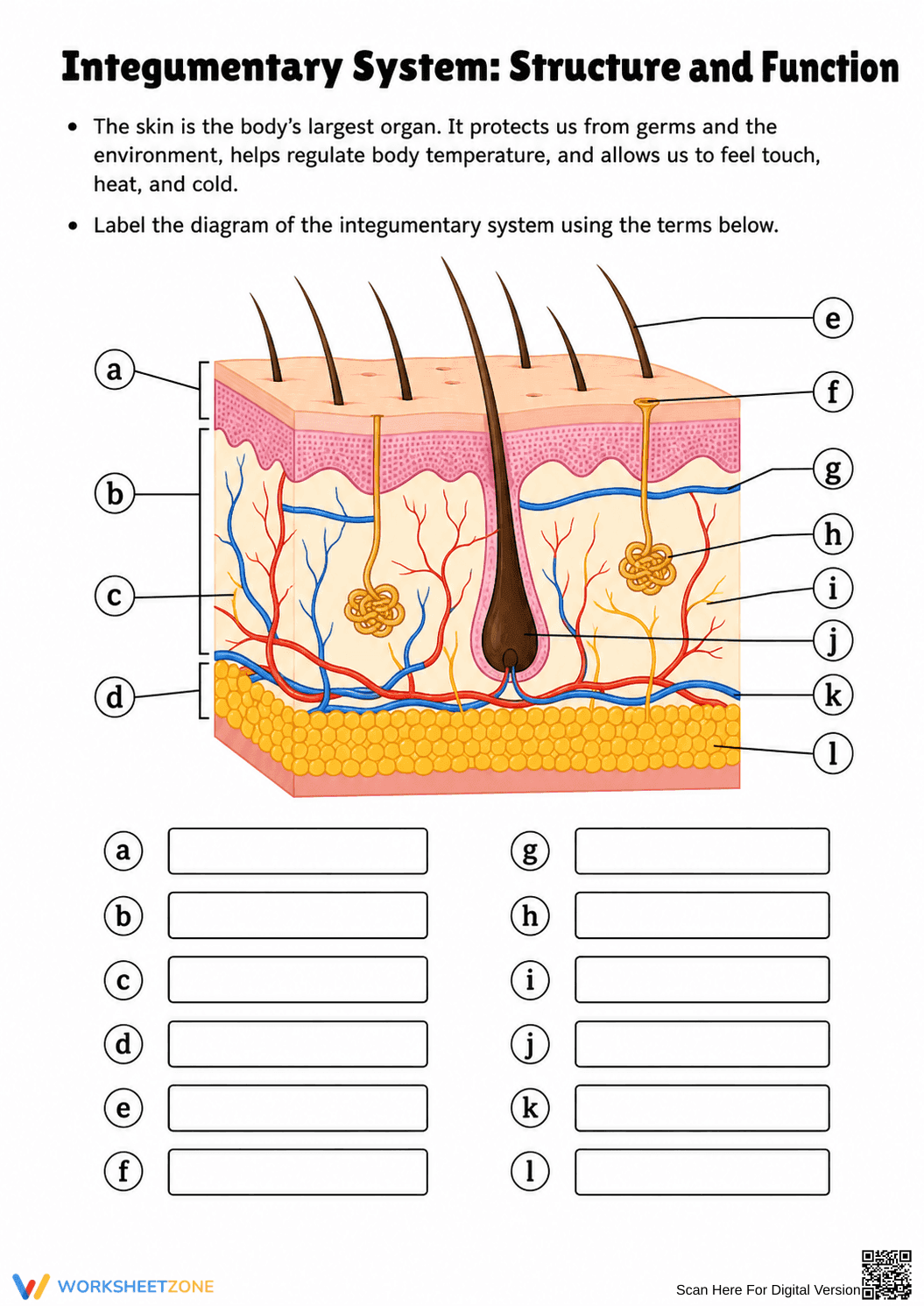
Students will master the complex anatomy of the human skin with this focused labeling activity. By identifying the specific layers and structures of the integumentary system, learners gain a concrete understanding of how this vital organ protects the body and regulates internal environments. This resource ensures students can visualize and name key biological components.
At a Glance
- Grade: 7 · Subject: Science
- Standard:
MS-LS1-3— Use evidence to show how the body is a system of interacting subsystems- Skill Focus: Skin anatomy labeling
- Format: 2 pages · 12 problems · Answer key included · PDF
- Best For: Anatomy review and formative assessment
- Time: 15–20 minutes
This 2-page PDF features a high-resolution, cross-sectional diagram of the human skin. It includes 12 specific labeling tasks targeting the epidermis, dermis, hypodermis, hair follicles, and various glands. The worksheet begins with a concise introductory text that defines the skin's primary functions, providing immediate context before students begin the identification exercise. A full answer key is provided for rapid grading.
- Guided Practice: Students read the introductory text to identify the three primary functions of the skin, establishing the purpose before the identification phase.
- Supported Practice: Using the visual cues in the detailed diagram, students map 12 alphabetical markers to their corresponding anatomical terms.
- Independent Practice: Learners synthesize their knowledge by explaining how structures like sweat glands and blood vessels contribute to temperature regulation.
This sequence follows a gradual-release model.
This resource is aligned with `MS-LS1-3`, which requires students to understand how the body is a system of interacting subsystems. By identifying the specific tissues and organs within the integumentary system, students gather evidence for how specialized cells work together. Both standard codes can be copied directly into lesson plans, IEP goals, or district curriculum mapping tools.
Use this worksheet as a formative assessment immediately following a lecture on human body systems to gauge student vocabulary acquisition. It also serves as an excellent companion for a microscope lab where students view prepared skin slides. Expect students to complete the labeling and introductory reading within 15 to 20 minutes.
This activity is designed for middle school life science students and introductory high school biology learners. It is particularly effective for visual learners who benefit from spatial representations of biological data. Pair this with a 3D torso model or an interactive digital anatomy tour.
The use of visual labeling tasks in life science education significantly enhances the retention of complex anatomical structures by reducing cognitive load during the initial acquisition phase. According to the RAND AIRS 2024 report on secondary science instruction, worksheets that integrate diagrammatic representation with specific terminology help students bridge the gap between abstract biological concepts and physical reality. This Integumentary System: Structure and Function worksheet aligns with MS-LS1-3 by requiring students to identify 12 distinct components of the skin, including the epidermis, dermis, and subcutaneous layers. By engaging in active recall through labeling, learners develop a more robust mental model of how the integumentary system serves as a protective barrier and sensory organ. This resource provides the necessary scaffolding for middle school students to master the vocabulary required for higher-level physiological discussions. Educators can utilize this tool to ensure that every student achieves the foundational knowledge necessary for understanding human body systems.


