


























Views
Downloads

Integumentary System Worksheet | Essential Grade 7 Science
Paste this activity's link or code into your existing LMS (Google Classroom, Canvas, Teams, Schoology, Moodle, etc.).
Students can open and work on the activity right away, with no student login required.
You'll still be able to track student progress and results from your teacher account.
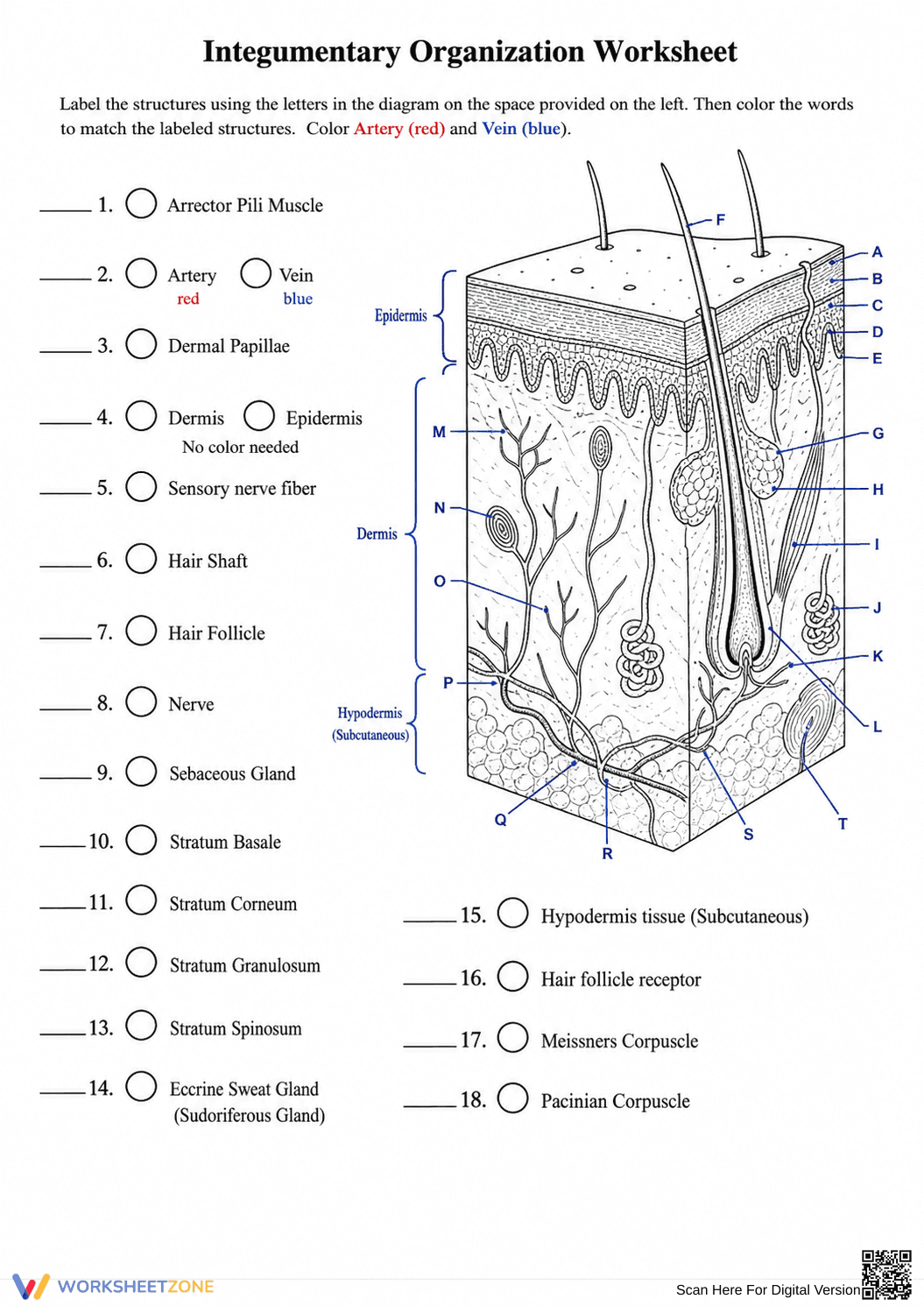
This Integumentary Organization worksheet provides a comprehensive anatomical review of the human skin system. Students identify and label 18 distinct structures, from the stratum corneum to the hypodermis. By mapping visual diagrams to scientific terminology, learners develop a concrete understanding of how specialized tissues organize to form the body's largest organ system.
At a Glance
- Grade: 7 · Subject: Science
- Standard:
MS-LS1-3— Use argument supported by evidence for how the body is a system- Skill Focus: Integumentary system anatomy
- Format: 1 page · 18 problems · Answer key included · PDF
- Best For: Anatomy review and formative assessment
- Time: 20–30 minutes
What's Inside
This single-page PDF features a high-resolution cross-section diagram of the skin. It includes 18 identification blanks paired with a letter-coded visual key. The worksheet incorporates a dual-modality approach, requiring students to both label text and apply specific color-coding to vascular structures like arteries and veins to reinforce circulatory connections.
Skill Progression
- Guided Practice: Students begin by identifying major layers (Epidermis, Dermis) using large bracketed cues on the diagram to establish spatial orientation.
- Supported Practice: Learners use the 18-item word bank to match specific structures like the arrector pili muscle and sebaceous glands to their corresponding letters.
- Independent Practice: Students apply color-coded logic to differentiate between arteries and veins, demonstrating an understanding of vascular organization within the dermal layer.
This resource follows a gradual-release model, moving from broad tissue identification to specific cellular structures and physiological components.
Standards Alignment
This resource aligns with `MS-LS1-3`, focusing on how the body is a system of interacting subsystems composed of groups of cells. It specifically addresses the organization of the integumentary system as a protective barrier. Both standard codes can be copied directly into lesson plans, IEP goals, or district curriculum mapping tools.
How to Use It
Use this worksheet as a mid-unit check after introducing the layers of the skin. It works effectively as a quiet independent activity while the teacher circulates to observe if students can distinguish between the various strata of the epidermis. Expect completion within 25 minutes during a standard science block.
Who It's For
This is designed for Grade 7 life science students but is rigorous enough for introductory biology. It pairs naturally with a skin model or a digital textbook chapter on human body systems. It is particularly helpful for visual learners who benefit from spatial organization and kinesthetic coloring tasks.
The Integumentary Organization worksheet is a targeted instructional tool designed to meet the rigorous demands of the MS-LS1-3 standard. By requiring students to label 18 specific anatomical structures, the resource facilitates the transition from basic identification to a systemic understanding of tissue organization. Research from Fisher & Frey (2014) emphasizes that visual scaffolding, such as the detailed cross-section diagram provided here, is essential for students to internalize complex biological hierarchies. This worksheet bridges the gap between abstract cellular concepts and observable physical structures. The inclusion of color-coding for vascular components further supports cognitive retention by engaging multiple sensory pathways. Educators can utilize this 1-page PDF as a reliable formative assessment to gauge student mastery of the integumentary system's role within the broader human body. It provides the precise technical vocabulary and spatial context necessary for high-level scientific literacy and future anatomical studies.


