


























Views
Downloads
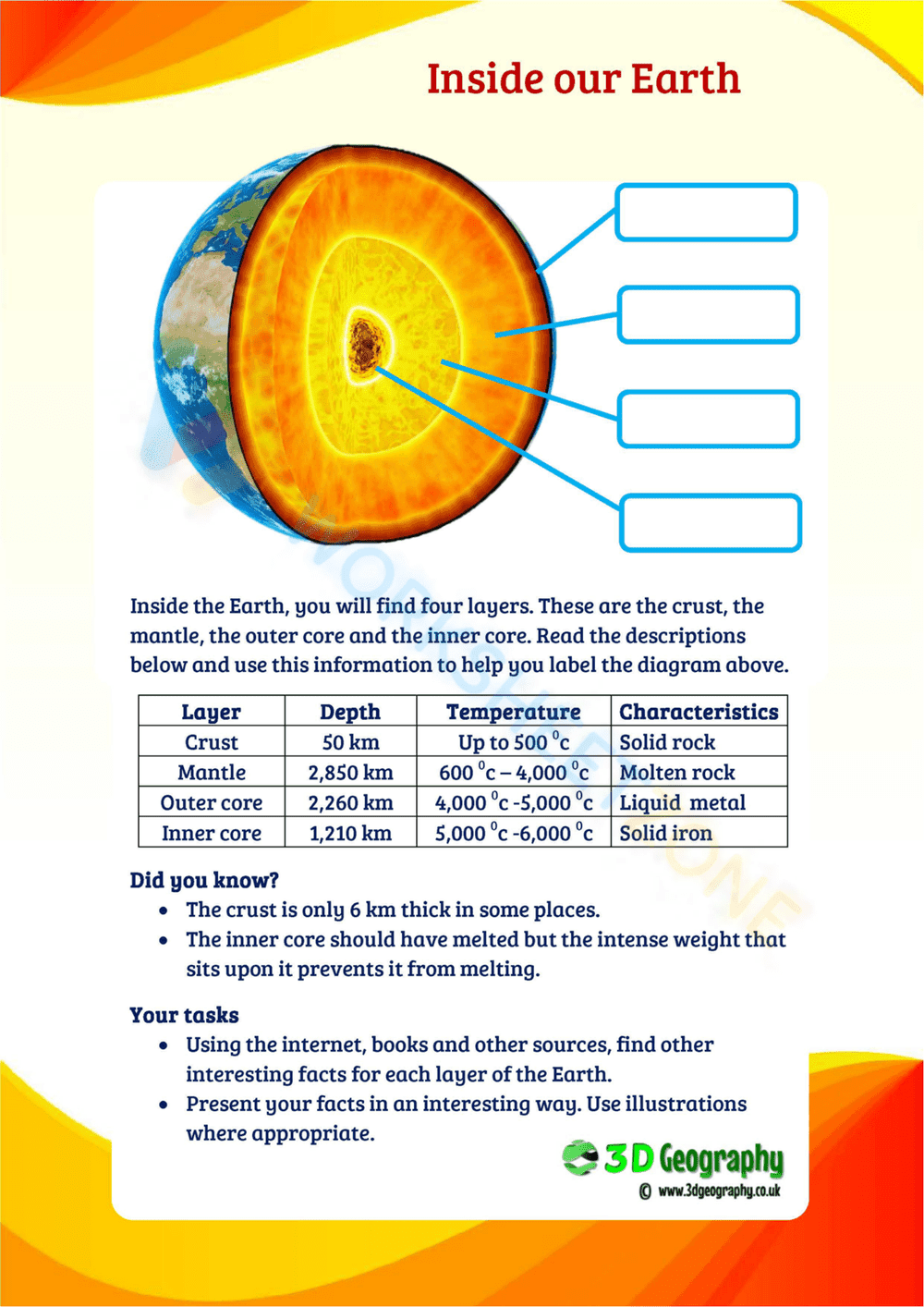

Inside our Earth Worksheet | Grade 6 Essential Science
Paste this activity's link or code into your existing LMS (Google Classroom, Canvas, Teams, Schoology, Moodle, etc.).
Students can open and work on the activity right away, with no student login required.
You'll still be able to track student progress and results from your teacher account.
This Grade 6 Earth Science worksheet provides a clear, visual framework for students to identify and describe the four primary layers of the Earth. By combining diagram labeling with data analysis from a provided table, students gain a concrete understanding of the crust, mantle, outer core, and inner core. It bridges the gap between visual models and scientific data.
At a Glance
At a Glance
- Grade: 6 · Subject: Earth Science
- Standard:
MS-ESS2-1— Develop a model to describe the cycling of Earth's materials and interior- Skill Focus: Earth's internal structure and characteristics
- Format: 1 page · 6 tasks · Answer key included · PDF
- Best For: Introductory lesson or quick formative assessment
- Time: 20–30 minutes
What's Inside
The worksheet features a high-quality cross-section diagram of the Earth with four distinct labeling zones. Below the diagram, a comprehensive data table lists the depth, temperature ranges, and physical characteristics (such as solid rock or liquid metal) for each layer. The page also includes a "Did you know?" section to spark curiosity and a two-part research task to extend learning beyond the page.
Zero-Prep Workflow
This resource is designed for a zero-prep workflow. First, print the single-page PDF (30 seconds). Second, distribute the sheets to students (1 minute). Third, review the completed diagrams as a whole group (5 minutes). Total teacher preparation time is under 2 minutes, making it an ideal choice for sub plans or busy lab days.
Standards Alignment
This resource aligns with `MS-ESS2-1`, which requires students to develop a model to describe the cycling of Earth's materials and the flow of energy. By identifying the physical properties and temperatures of the interior, students build the foundational knowledge necessary to understand plate tectonics and mantle convection. This standard code can be copied directly into lesson plans, IEP goals, or district curriculum mapping tools.
How to Use It
Use this worksheet during the "Explain" phase of a 5E lesson cycle. After students have explored general concepts of Earth's composition, use this page to formalize their vocabulary and data literacy. As a formative assessment tip, observe if students can correctly correlate the "liquid metal" characteristic of the outer core with its specific temperature range in the table. Completion typically takes 20 to 30 minutes.
Who It's For
This worksheet is tailored for Grade 6 students but is highly effective for Grade 5 enrichment or Grade 7 review. The clear table and visual cues provide excellent support for English Language Learners and students with IEPs who benefit from structured data presentation. It pairs naturally with a classroom globe or an interactive digital simulation of Earth's interior.
According to the RAND AIRS 2024 report, high-quality visual models are essential for middle school students to conceptualize abstract scientific phenomena like Earth's interior. This worksheet addresses MS-ESS2-1 by requiring students to synthesize text-based data with a visual model of the crust, mantle, and core. Research from Fisher & Frey (2014) emphasizes that scaffolded data interpretation helps students move from basic identification to complex systems thinking. By providing specific depths and temperatures, this resource ensures that students are not just memorizing names but are understanding the physical realities of planetary layers. The inclusion of a research-based extension task aligns with NAEP recommendations for inquiry-based science education. This 1-page PDF serves as a robust tool for building scientific literacy and mastery of Earth Science standards in a classroom setting.


