


























Views
Downloads
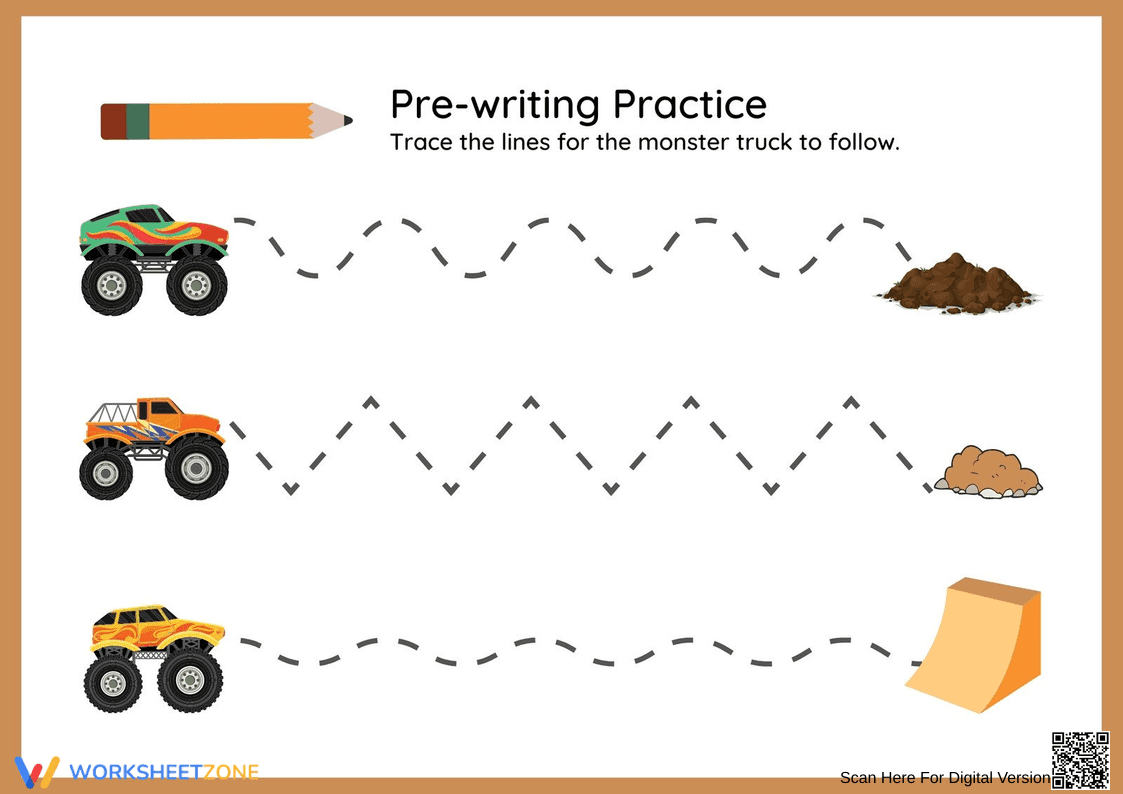

Printable Monster Truck Tracing Worksheet | Pre-K
Paste this activity's link or code into your existing LMS (Google Classroom, Canvas, Teams, Schoology, Moodle, etc.).
Students can open and work on the activity right away, with no student login required.
You'll still be able to track student progress and results from your teacher account.
This pre-writing practice worksheet helps early learners develop essential fine motor control by tracing distinct paths. Students follow dashed lines to guide monster trucks to their destinations, building the hand-eye coordination and pencil grip required for future letter formation and writing success.
At a Glance
- Grade: Pre-K · Subject: English Language Arts
- Standard:
CCSS.ELA-LITERACY.L.K.1.A— Practice foundational strokes for printing letters- Skill Focus: Line tracing and fine motor control
- Format: 1 page · 3 problems · No answer key needed · PDF
- Best For: Morning work or centers
- Time: 5–10 minutes
This single-page resource features three distinct tracing tasks designed to engage young learners. Each row presents a brightly colored monster truck alongside a unique dashed path—curved, zigzag, and wavy—leading to a dirt pile or ramp. The clear layout ensures students focus entirely on pencil control without visual distractions. No answer key is required, making it an immediate addition to any folder.
Zero-Prep Workflow
- Print (30 seconds): Generate the PDF and print the required number of copies. The high-contrast dashed lines print clearly in both color and grayscale.
- Distribute (1 minute): Hand out the sheets along with thick pencils, crayons, or markers suitable for early learners developing their pincer grasp.
- Review (30 seconds): Briefly model how to start at the truck and follow the line to the end. Total teacher prep time is under two minutes, making this an ideal emergency sub plan or quick transition activity.
Standards Alignment
This activity aligns with foundational pre-writing skills leading up to CCSS.ELA-LITERACY.L.K.1.A: Print many upper- and lowercase letters. By mastering curved, zigzag, and wavy strokes, students build the muscle memory necessary for standard letter formation. Both standard codes can be copied directly into lesson plans, IEP goals, or district curriculum mapping tools.
How to Use It
Deploy this worksheet during morning arrival as a calm, focused task to start the day, or place it in a fine motor center alongside dry-erase markers if laminated. Before direct instruction on letter writing, use this to warm up hand muscles. As a formative assessment observation tip, watch the student's pencil grip and note if they cross the midline smoothly while tracing the zigzag path. Expected completion time ranges from five to ten minutes depending on the child's developmental stage.
Who It's For
This resource is primarily designed for Pre-K and early Kindergarten students developing their pre-writing abilities. It serves as an excellent intervention tool for occupational therapy sessions or students needing extra fine motor support. For differentiation, provide thicker markers for students struggling with grip, or ask advanced learners to trace the line backward. Pair this activity with a read-aloud about trucks or a hands-on sensory bin to reinforce the thematic engagement.
Developing strong fine motor skills through targeted pre-writing activities is a critical precursor to academic success. This resource supports foundational strokes for printing letters, aligning with the developmental trajectory toward CCSS.ELA-LITERACY.L.K.1.A. According to Fisher & Frey (2014), purposeful, guided practice in early childhood significantly improves later writing fluency and cognitive load management. When students engage in tracing varied paths—such as the curved and zigzag lines featured in this activity—they strengthen the intrinsic hand muscles and refine the visual-motor integration required for legible handwriting. Early intervention with structured tracing tasks reduces frustration when students transition to formal letter formation. By integrating high-interest themes like monster trucks, educators can sustain attention during these repetitive but essential motor exercises, ensuring young learners build the stamina needed for kindergarten readiness.


