


























Views
Downloads


Essential Counting 1-10 Worksheet | Grade K Printable
Paste this activity's link or code into your existing LMS (Google Classroom, Canvas, Teams, Schoology, Moodle, etc.).
Students can open and work on the activity right away, with no student login required.
You'll still be able to track student progress and results from your teacher account.
This comprehensive Kindergarten math worksheet provides students with targeted practice to master numbers 1 through 10. By engaging with vibrant visuals and varied tasks, learners build a rock-solid foundation in number recognition, cardinality, and basic quantity comparison. It is a complete resource designed to bridge the gap between abstract numbers and concrete counting.
At a Glance
- Grade: K · Subject: Math
- Standard:
K.CC.B.4— Understand the relationship between numbers and quantities and connect counting to cardinality- Skill Focus: Number recognition and counting 1-10
- Format: 3 pages · 11 problems · Answer key included · PDF
- Best For: Kindergarten independent practice and homework
- Time: 15–20 minutes
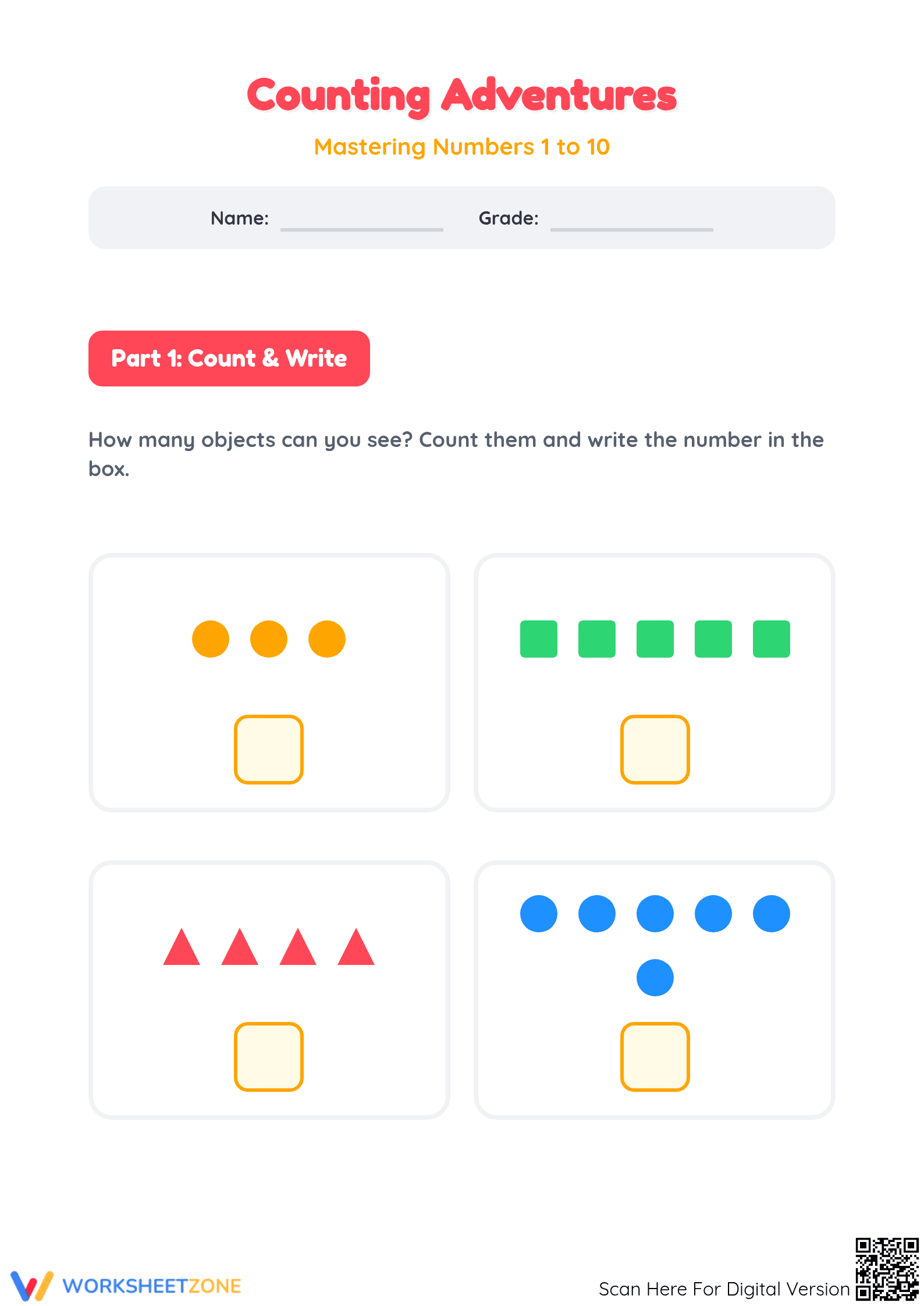
This 3-page PDF features four distinct activity sections: counting and writing numerals, matching digits to number words, tracing vocabulary, and identifying larger groups. With 11 individual problems and a full answer key, it provides a structured pathway for early learners to visualize and interact with single-digit values in multiple formats like geometric shapes and friendly animal icons.
Skill Progression
- Guided practice: Initial counting tasks utilize large, clear geometric shapes to help students establish one-to-one correspondence for the first 4 problems on page one.
- Supported practice: Matching and tracing exercises reinforce the connection between numerical symbols and their written word forms, providing scaffolded literacy support for numbers like eight and ten.
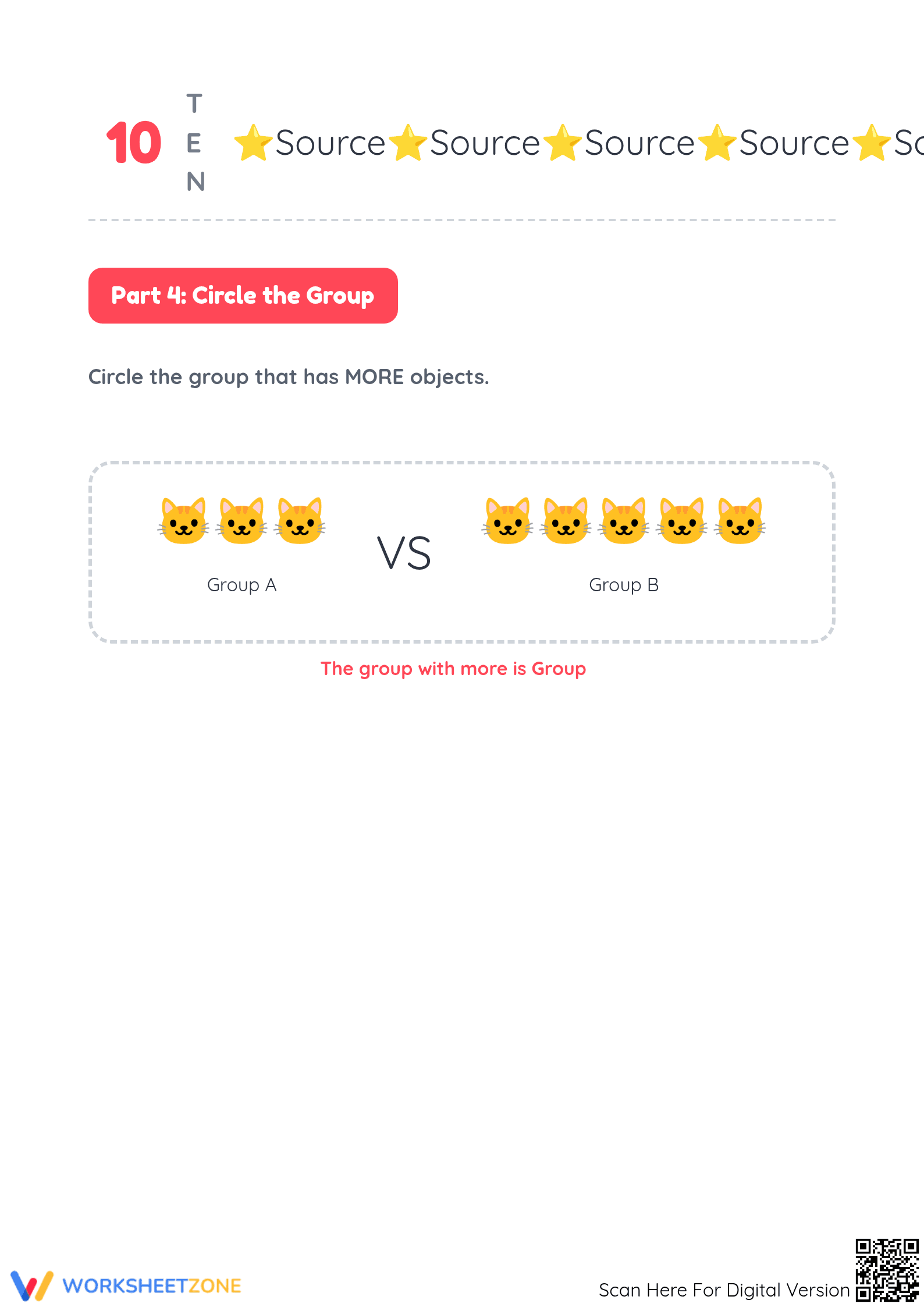
- Independent practice: The final section challenges students to apply their counting skills to compare two distinct groups and identify the set with more objects.
The worksheet follows a gradual-release model, moving from direct counting to symbolic matching and culminating in higher-order comparison using the "I Do, We Do, You Do" framework.
Standards Alignment
This resource aligns with K.CC.B.4: "Understand the relationship between numbers and quantities; connect counting to cardinality." This worksheet also supports K.CC.C.6 regarding identifying whether the number of objects in one group is greater than another. Both standard codes can be copied directly into lesson plans, IEP goals, or district curriculum mapping tools.
How to Use It
Use this as a post-instruction practice tool after introducing numbers 1-10 in a whole-group setting. It works perfectly as a station activity or a formative assessment. Observation tip: Watch students as they count the cats in the final section to see if they touch each object or use subitizing for smaller groups. Expected completion time is 20 minutes.
Who It's For
Ideal for Kindergarten students or Pre-K learners ready for elementary math concepts. It provides excellent support for students needing visual aids or fine motor tracing practice. Pair it with a number line anchor chart or concrete manipulatives for maximum instructional impact during small-group intervention.
Research from NAEP suggests that early mastery of one-to-one correspondence is the single greatest predictor of future mathematical success in primary grades. By explicitly linking numerals to number words through tracing and matching, this resource aligns with the scaffolded practice approach popularized by Fisher & Frey (2014). The inclusion of multi-modal tasks—visual counting, writing, and word-to-digit association—ensures that students develop a deeper cognitive map of cardinality. This worksheet addresses specific K.CC.B.4 requirements by requiring students to count objects and represent that count with a written numeral. Systematic use of such materials has been shown by EdReports 2024 to improve student fluency with single-digit numbers while reducing cognitive load during the transition to elementary arithmetic. By providing 11 distinct tasks, teachers can quickly gauge student readiness for addition.


