


























Views
Downloads

Identifying Tens and Ones Worksheet | Grade 1 Printable
Paste this activity's link or code into your existing LMS (Google Classroom, Canvas, Teams, Schoology, Moodle, etc.).
Students can open and work on the activity right away, with no student login required.
You'll still be able to track student progress and results from your teacher account.
This comprehensive Identifying Tens and Ones worksheet helps Grade 1 students master the foundational principles of place value through visual decomposition. By engaging with part-whole models and sentence-based breakdowns, learners develop a concrete understanding of how two-digit numbers are constructed, ensuring a smooth transition to more complex mathematical operations and multi-digit addition.
At a Glance
- Grade: 1 · Subject: Math
- Standard:
CCSS.MATH.CONTENT.1.NBT.B.2— Understand that the two digits of a two-digit number represent amounts of tens and ones- Skill Focus: Tens and Ones Place Value
- Format: 3 pages · 13 problems · Answer key included · PDF
- Best For: Small group place value intervention sessions
- Time: 20–30 minutes
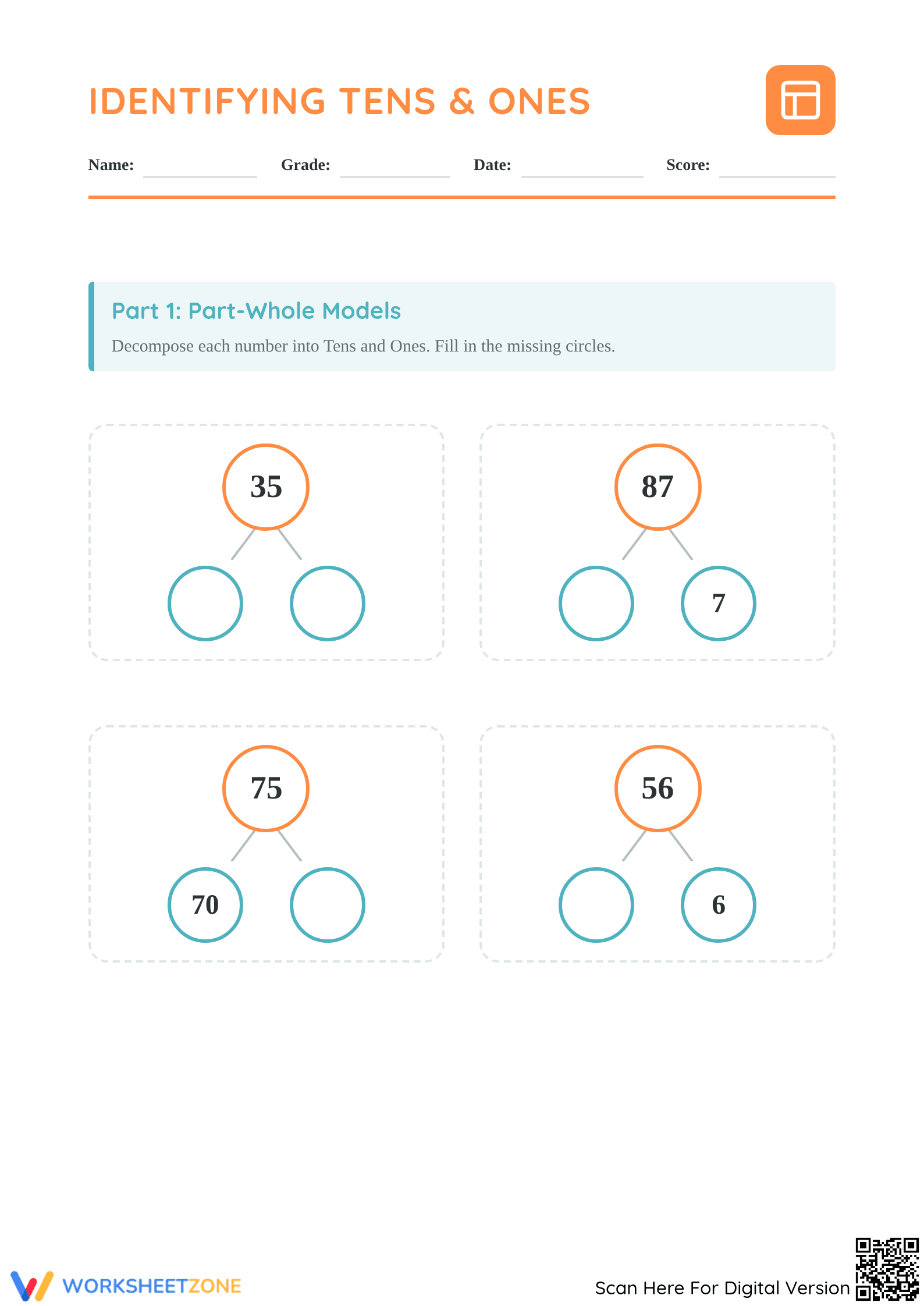
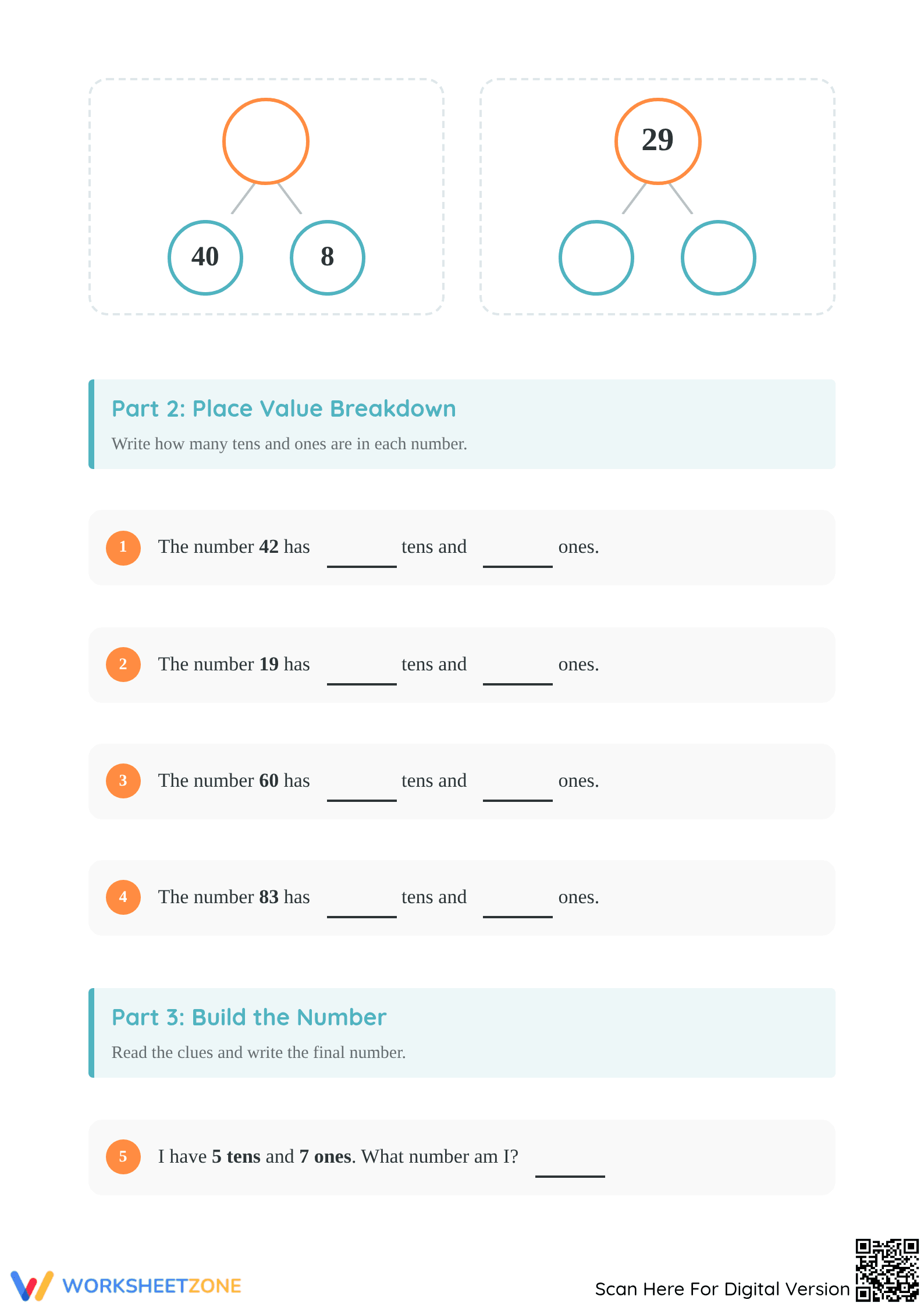
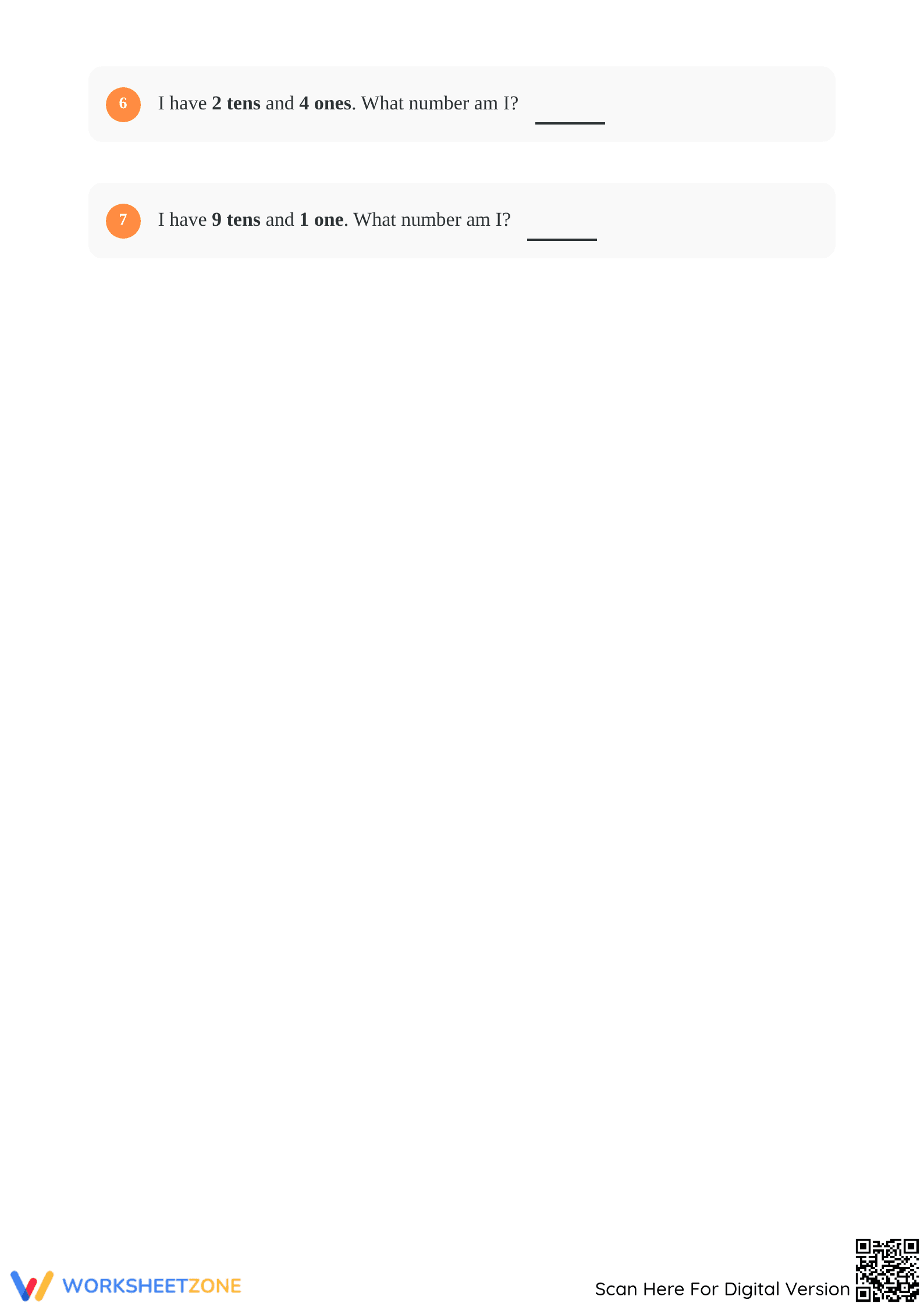
This three-page PDF resource features thirteen structured exercises divided into three logical sections. It begins with part-whole circle models for visual decomposition, moves into fill-in-the-blank sentences for linguistic reinforcement, and concludes with "Build the Number" riddles that challenge students to synthesize tens and ones into a final value. A complete answer key is provided for immediate feedback.
- Guided practice involves decomposing numbers like 35 and 87 using pre-drawn part-whole models that visually separate values into their component tens and ones.
- Supported practice transitions students to place value breakdowns where they must identify the specific digit counts within four different two-digit numbers in sentence form.
- Independent practice culminates in "Build the Number" tasks where students use mental math to combine given tens and ones into a standard numeric representation.
This sequence follows a gradual-release model to build student confidence.
The primary focus is CCSS.MATH.CONTENT.1.NBT.B.2, which requires students to understand that the two digits of a two-digit number represent amounts of tens and ones. This worksheet directly addresses sub-standard 1.NBT.B.2.A by modeling ten as a bundle of ten ones. Both standard codes can be copied directly into lesson plans, IEP goals, or district curriculum mapping tools.
Use this worksheet as a formative assessment after introducing base-ten blocks. Observe if students can correctly identify that "60" has 6 tens and 0 ones, which is a common stumbling block. Alternatively, assign the "Build the Number" section as a quick exit ticket to gauge mastery of the day's objective. Total completion time is roughly 25 minutes.
Designed for first-grade students or second-grade learners requiring place value review. It pairs naturally with physical manipulatives like unifix cubes or base-ten rods to provide a multi-sensory learning experience. This resource is particularly effective for students who struggle with the abstract nature of number position.
Mastering place value is the essential gateway to mathematical literacy, as it forms the basis for the entire base-ten number system. This resource targets CCSS.MATH.CONTENT.1.NBT.B.2 by providing thirteen focused tasks that bridge the gap between concrete counting and abstract numeric representation. Students engage in decomposing and composing numbers, a dual process that research from RAND AIRS 2024 identifies as critical for developing early number sense and operational fluency. By utilizing part-whole models, the worksheet leverages visual scaffolding to reduce cognitive load during the initial stages of place value acquisition. Evidence suggests that students who master tens and ones identification in Grade 1 are significantly better prepared for the regrouping demands of Grade 2 arithmetic. This printable PDF offers a structured, evidence-based approach to ensuring every learner understands that a digit's position fundamentally determines its value in any mathematical context.


