


























Views
Downloads

Essential Tens and Ones Worksheet | Grade 1-2 Aligned
Paste this activity's link or code into your existing LMS (Google Classroom, Canvas, Teams, Schoology, Moodle, etc.).
Students can open and work on the activity right away, with no student login required.
You'll still be able to track student progress and results from your teacher account.
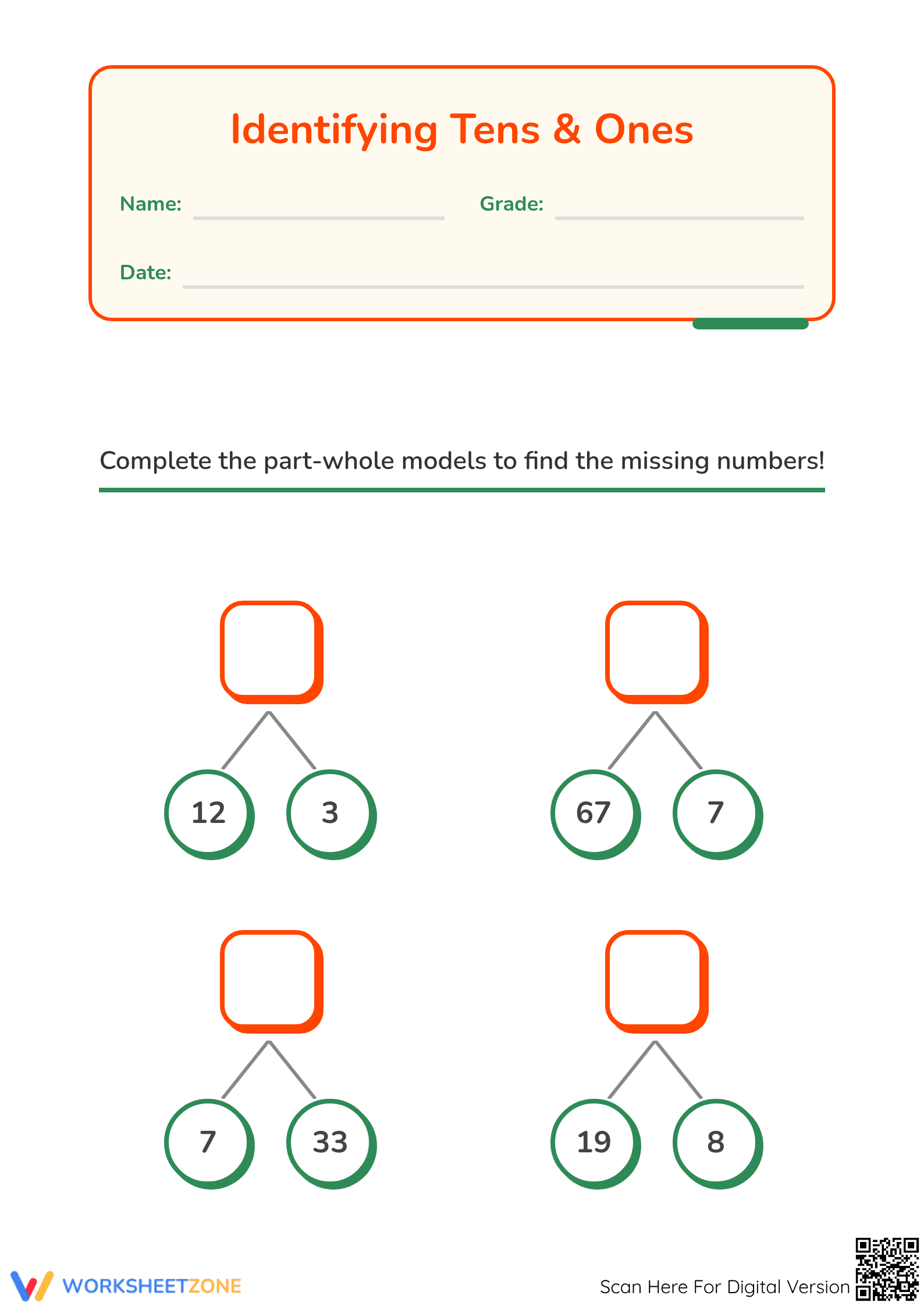
This Identifying Tens and Ones worksheet provides elementary students with targeted practice in decomposing two-digit numbers using the part-whole model. By visualizing how numbers are composed of distinct tens and ones, learners build a concrete foundation for place value mastery and mental addition. This resource ensures students can fluently bridge the gap between abstract numerals and their constituent values.
At a Glance
- Grade: 1–2 · Subject: Math
- Standard:
1.NBT.B.2— Understand that two digits represent amounts of tens and ones- Skill Focus: Place Value Decomposition
- Format: 3 pages · 12 problems · Answer key included · PDF
- Best For: Independent place value practice sessions
- Time: 15–20 minutes
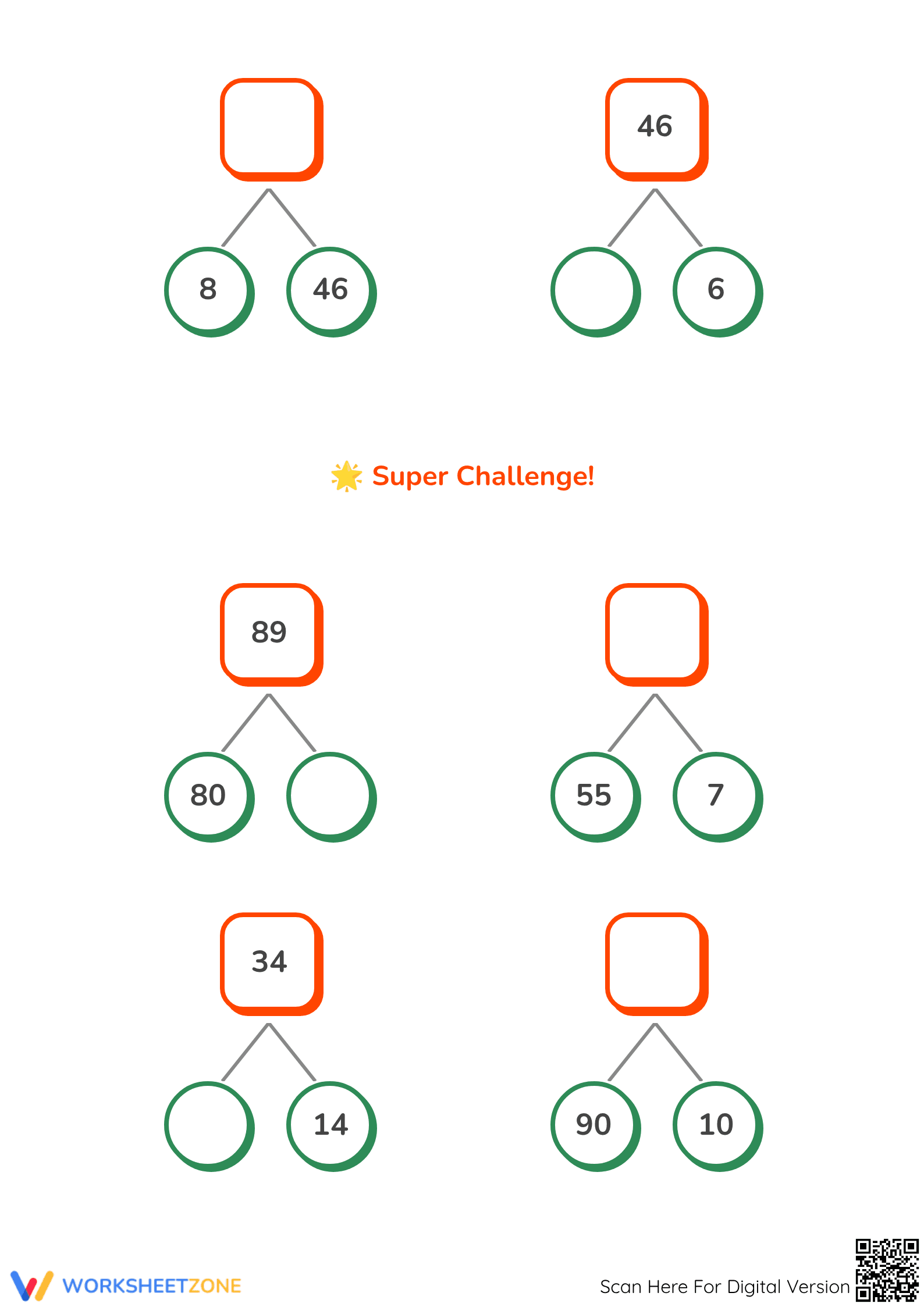
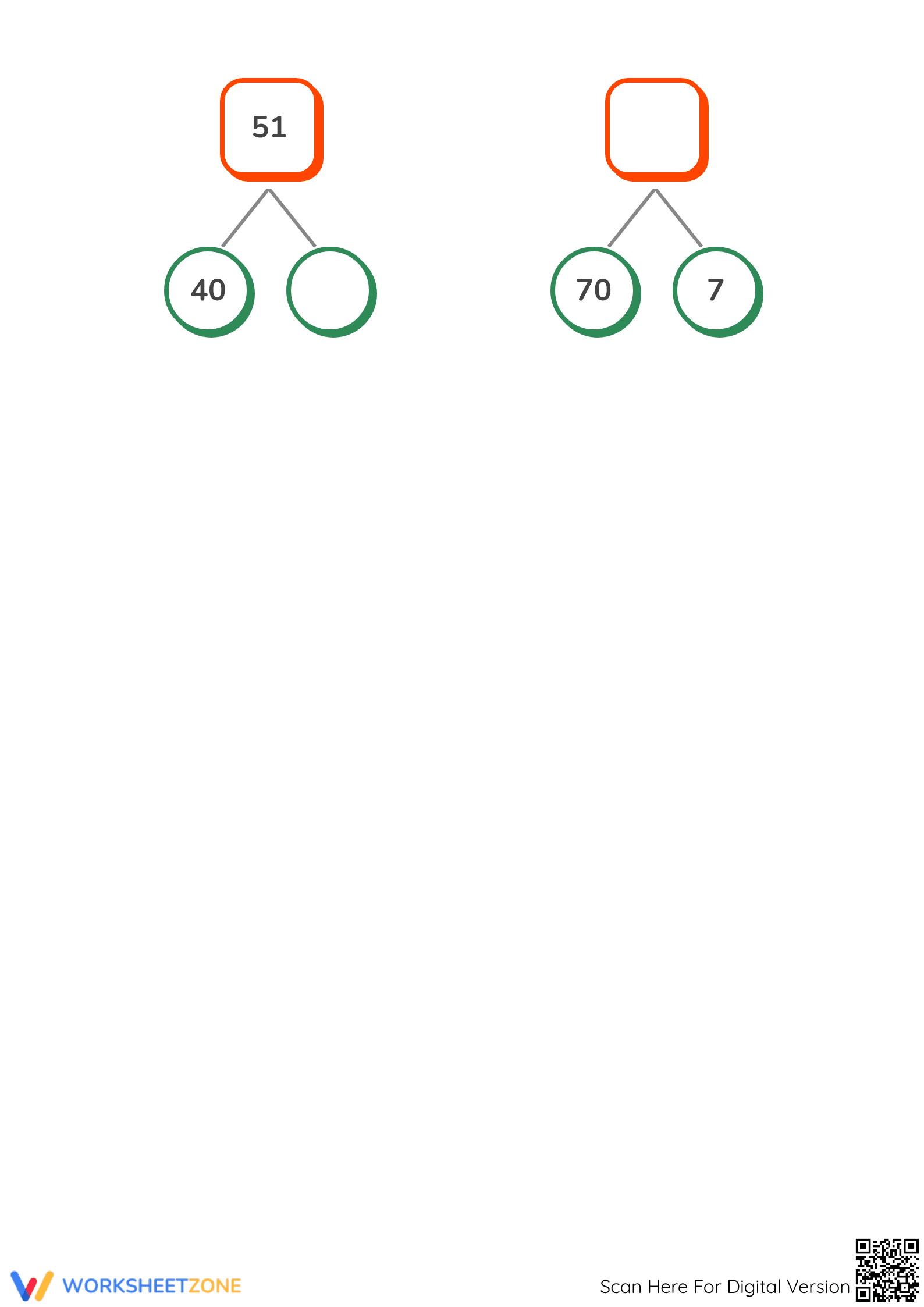
This comprehensive three-page PDF features 12 strategically designed part-whole models that challenge students to identify missing wholes or parts (tens and ones). The worksheet progresses from basic identification to a "Super Challenge" section that requires higher-order thinking. Each page includes a clear workspace and structured graphic organizers to support visual learners. A complete answer key is included for rapid grading or student self-correction.
Implementing this resource is effortless. Step one: Print the PDF (10 seconds). Step two: Distribute for morning work (1 minute). Step three: Review with the answer key (30 seconds). Total prep time is under two minutes, making it ideal for sub plans or intervention. This print-and-go workflow saves valuable instructional time while maintaining high academic rigor in the classroom environment.
The primary focus is 1.NBT.B.2, which requires students to understand that the two digits of a two-digit number represent amounts of tens and ones. This worksheet directly supports the sub-standard 1.NBT.B.2.A, identifying 10 as a bundle of ten ones. Supporting standards include 1.OA.C.6 for additive fluency within 20. Both standard codes can be copied directly into lesson plans, IEP goals, or district curriculum mapping tools.
Use this worksheet as a summative exit ticket after a direct instruction lesson on place value bundles. Ask students to verbalize their thinking for the "Super Challenge" problems to assess their depth of understanding. Alternatively, use page one as a guided practice activity under a document camera before assigning pages two and three for independent work. Completion typically ranges from 15 to 20 minutes depending on student familiarity with the part-whole model.
This resource is tailored for Grade 1 and Grade 2 students who are beginning their journey into base-ten systems. It is particularly effective for students requiring visual scaffolds or those working toward IEP goals involving number decomposition. It pairs naturally with base-ten blocks, ten-frame counters, or a standard place value mat to provide a multi-sensory learning experience during small-group instruction.
Research from the RAND AIRS 2024 report emphasizes that visual schema, such as the part-whole model used in this Identifying Tens and Ones worksheet, significantly improves long-term retention of place value concepts in early elementary learners. By explicitly linking the numeric representation to a structural model, students move beyond rote memorization toward a conceptual grasp of quantity. The 1.NBT.B.2 standard remains a critical 'major cluster' in the Common Core framework, serving as a prerequisite for regrouping in multi-digit addition and subtraction. Providing consistent, low-stakes opportunities for place value decomposition allows educators to identify misconceptions early in the instructional cycle. This evidence-based approach aligns with best practices for mathematical fluency, ensuring that every student develops the numerical literacy required for future success in algebraic thinking and complex computation across the primary curriculum, supporting the transition to more advanced arithmetic operations later.


