


























Views
Downloads

Identifying Tens and Ones Worksheet | Grade 1 Printable
Paste this activity's link or code into your existing LMS (Google Classroom, Canvas, Teams, Schoology, Moodle, etc.).
Students can open and work on the activity right away, with no student login required.
You'll still be able to track student progress and results from your teacher account.
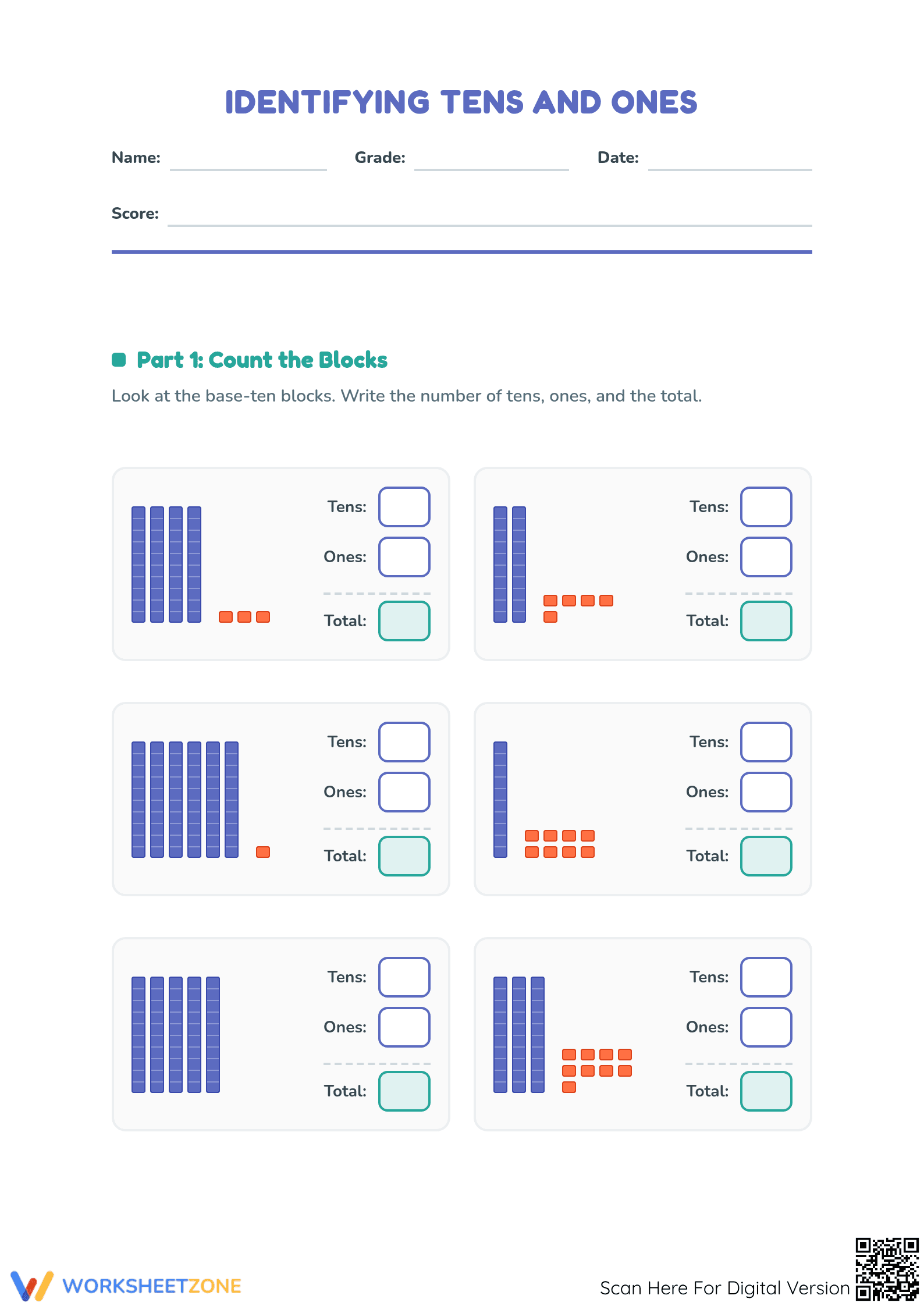
Developing a strong foundation in place value is critical for early mathematical success. This Identifying Tens and Ones worksheet provides structured practice for students to visualize and decompose two-digit numbers. By bridging concrete base-ten block representations with abstract numerical forms, students gain the fluency needed for addition and subtraction regrouping.
At a Glance
- Grade: 1 · Subject: Math
- Standard:
1.NBT.B.2— Understand that the two digits of a two-digit number represent tens and ones- Skill Focus: Place Value & Expanded Form
- Format: 4 pages · 24 problems · Answer key included · PDF
- Best For: Independent practice or formative assessment
- Time: 15–25 minutes
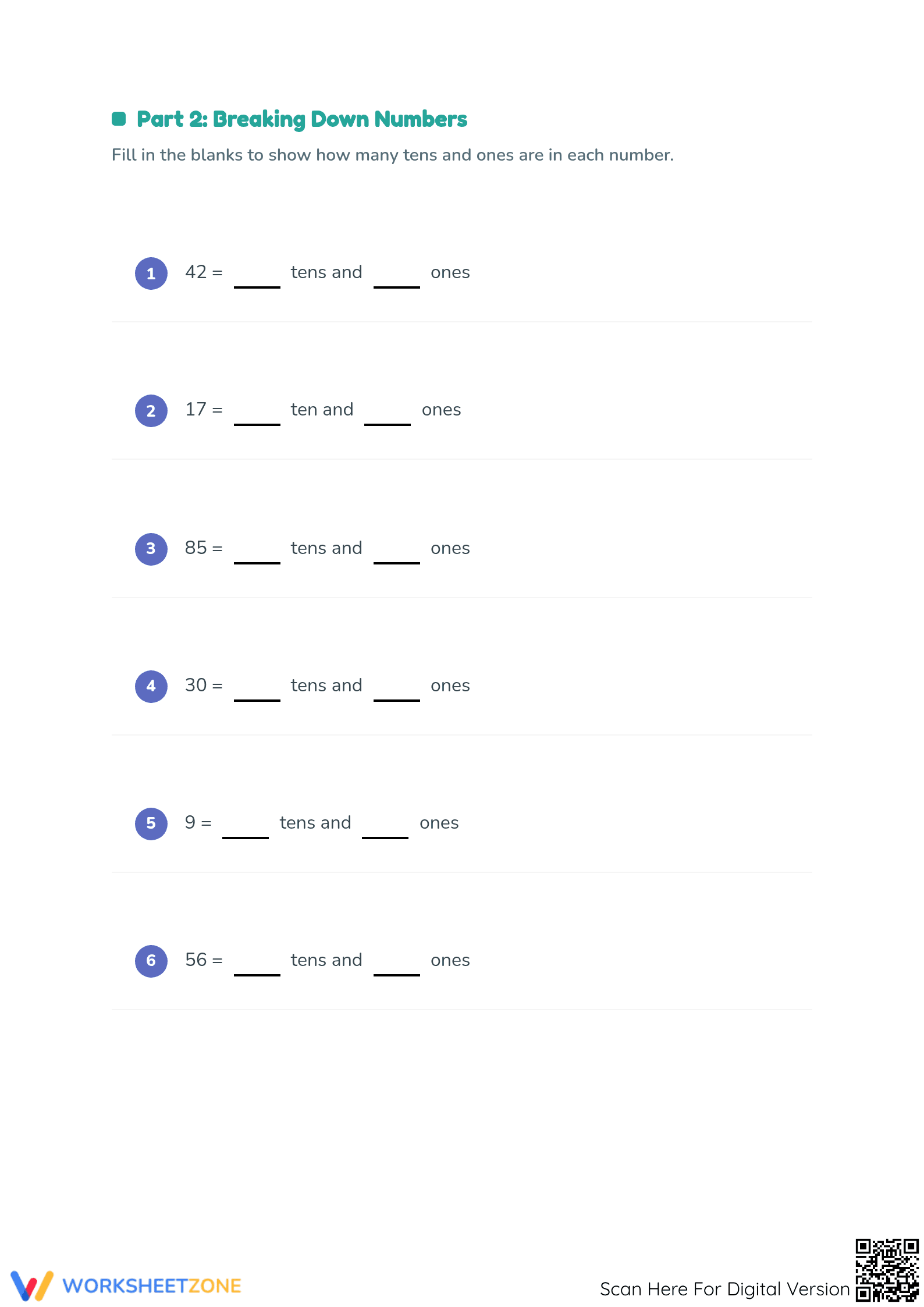
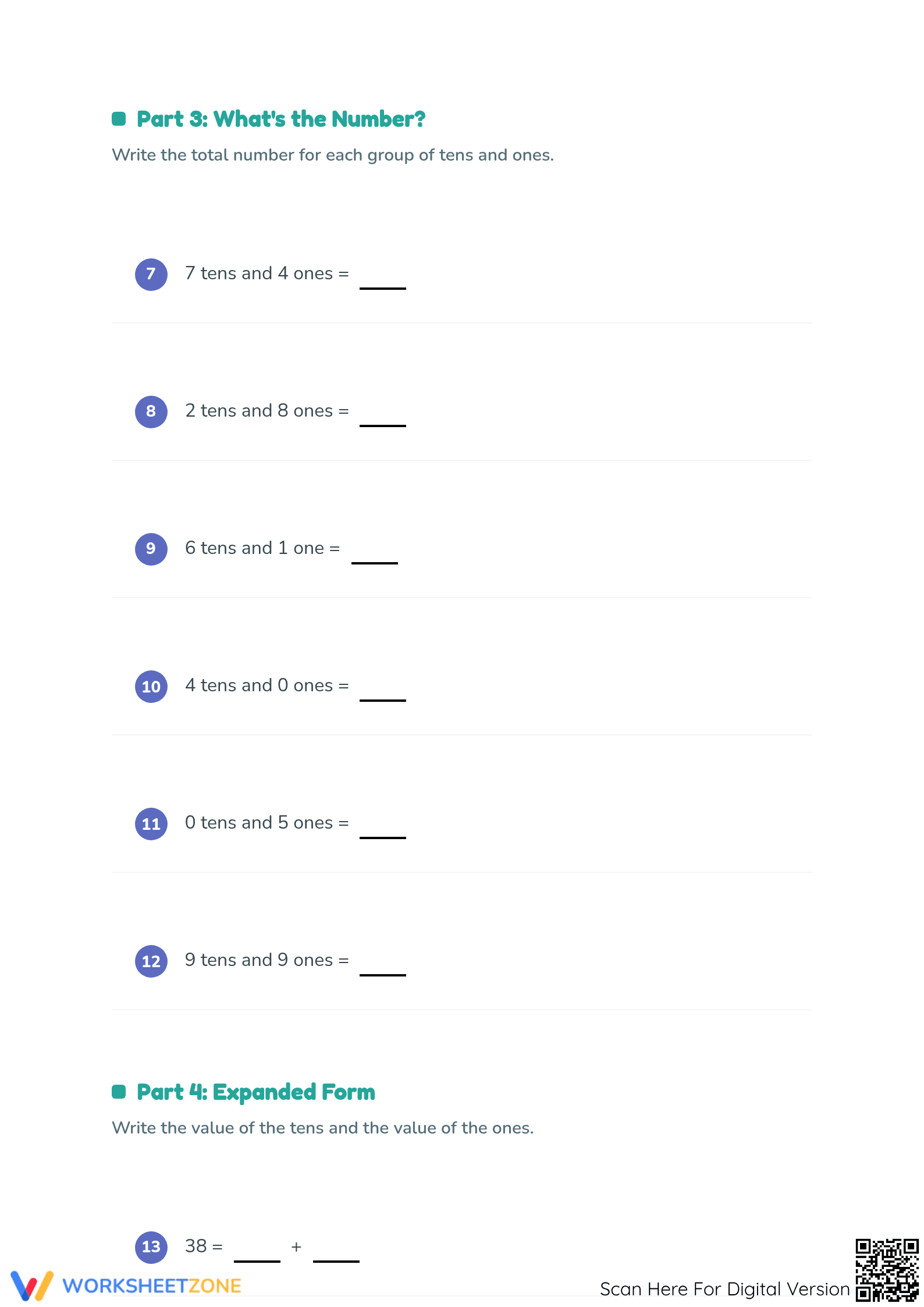
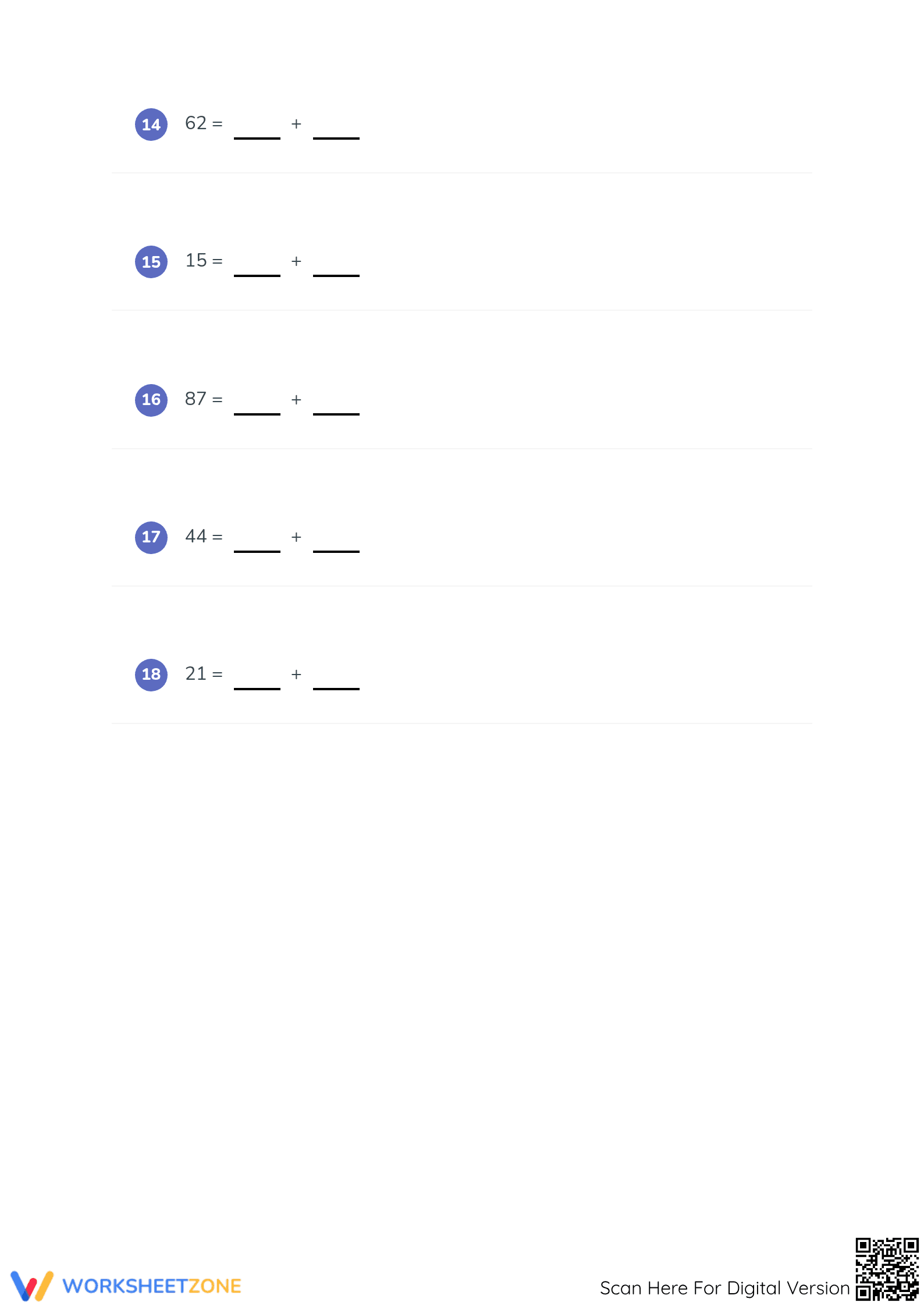
The worksheet package contains four distinct parts across four printable pages. Students interact with visual base-ten block counting, numerical decomposition into place value components, and expanded form equations. A comprehensive answer key is included, allowing for rapid grading or student self-correction. The layout is clean and spacious, providing ample room for young learners to write their responses clearly.
Skill Progression
- Guided Practice: Part 1 uses 6 visual base-ten block sets to help students bridge concrete models to abstract totals with high visual scaffolding.
- Supported Practice: Part 2 features 6 items where students break down digits into their respective values using linguistic frames like "tens and ones."
- Independent Practice: Parts 3 and 4 include 12 problems focused on converting written place values back into standard numbers and writing expanded form equations.
This structured approach follows the gradual-release model, ensuring that visual supports are removed as students demonstrate mastery of the base-ten system.
Standards Alignment
The primary focus of this resource is CCSS.MATH.CONTENT.1.NBT.B.2: Understand that the two digits of a two-digit number represent amounts of tens and ones. Specifically, it addresses the conceptual understanding that a "ten" is a bundle of ten ones. Both standard codes can be copied directly into lesson plans, IEP goals, or district curriculum mapping tools to track student progress effectively.
How to Use It
Incorporate this worksheet during the independent practice phase of a place value lesson. After introducing base-ten blocks with physical manipulatives, use the first page as a transition to paper-and-pencil tasks. For a quick formative check, assign the Part 2 decomposition section and observe if students can differentiate between the value of the digit in the tens place versus the ones place.
Who It's For
This resource is tailored for first-grade students or second-graders needing remedial place value support. It serves as an excellent companion to Part-Part-Whole instruction and direct modeling. The clear formatting supports students with dyscalculia by minimizing visual clutter and providing predictable patterns for problem-solving across all four pages of the set.
Mastering place value in the early grades is a prerequisite for understanding the base-ten number system and multi-digit computation. According to Fisher & Frey (2014), the use of scaffolded practice—moving from concrete visual representations like base-ten blocks to abstract expanded form—is essential for cognitive load management during the acquisition of new mathematical concepts. This worksheet aligns with the 1.NBT.B.2 standard, ensuring that students can reliably identify tens and ones in any two-digit number. Research from the NAEP highlights that students who lack a conceptual grasp of place value by the end of first grade often struggle with regrouping in later arithmetic. By providing 24 targeted tasks that bridge these representations, this resource offers the essential practice needed to solidify foundational place value skills before advancing to more complex operations.


