




























Views
Downloads
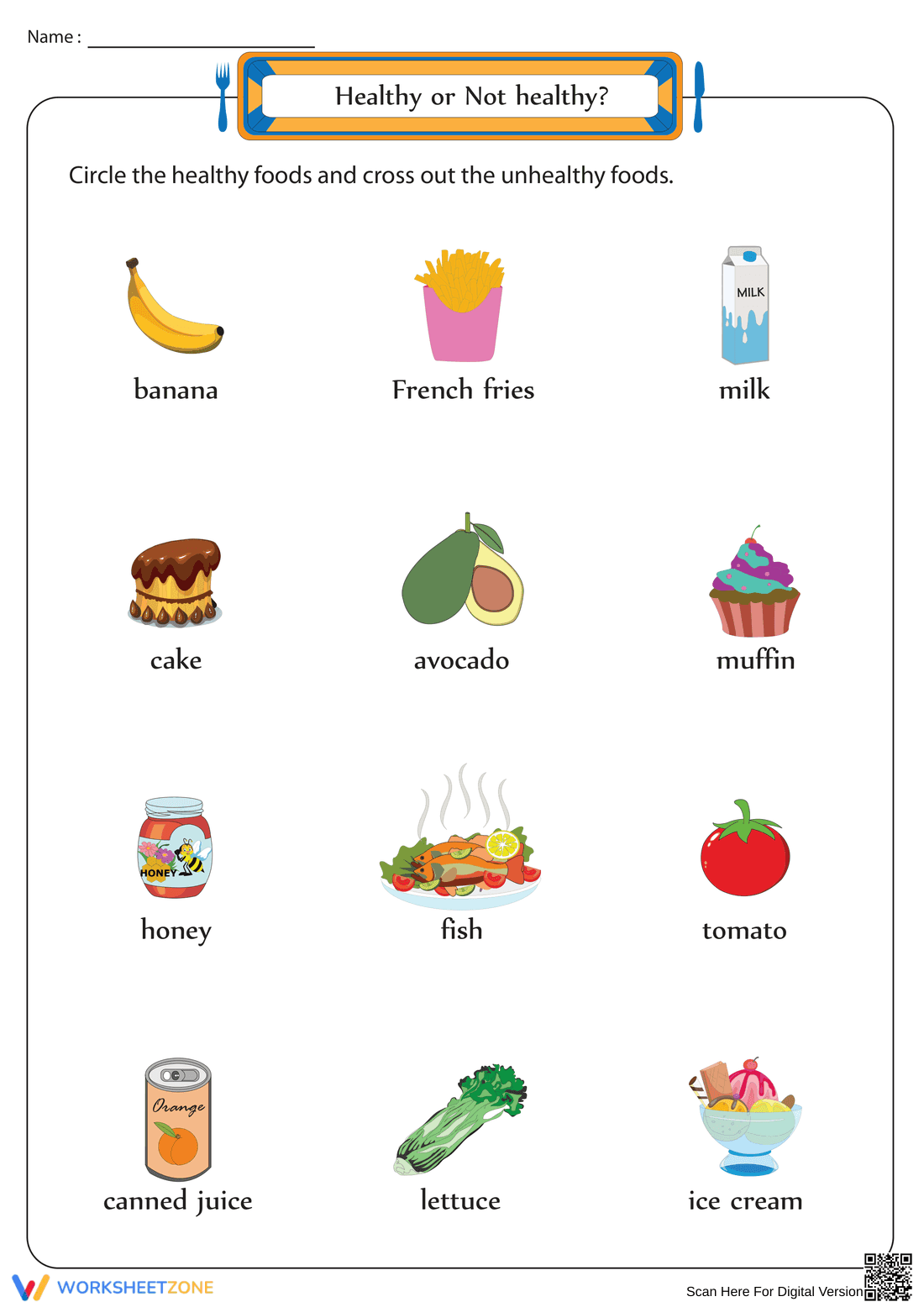

Essential Healthy vs Unhealthy Worksheet | Grade 1 Ready

Paste this activity's link or code into your existing LMS (Google Classroom, Canvas, Teams, Schoology, Moodle, etc.).
Students can open and work on the activity right away, with no student login required.
You'll still be able to track student progress and results from your teacher account.
Teaching young learners to distinguish between nutritious choices and occasional treats is a vital step in developing wellness habits. This worksheet provides a visual exercise for first graders to practice identifying healthy versus unhealthy foods. By categorizing twelve items, students build the vocabulary and discernment necessary to make informed dietary decisions.
At a Glance
- Grade: 1 · Subject: Health & Nutrition
- Standard:
NHES.1.2.1— Students will identify that healthy behaviors, like eating nutritious foods, impact health.- Skill Focus: Nutrition Categorization
- Format: 1 page · 12 problems · Answer key included · PDF
- Best For: Early finishers or a nutrition unit introduction.
- Time: 10–15 minutes
What's Inside
The worksheet features twelve illustrations of various food items, ranging from fresh produce like bananas to processed snacks like muffins. The layout is clean, allowing students to easily circle or cross out items. A comprehensive answer key is provided on the second page for immediate review. Bold labels under each image support early literacy while focusing on the core nutritional objective.
Zero-Prep Workflow
This resource is designed for immediate integration with zero preparation required. First, print the single-page student worksheet (under 30 seconds). Second, distribute materials and provide a brief verbal instruction on the task (under 1 minute). Finally, review the completed work using the included answer key (under 2 minutes). This streamlined process makes it an ideal choice for emergency sub plans or quick formative checks.
Standards Alignment
This activity aligns with NHES.1.2.1, requiring students to identify how healthy behaviors impact personal wellness. It addresses the ability to recognize the nutritional value of fresh versus processed options. It also supports ELA-Literacy.RI.1.7 by requiring students to use illustrations to comprehend concepts. Both standard codes can be copied directly into lesson plans, IEP goals, or district curriculum mapping tools.
How to Use It
Incorporate this worksheet during a health lesson to reinforce instruction about food groups. It serves as a formative assessment to check if students can apply definitions of "healthy" to real-world examples. Teachers should observe students as they work, noting any confusion between food types. Completion typically takes ten to fifteen minutes. It works well as an independent practice activity following a teacher-led discussion.
Who It's For
The resource is tailored for Grade 1 students but also suits Kindergarteners needing an extension or Grade 2 students requiring review. The visual nature supports English Language Learners and students with IEPs by providing pictorial cues alongside labels. It pairs naturally with a classroom nutrition chart or a direct instruction lesson on healthy eating, creating a cohesive experience for young learners.
Nutrition education in early childhood is critical for establishing patterns that support lifelong health. Research from RAND AIRS 2024 indicates that visual categorization tasks are highly effective for first-grade students as they align with concrete operational thinking. This worksheet focuses on the NHES.1.2.1 standard, requiring students to identify nutritious foods through a simple circle-and-cross methodology. Fisher & Frey (2014) emphasize that such scaffolds allow students to build domain-specific vocabulary while practicing independent application of health concepts. This zero-prep tool ensures that teachers can provide high-quality instruction without an extensive time commitment. The inclusion of a comprehensive answer key further supports the instructional cycle of feedback and mastery, making it a reliable asset for any primary health or science curriculum. By engaging with twelve distinct items, learners practice discernment in a low-stakes, printable format.


