


























Views
Downloads


Identifying Adjectives Worksheet | Grade 1 Essential
Paste this activity's link or code into your existing LMS (Google Classroom, Canvas, Teams, Schoology, Moodle, etc.).
Students can open and work on the activity right away, with no student login required.
You'll still be able to track student progress and results from your teacher account.
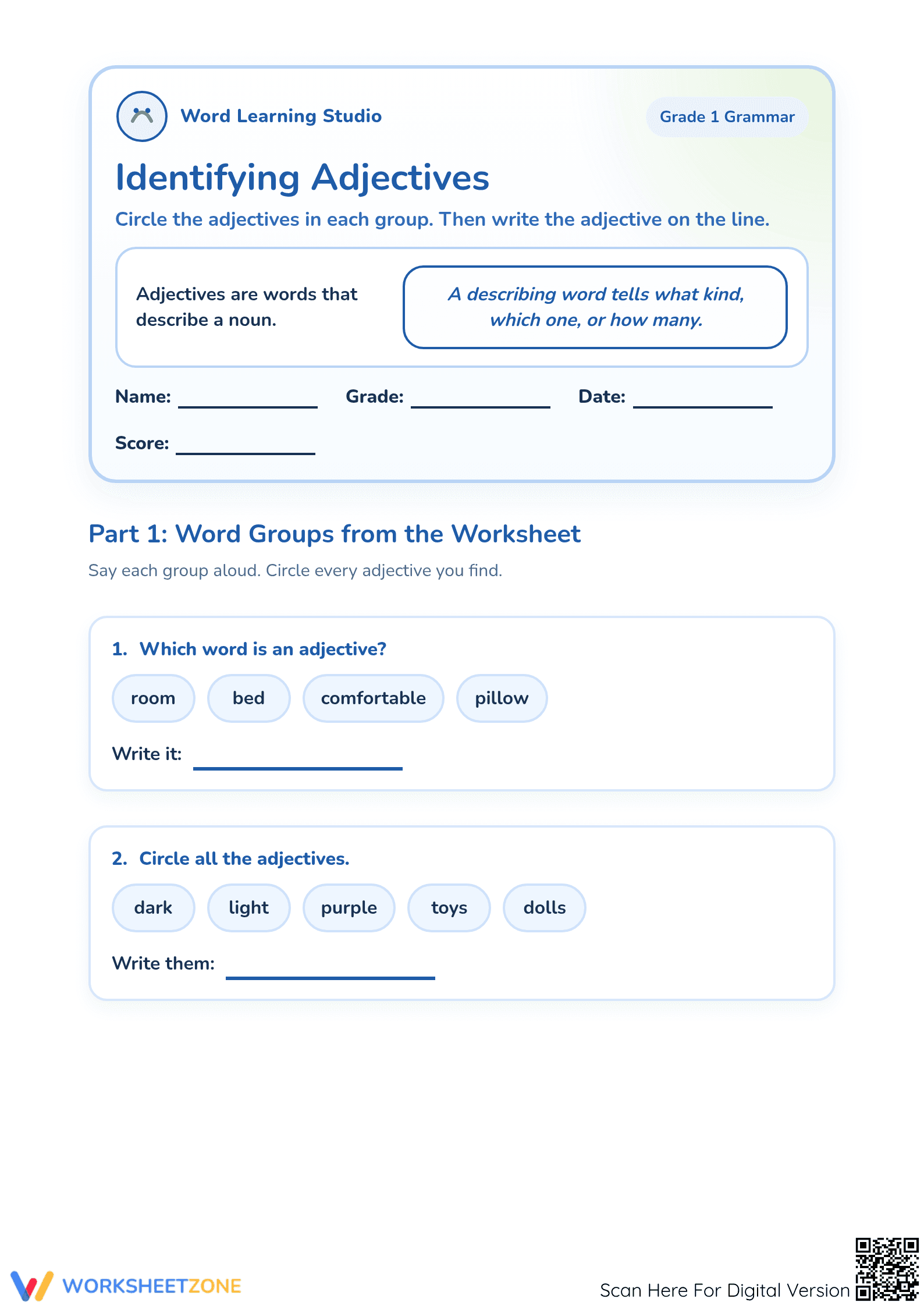
This Grade 1 grammar worksheet provides targeted practice for identifying adjectives within word groups. Students learn to recognize describing words that tell what kind, which one, or how many. By isolating adjectives from nouns and verbs, learners build the foundational vocabulary skills necessary for descriptive writing and reading comprehension.
At a Glance
- Grade: 1 · Subject: ELA
- Standard:
CCSS.ELA-LITERACY.L.1.1.F— Use frequently occurring adjectives to describe nouns and express ideas clearly- Skill Focus: Identifying Adjectives
- Format: 3 pages · 10 problems · Answer key included · PDF
- Best For: Independent practice or grammar centers
- Time: 15–20 minutes
The resource contains 3 pages featuring 10 distinct word-group tasks. Each task presents a cluster of words where students must circle the adjectives and then write them on a provided line. The layout includes a helpful definition box at the top of the first page to remind students that adjectives describe nouns. A full answer key is provided for quick grading and immediate feedback.
This resource is designed for a zero-prep classroom experience. First, print the three-page PDF (30 seconds). Next, distribute the sheets to students for independent work or as a guided grammar activity (1 minute). Finally, use the included answer key to review responses or allow students to self-correct their work (1 minute). Total teacher preparation time is under 3 minutes, making it an ideal choice for sub plans or morning work.
The primary focus is CCSS.ELA-LITERACY.L.1.1.F, which requires students to use frequently occurring adjectives. By identifying these words in isolation, students prepare to integrate them into their own sentences. This worksheet also supports vocabulary acquisition by helping students distinguish between different word classes. Both standard codes can be copied directly into lesson plans, IEP goals, or district curriculum mapping tools.
Use this worksheet during the independent practice phase of a lesson on parts of speech. It serves as an excellent formative assessment to check if students can distinguish between objects (nouns) and their qualities (adjectives). For a quick extension, ask students to use one of the identified adjectives in a verbal sentence about an object in the classroom to reinforce the concept of modification.
This resource is ideal for first-grade students or second-grade learners needing a review of basic word classes. It is particularly helpful for English Language Learners (ELLs) who are building their descriptive vocabulary. Pair this with a colorful picture book to have students find adjectives that describe the illustrations, creating a bridge between isolated word practice and authentic text engagement.
Research by Fisher & Frey (2014) emphasizes the importance of word-level mastery before students can successfully engage in complex sentence construction. This worksheet addresses that need by providing 10 focused opportunities to isolate adjectives from other lexical categories. By identifying frequently occurring adjectives as outlined in CCSS.ELA-LITERACY.L.1.1.F, students develop the linguistic building blocks required for more sophisticated literacy tasks. The structured format of circling and writing the words reinforces the connection between recognition and production. According to recent NAEP data, early intervention in grammar and vocabulary is a significant predictor of long-term reading proficiency. This 3-page resource offers the high-repetition practice necessary for first-grade students to internalize the function of describing words. It provides a clear, distraction-free environment that supports cognitive load management for young learners during independent practice sessions.


