


























Views
Plays
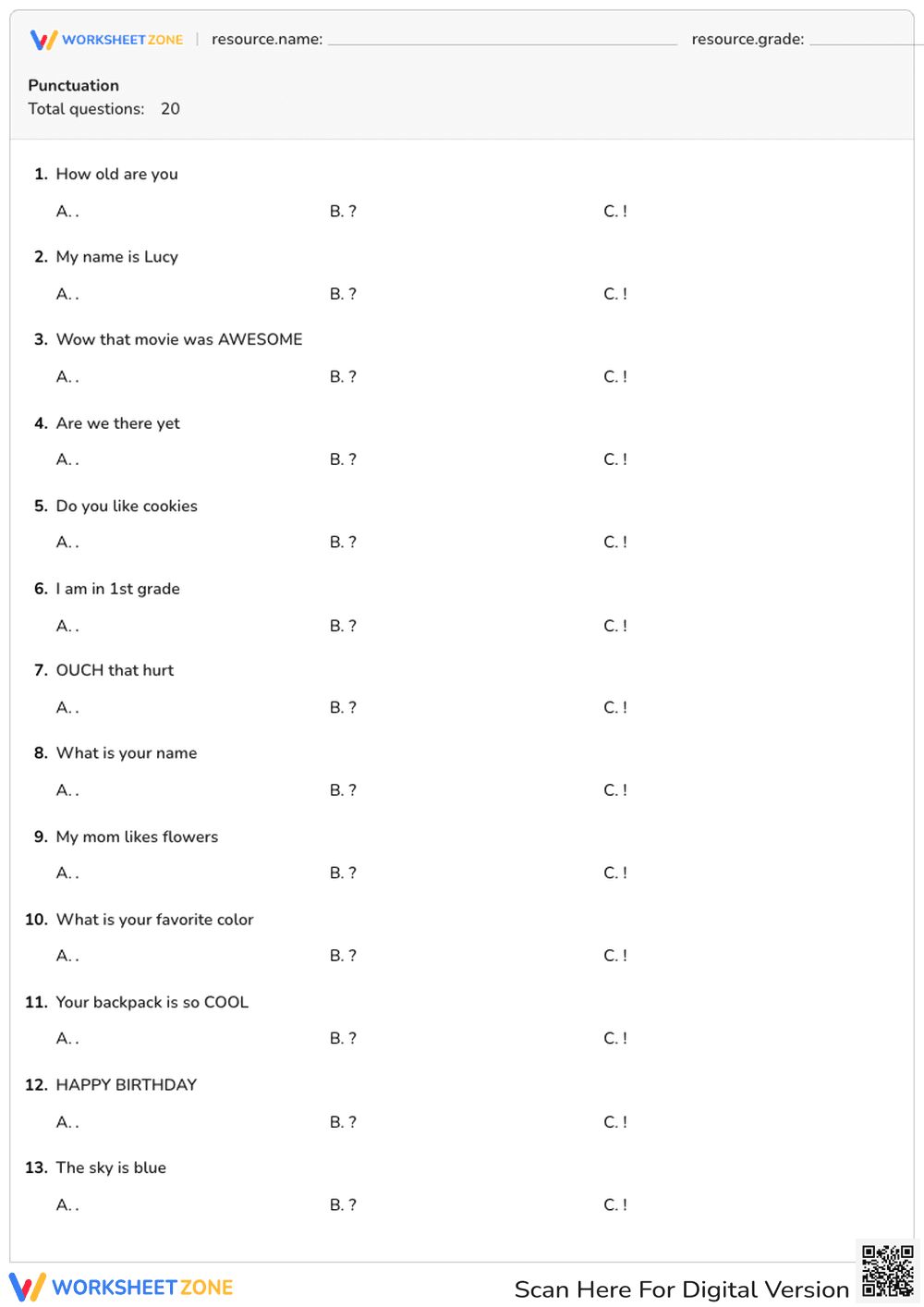


Ending Punctuation Practice | Grade 1-2 Printable
Paste this activity's link or code into your existing LMS (Google Classroom, Canvas, Teams, Schoology, Moodle, etc.).
Students can open and work on the activity right away, with no student login required.
You'll still be able to track student progress and results from your teacher account.
This Grade 1 and 2 grammar worksheet provides essential practice for identifying correct ending punctuation. Students analyze 20 unique sentences to determine if a period, question mark, or exclamation point is required. By focusing on sentence function and tone, learners develop the foundational mechanics necessary for clear written communication and reading fluency.
At a Glance
- Grade: 1-2 · Subject: ELA Grammar
- Standard:
CCSS.ELA-LITERACY.L.1.2.B— Use end punctuation for sentences to indicate statements, questions, or emotions- Skill Focus: Ending Punctuation Identification
- Format: 2 pages · 20 problems · Answer key included · PDF
- Best For: Independent practice or quick formative assessment
- Time: 10–15 minutes
What's Inside
Inside this resource, you will find two pages containing 20 multiple-choice questions. Each item presents a complete sentence missing its terminal mark, followed by three clear options: a period, a question mark, and an exclamation point. The layout is clean and distraction-free, featuring large text suitable for early elementary readers. A comprehensive answer key is provided for rapid grading.
Zero-Prep Workflow
- Print: Select the two-page PDF and print enough copies for your class (30 seconds).
- Distribute: Hand out the sheets for students to complete during a literacy block or as morning work (10-15 minutes).
- Review: Use the included answer key for individual grading or review as a whole group to discuss sentence intent (2 minutes).
Standards Alignment
This worksheet is directly aligned with `CCSS.ELA-LITERACY.L.1.2.B`, which requires students to use end punctuation for sentences. It also supports `CCSS.ELA-LITERACY.L.2.2`, focusing on capitalization and punctuation consistency. Both standard codes can be copied directly into lesson plans, IEP goals, or district curriculum mapping tools.
How to Use It
Use this worksheet as an exit ticket after a direct instruction lesson on sentence types (declarative, interrogative, and exclamatory). Alternatively, assign it as a center activity where students read the sentences aloud to a partner to hear the inflection before choosing the mark. Expect completion within 15 minutes. Observe if students struggle specifically with the excited tone of exclamation points.
Who It's For
This resource is designed for first and second-grade students, as well as English Language Learners (ELL) who need targeted mechanics support. It pairs naturally with a mentor text or an anchor chart displaying the three main punctuation marks and their specific functions in writing.
Effective punctuation instruction in early childhood is a critical predictor of later writing proficiency and reading comprehension. According to Fisher & Frey (2014), the gradual release of responsibility model benefits from structured, discrete skill practice like identifying terminal marks. This worksheet targets CCSS.ELA-LITERACY.L.1.2.B, ensuring students can distinguish between statements, questions, and exclamations. Research from EdReports (2024) emphasizes that high-quality instructional materials must provide explicit opportunities for students to apply grammar conventions in isolated contexts before moving to generative writing. By engaging with 20 specific instances of ending punctuation, students build the cognitive muscle memory required for automaticity. This resource serves as a reliable tool for teachers seeking to bridge the gap between phonics and formal composition. It provides measurable data on student mastery of basic sentence boundaries, a fundamental requirement for meeting national literacy benchmarks in the primary grades.


