


























Views
Downloads

Patterns of the Sun Worksheet | Grade 1 Essential Science
Paste this activity's link or code into your existing LMS (Google Classroom, Canvas, Teams, Schoology, Moodle, etc.).
Students can open and work on the activity right away, with no student login required.
You'll still be able to track student progress and results from your teacher account.
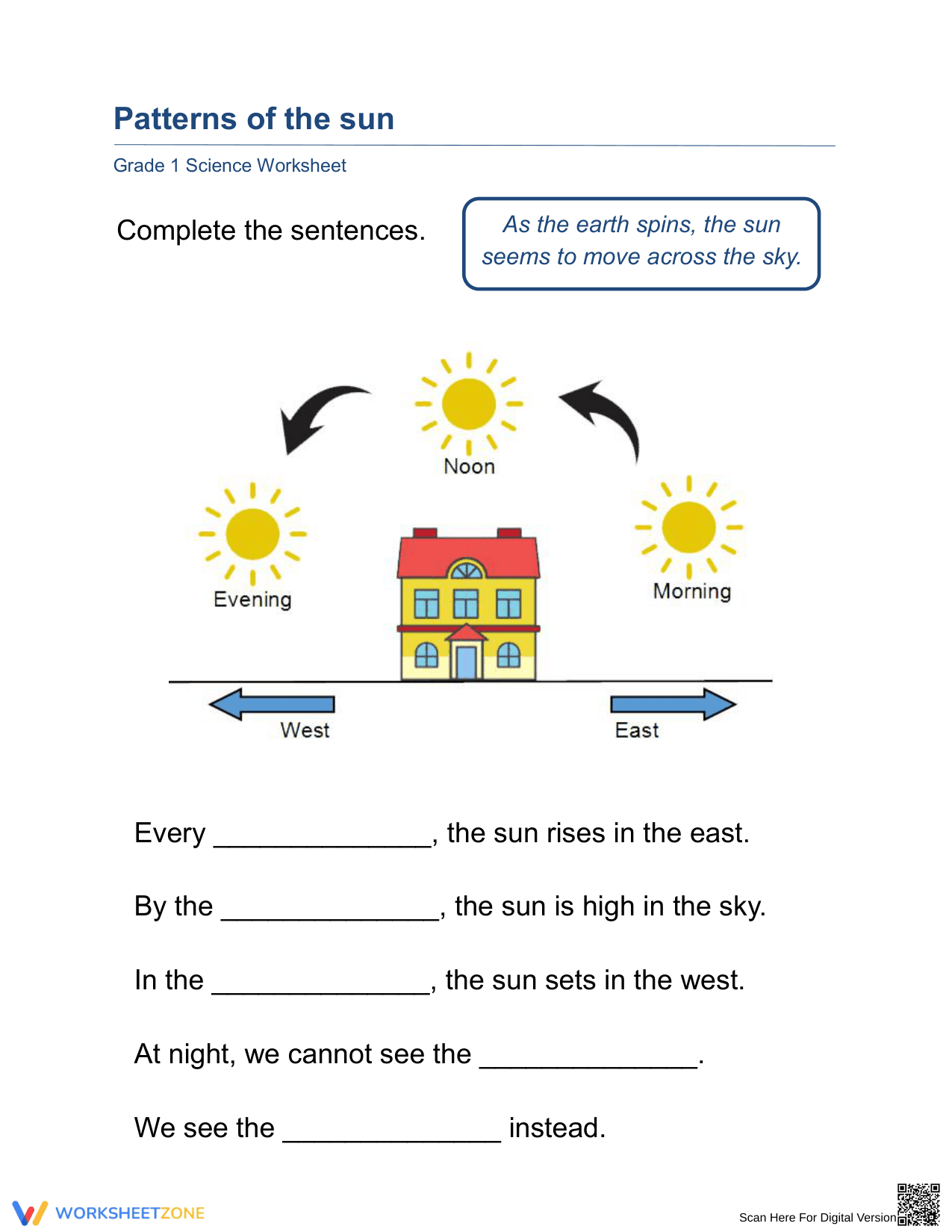
This patterns of the sun worksheet helps first-grade students observe and describe the predictable movement of the sun throughout the day. By completing structured sentences, learners demonstrate their understanding of solar positions from morning to evening. This resource ensures students grasp the fundamental relationship between the earth's rotation and the sun's apparent path across the sky.
At a Glance
- Grade: 1 · Subject: Science
- Standard:
1-ESS1-1— Use observations of the sun to describe patterns that can be predicted- Skill Focus: Daily solar patterns and positions
- Format: 2 pages · 5 problems · Answer key included · PDF
- Best For: Introduction to Earth and Space Science
- Time: 10–15 minutes
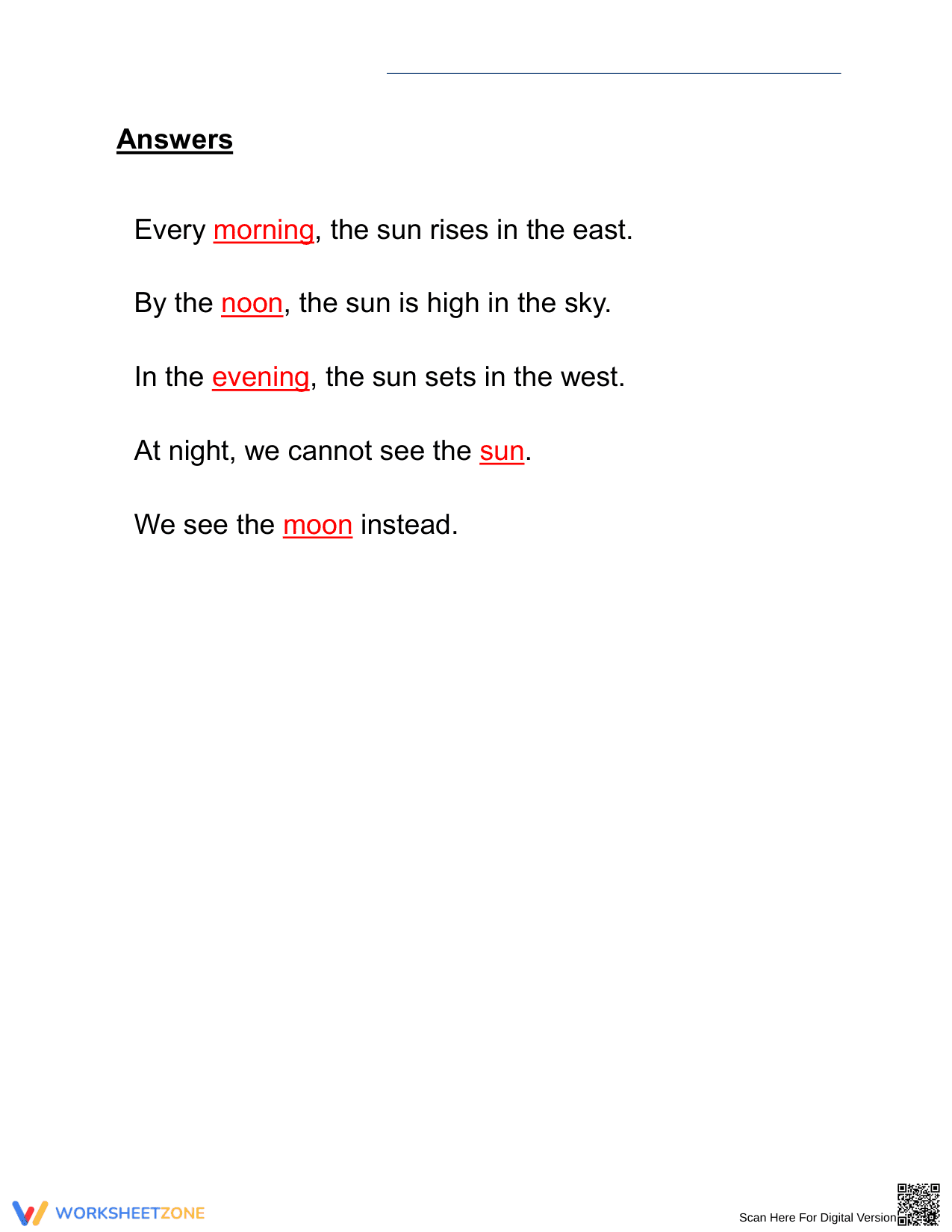
Inside this resource, find a worksheet with a visual sun arc diagram. It includes five fill-in-the-blank sentences targeting morning, noon, and evening vocabulary. A complete answer key is on the second page for quick grading and immediate feedback.
The zero-prep workflow is efficient. Print the page in 30 seconds and distribute it. Since instructions are self-explanatory, students start with zero setup. Reviewing answers together takes 5 minutes, making it ideal for sub plans or quick science blocks.
This resource aligns to 1-ESS1-1. The standard requires students to use observations to describe predictable patterns. Focusing on solar rise and set builds foundations for rotation concepts. Standard codes can be copied directly into lesson plans, IEP goals, or district mapping tools.
Assign this during the elaborate phase of a science lesson. Ask students to point to the sun as a formative assessment before starting. Completion takes 12 minutes. It bridges outdoor observations and classroom literacy by translating experiences into formal sentence structures.
This is for Grade 1, Kindergarten enrichment, or Grade 2 review. It supports learners via visual cues and sentence frames. Pair this with a globe and flashlight demonstration to represent the sun's motion or a compass anchor chart.
According to research from Fisher & Frey (2014) on the gradual release of responsibility, scaffolded tasks like these sentence frames are essential for developing scientific academic language in early elementary students. The 1-ESS1-1 standard emphasizes the importance of observational patterns as a precursor to complex celestial mechanics. By identifying the sun's rise and set, students internalize the concept of predictable natural cycles, a key component of the NAEP science framework for primary grades. This worksheet provides 5 targeted points of data to assess whether a student can successfully identify these solar transitions. Structured practice in Earth science significantly improves long-term retention of spatial concepts compared to passive reading alone. Educators can use these results to determine if students are ready to progress to lunar phases or if further direct instruction on day and night is required. This summary reflects evidence-based instructional design for early childhood science literacy.


