


























Views
Downloads

Essential Parts of Speech Practice | Grade 3 Printable
Paste this activity's link or code into your existing LMS (Google Classroom, Canvas, Teams, Schoology, Moodle, etc.).
Students can open and work on the activity right away, with no student login required.
You'll still be able to track student progress and results from your teacher account.
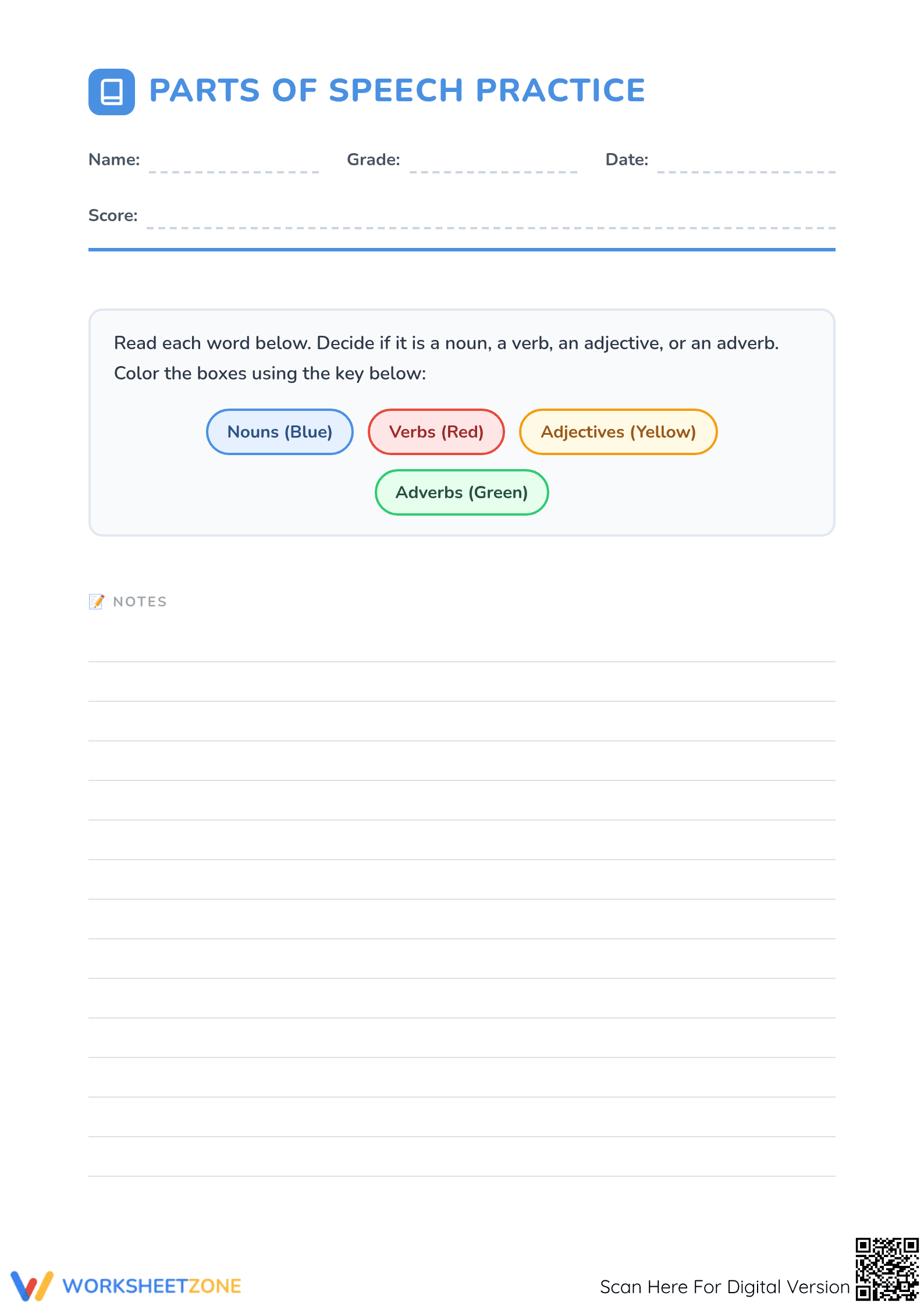
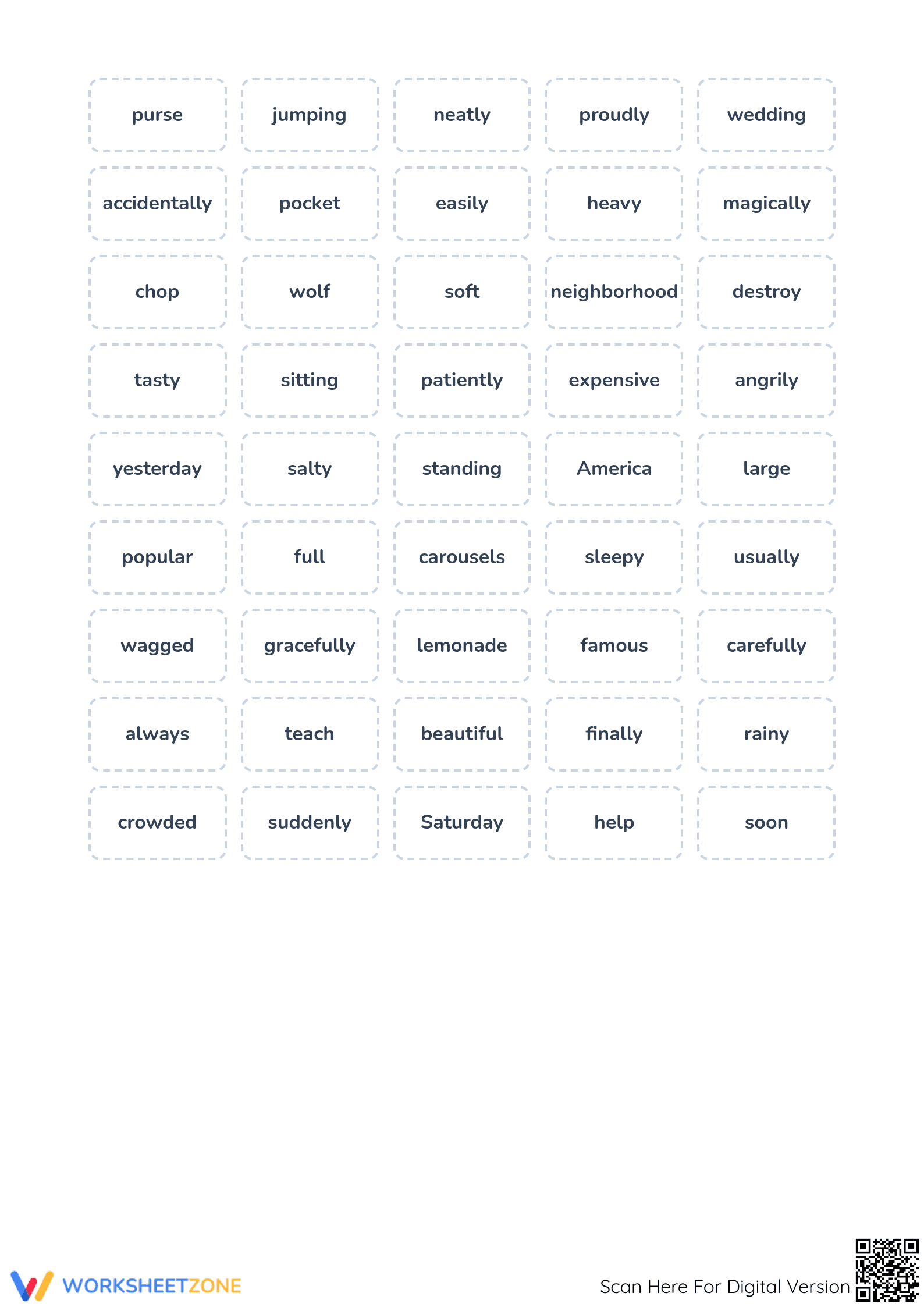
This comprehensive parts of speech worksheet provides a rigorous review of lexical categories, requiring students to distinguish between nouns, verbs, adjectives, and adverbs. By applying a color-coded system to 45 distinct words, learners develop the visual discrimination skills necessary for advanced sentence construction and grammatical mastery. Students will categorize words like 'gracefully,' 'lemonade,' and 'suddenly' to demonstrate their understanding.
At a Glance
- Grade: 3 · Subject: English Language Arts
- Standard:
CCSS.ELA-LITERACY.L.3.1.A— Explain the functions of nouns, verbs, adjectives, and adverbs in general- Skill Focus: Lexical classification and parts of speech identification
- Format: 2 pages · 45 problems · Answer key included · PDF
- Best For: Independent practice and formative assessment
- Time: 20–30 minutes
What's Inside: This 2-page PDF resource is designed for clarity and ease of use. The first page features a clear color-coding key (Blue for Nouns, Red for Verbs, Yellow for Adjectives, and Green for Adverbs) alongside a dedicated notes section for student observations. The second page contains a grid of 45 high-frequency and academic vocabulary words. A full answer key is provided to facilitate rapid grading.
Zero-Prep Workflow: This resource is designed to minimize teacher workload while maximizing student engagement. First, print the two-page document (30 seconds). Second, distribute the sheets and ensure students have the four required crayon or highlighter colors (1 minute). Third, review the completed color-coded grid using the provided answer key to identify common misconceptions in adverb or adjective identification (5 minutes). This layout is ideal for emergency sub plans or quiet morning work.
Standards Alignment: This activity is directly aligned with `CCSS.ELA-LITERACY.L.3.1.A`, which requires students to explain the function of nouns, pronouns, verbs, adjectives, and adverbs in general and their functions in particular sentences. While this worksheet focuses on isolated word classification, it serves as the prerequisite step for functional sentence analysis. This standard code can be copied directly into lesson plans, IEP goals, or district curriculum mapping tools.
How to Use It: Assign this worksheet during the 'You Do' phase of a gradual release lesson on word classes. It serves as an excellent formative assessment tool to see if students can distinguish between adverbs ending in '-ly' and adjectives. Expected completion time is 25 minutes. For a quick check, have students swap papers and use the answer key for peer-review, allowing them to justify why 'magically' is an adverb while 'heavy' is an adjective.
Who It's For: This resource is optimized for 3rd-grade students but is highly effective for 2nd-grade enrichment or 4th-grade remediation. It is particularly useful for English Language Learners (ELLs) who benefit from the visual association of colors with grammatical functions. Pair this with a parts-of-speech anchor chart to provide additional scaffolding for struggling readers.
According to research by Fisher & Frey (2014) on the gradual release of responsibility, structured independent practice is vital for moving students toward mastery of complex linguistic rules. This worksheet facilitates that transition by providing 45 specific opportunities for students to apply their knowledge of CCSS.ELA-LITERACY.L.3.1.A. By categorizing nouns, verbs, adjectives, and adverbs in a non-threatening, color-coded format, students build the cognitive stamina required for more complex syntactic tasks. The inclusion of various word endings and lexical types ensures that the practice is not merely repetitive but requires active evaluation of each word's function. This systematic approach to grammar instruction is supported by the NAEP framework, which emphasizes the importance of understanding how language conventions function within the English language. Teachers can use the resulting data to target specific interventions for students who struggle with particular word classes, ensuring that foundational literacy gaps are addressed before moving to complex writing assignments.


