




























0
Views
0
Downloads

0.0
0
Save
0 Likes
Share
Ice Thermodynamics
0 Views
0 Downloads

Paste this activity's link or code into your existing LMS (Google Classroom, Canvas, Teams, Schoology, Moodle, etc.).
Students can open and work on the activity right away, with no student login required.
You'll still be able to track student progress and results from your teacher account.
Information
Description
What It Is:
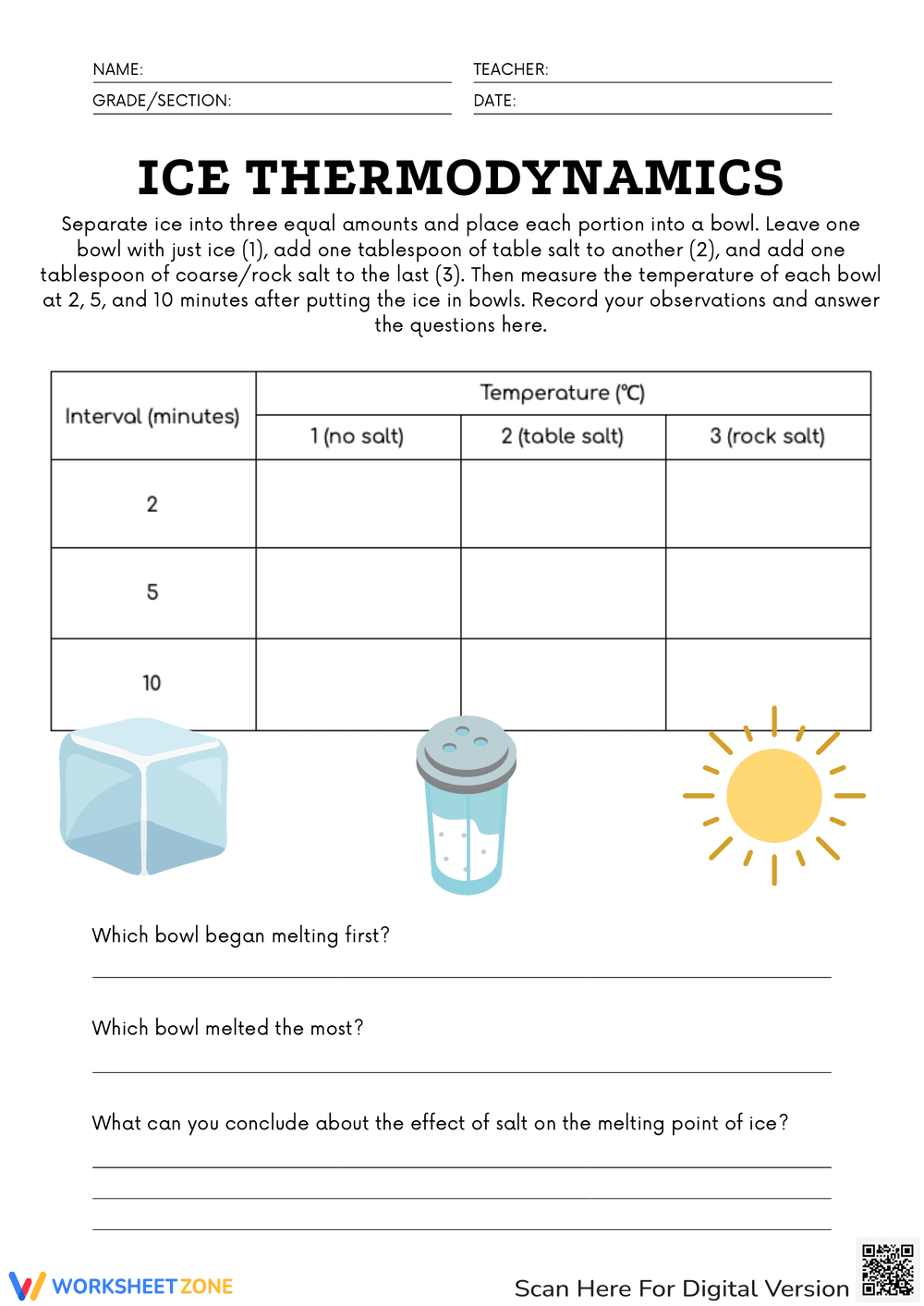
This ice thermodynamics worksheet guides students through a simple experiment to observe how salt affects the melting rate of ice. Learners divide ice into three bowls—one with no salt, one with table salt, and one with rock salt—then record temperature changes at 2, 5, and 10 minutes. The activity includes a data table and follow-up questions to help students analyze results.
Why Use It:
This hands-on investigation helps students understand heat transfer, melting point depression, and the real-world chemistry behind why salt is used on icy roads. It encourages observation, data recording, and scientific reasoning, making thermodynamics more accessible and engaging.
How to Use It:
• Use as a lab activity during lessons on heat, phase changes, or thermodynamics.
• Assign individually or in small groups for collaborative experimentation.
• Have students compare temperature data and discuss why different salts produce different melting rates.
• Perfect for reinforcing cause-and-effect thinking in physical science units.
Grade Suitability:
Best for Grades 8–10, especially in physical science or introductory chemistry.
Target Users:
Teachers, science students, and homeschool educators exploring heat transfer and phase changes.
This ice thermodynamics worksheet guides students through a simple experiment to observe how salt affects the melting rate of ice. Learners divide ice into three bowls—one with no salt, one with table salt, and one with rock salt—then record temperature changes at 2, 5, and 10 minutes. The activity includes a data table and follow-up questions to help students analyze results.
Why Use It:
This hands-on investigation helps students understand heat transfer, melting point depression, and the real-world chemistry behind why salt is used on icy roads. It encourages observation, data recording, and scientific reasoning, making thermodynamics more accessible and engaging.
How to Use It:
• Use as a lab activity during lessons on heat, phase changes, or thermodynamics.
• Assign individually or in small groups for collaborative experimentation.
• Have students compare temperature data and discuss why different salts produce different melting rates.
• Perfect for reinforcing cause-and-effect thinking in physical science units.
Grade Suitability:
Best for Grades 8–10, especially in physical science or introductory chemistry.
Target Users:
Teachers, science students, and homeschool educators exploring heat transfer and phase changes.


