


























Views
Downloads


Printable Hundreds Chart Addition: Adding 10 and 1 Worksheet
Paste this activity's link or code into your existing LMS (Google Classroom, Canvas, Teams, Schoology, Moodle, etc.).
Students can open and work on the activity right away, with no student login required.
You'll still be able to track student progress and results from your teacher account.
Master mental addition and number patterns with this hundreds chart activity. Students learn to navigate the 100s grid by identifying +1 and +10 relationships through shaded patterns and puzzle-solving tasks. This Grade 2 resource builds a strong conceptual foundation for place value and multi-digit addition without the need for complex calculations.
At a Glance
- Grade: 2 · Subject: Math
- Standard:
2.NBT.B.8— Mentally add 10 to a given number from 100–900- Skill Focus: Hundreds Chart Patterns
- Format: 2 pages · 25 problems · Answer key included · PDF
- Best For: Independent practice and morning work
- Time: 15–20 minutes
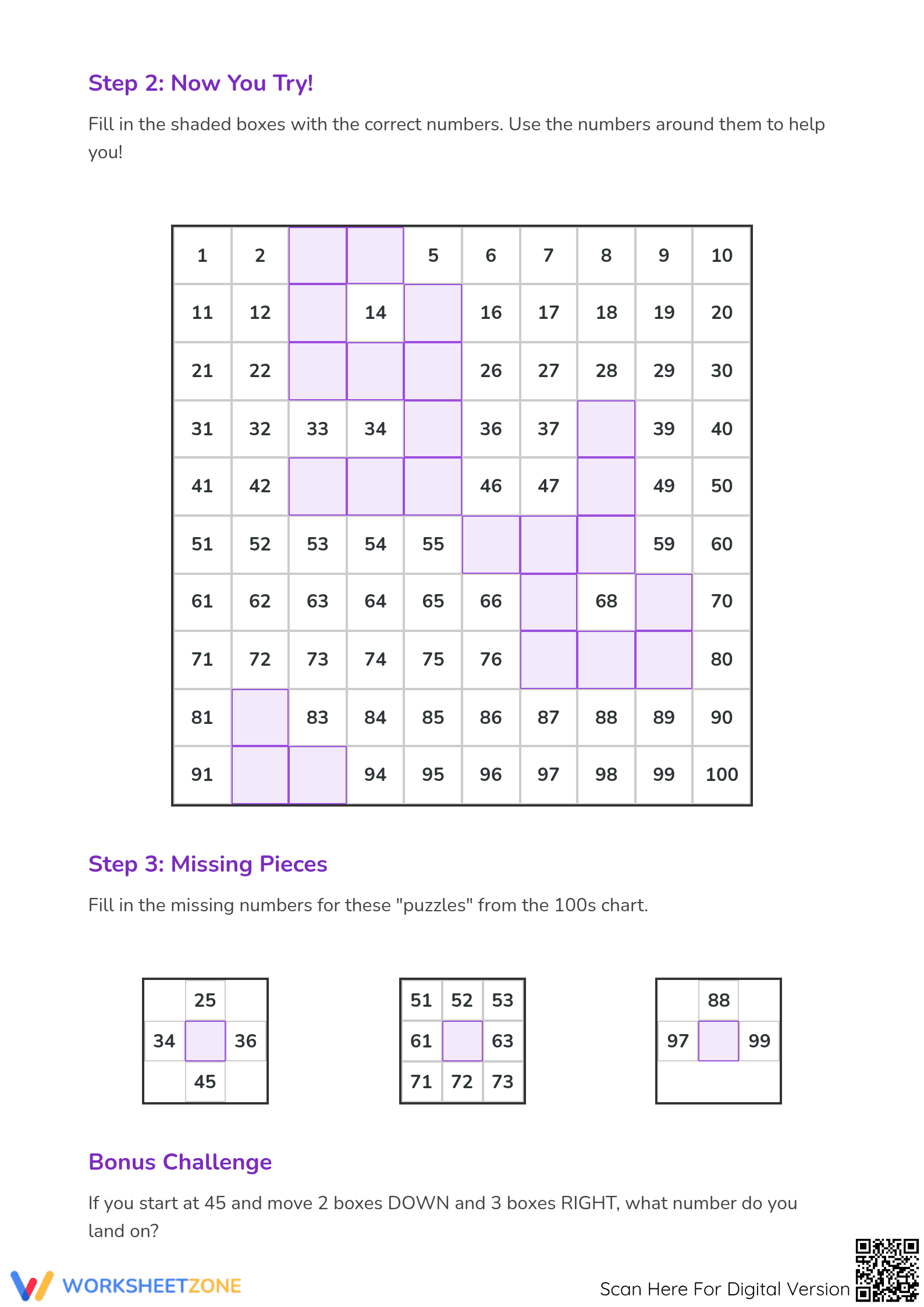
This 2-page PDF explores the hundreds chart. Page 1 introduces the visual pattern of adding 1 and 10. Page 2 challenges students to fill in missing numbers and solve "puzzle pieces"—mini grids requiring directional patterns. A bonus challenge asks students to navigate the chart using coordinate-style instructions.
The zero-prep workflow is designed for busy classrooms. Print the two-sided worksheet (30 seconds), distribute to students as a bell-ringer (1 minute), and use the included answer key for rapid grading (2 minutes). It is a reliable choice for substitute plans or quick assessment checks.
This resource aligns with `2.NBT.B.8`, requiring students to mentally add 10 to a number. By using the chart, students visualize "downward" movement as a tens-place increase. It also supports `2.NBT.A.2` skip-counting. Both standard codes can be copied directly into lesson plans, IEP goals, or curriculum tools.
Use this during the guided practice phase of a place value lesson. Model how moving one row down is the same as adding ten. For formative assessment, watch students who struggle with decade transitions. It typically takes students 15 to 20 minutes to complete both pages.
This is perfect for second-grade students developing number sense and first graders ready for an extension. It works well for RTI groups needing visual scaffolds. Pair this with a physical chart or base-ten blocks to help learners bridge the gap between concrete objects and abstract grids.
This worksheet utilizes the hundreds chart as a semi-concrete representational tool to bridge student understanding from counting to operational fluency. Research by Fisher & Frey (2014) emphasizes the importance of visual models in the gradual release of responsibility, particularly for foundational math concepts. By focusing on the spatial orientation of numbers (+1 right, +10 down), this activity reinforces the base-ten structure of our number system. The 25+ practice tasks provide sufficient repetition for students to internalize these mental math strategies. According to the RAND AIRS 2024 report, instructional materials that integrate visual patterns with procedural tasks significantly improve long-term retention of place value concepts. This Grade 2 Aligned resource for `2.NBT.B.8` serves as an Essential guide for teachers seeking to build student confidence in mental addition and skip-counting within 100.


