


























Views
Downloads

Essential Human Heart Worksheet | Grade 5 Science
Paste this activity's link or code into your existing LMS (Google Classroom, Canvas, Teams, Schoology, Moodle, etc.).
Students can open and work on the activity right away, with no student login required.
You'll still be able to track student progress and results from your teacher account.
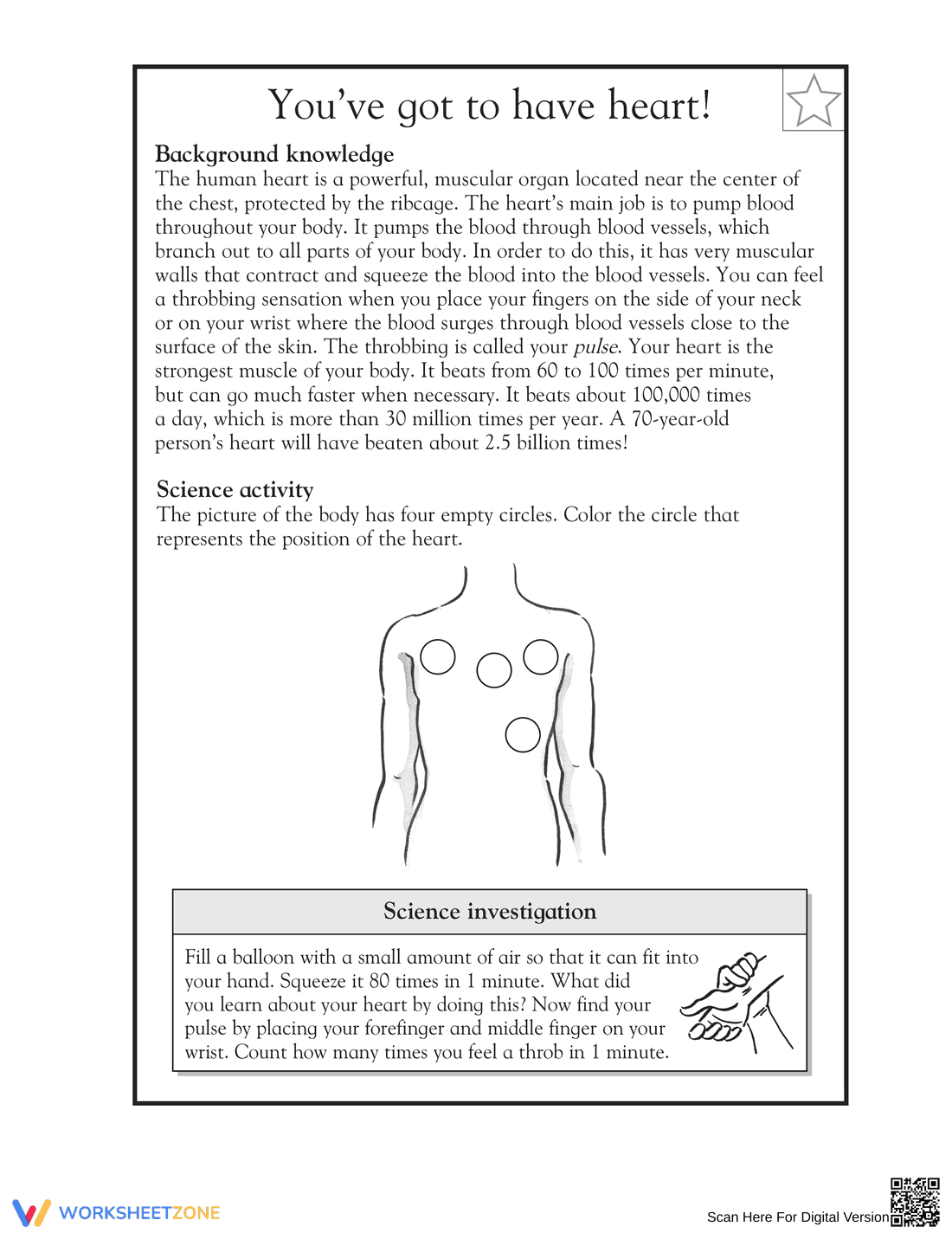
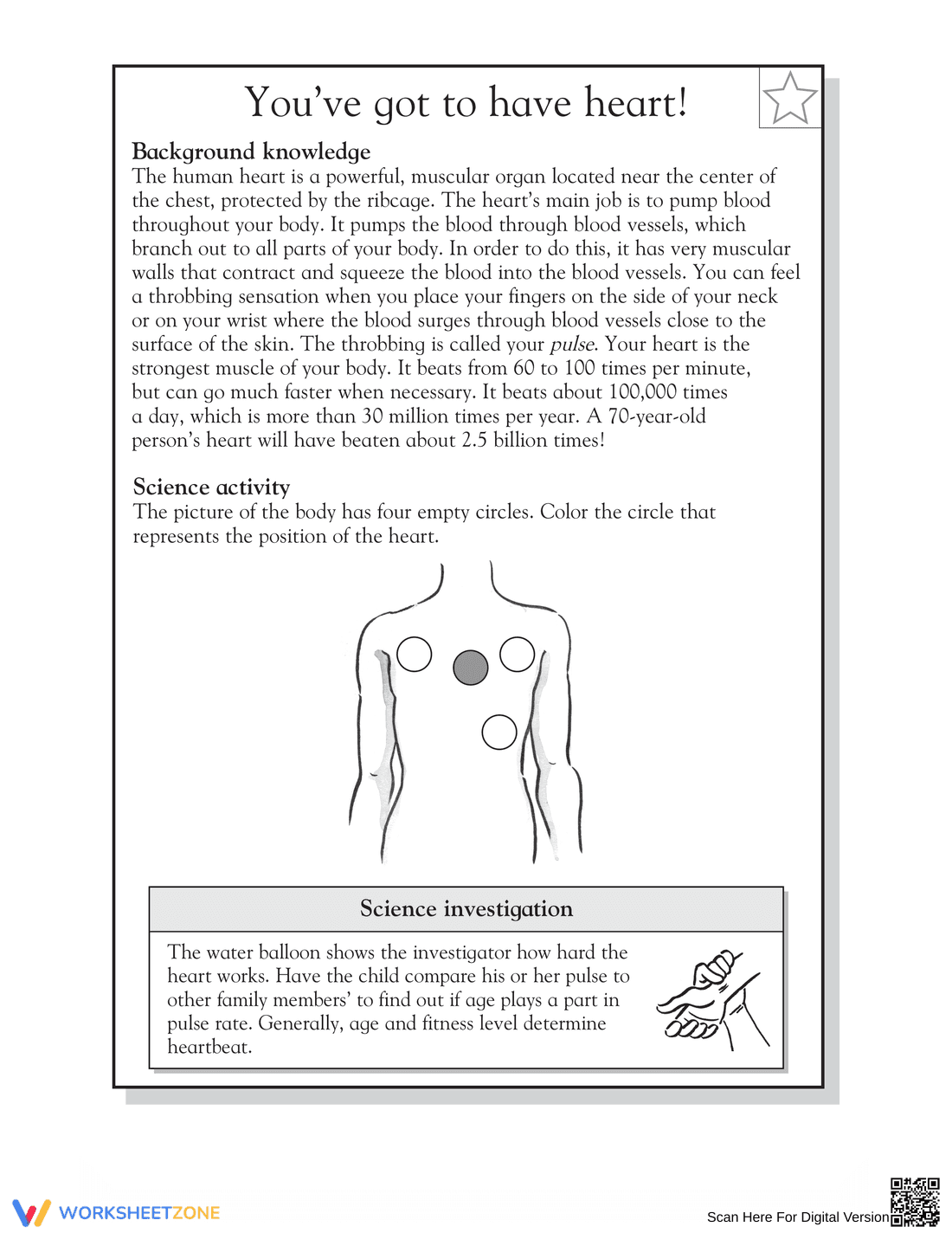
This comprehensive human heart worksheet helps Grade 5 students understand the vital role of the circulatory system's primary organ. Students will identify the heart's location within the thoracic cavity and engage in hands-on pulse rate investigations. By connecting physiological facts to physical experiences, learners build a concrete understanding of internal biological structures and their functions.
At a Glance
- Grade: 5 · Subject: Science
- Standard:
4-LS1-1— Describe how internal structures like the heart function to support animal survival- Skill Focus: Human Anatomy and Circulatory System
- Format: 1 page · 3 problems · Answer key included · PDF
- Best For: Zero-prep science center or supplemental lesson
- Time: 15–20 minutes
This single-page resource features a detailed background knowledge section that defines the heart as a muscular organ and explains its relationship to blood vessels and the ribcage. It includes a biological diagram for locating the heart, an 80-squeeze balloon simulation to model muscle contractions, and a step-by-step pulse measurement activity. The layout is designed for independent reading and immediate practical application.
The zero-prep workflow is designed for maximum efficiency in the modern classroom. First, print the single-sided PDF (30 seconds). Second, distribute to students for independent reading of the background text (5 minutes). Third, lead a quick review of the investigation results to verify student comprehension (2 minutes). Total prep is under two minutes, ideal for sub plans.
This resource is primarily aligned to 4-LS1-1, which requires students to construct an argument that internal structures function to support survival. While categorized for Grade 5, it serves as a critical bridge between basic anatomical awareness and the complex biological systems studied in later grades. Codes can be copied into lesson plans or IEP goals.
Use this worksheet during the "Explain" or "Explore" phases of a 5E science lesson on body systems. It works best after a brief direct instruction on the circulatory system or as a standalone exploration for fast-finishers. For formative assessment, observe students during the pulse-counting phase to ensure they can accurately identify a physical sensation and translate it into a numerical data point.
This activity is designed for Grade 5 students, though its clear language makes it accessible for English Language Learners and students requiring reading support. It pairs naturally with an anatomical model of the human torso or a short informational video on the cardiac cycle. The inclusion of hands-on investigation makes it a favorite for tactile and kinesthetic learners.
The efficacy of modeling biological functions through physical activity, such as the pulse investigations provided in this resource, is well-documented in educational research. According to Fisher & Frey (2014), engaging students in hands-on simulations of internal processes allows for the development of mental models that purely textual instruction cannot achieve. This worksheet addresses 4-LS1-1 by requiring students to identify the heart’s location and measure its rhythmic activity, thereby reinforcing the concept that internal structures have specialized roles in maintaining life. By providing a structured pathway from background knowledge to empirical observation, the material ensures that Grade 5 learners meet standard benchmarks for describing organ functions within a systemic context. Educators can rely on this tool to provide high-quality, research-backed instruction that bridges the gap between abstract biological concepts and observable physiological phenomena, supporting long-term retention of core science concepts across diverse learner populations.


