




























Views
Downloads

Human Body Organization Worksheet | Essential Grade 6-9

Paste this activity's link or code into your existing LMS (Google Classroom, Canvas, Teams, Schoology, Moodle, etc.).
Students can open and work on the activity right away, with no student login required.
You'll still be able to track student progress and results from your teacher account.
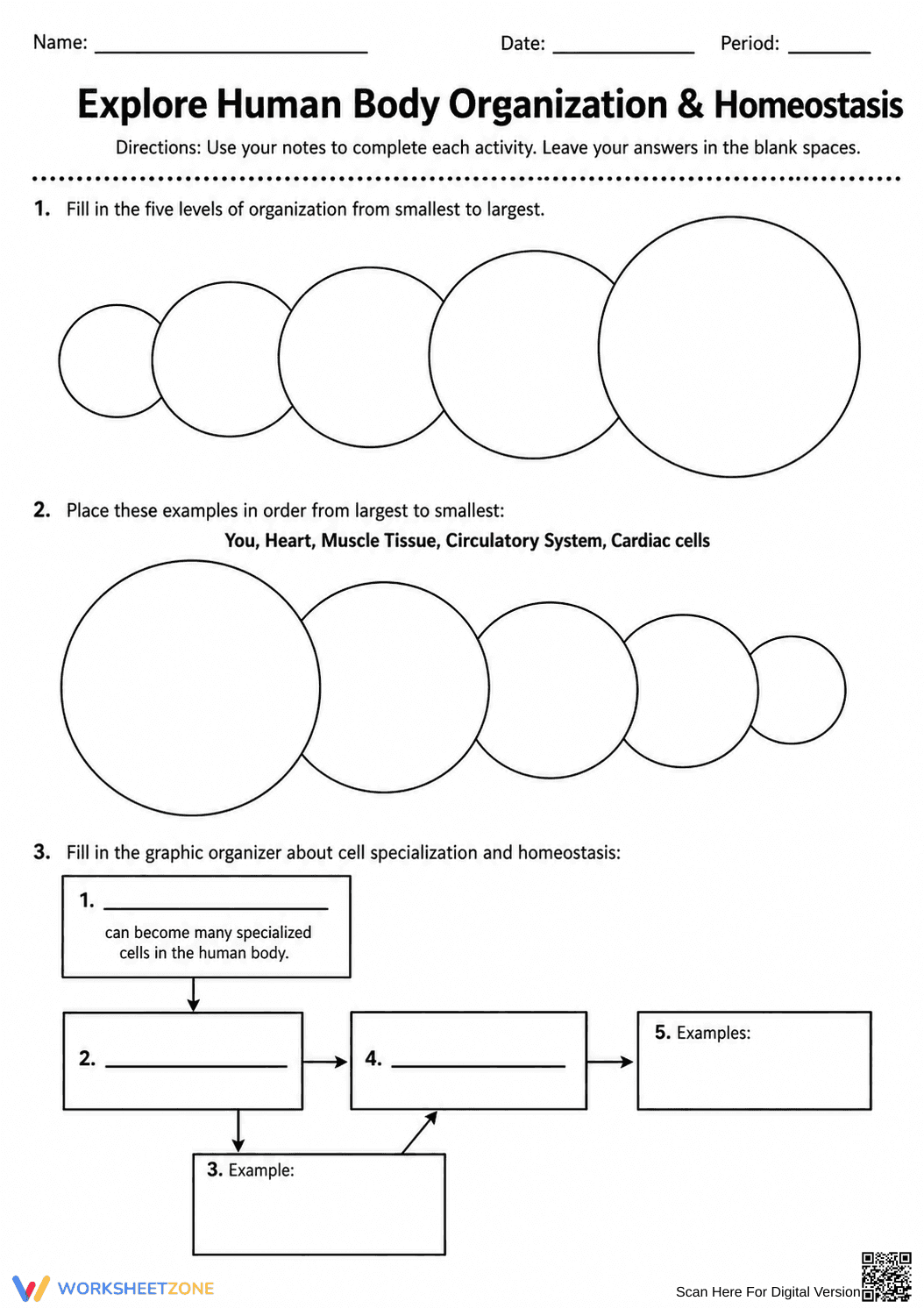
This human body organization and homeostasis worksheet helps students master the hierarchical structure of living organisms. By identifying the relationships between cells, tissues, organs, and systems, learners develop a foundational understanding of how complex life functions. It provides a clear visual framework for students to organize biological concepts and define the mechanisms of internal balance.
At a Glance
- Grade: 6-9 · Subject: Biology
- Standard:
MS-LS1-3— Explain how the body is a system of interacting subsystems composed of cells- Skill Focus: Biological Levels of Organization
- Format: 1 page · 15 problems · Answer key included · PDF
- Best For: Middle school life science introductory lessons
- Time: 15–25 minutes
The worksheet features three distinct graphic organizers across a single page. The first activity uses concentric circles to help students visualize the scale of organization from smallest to largest. The second activity provides specific examples like "Cardiac cells" and "Circulatory System" for students to categorize. Finally, a specialized flow chart focuses on cell specialization and the role of homeostasis, requiring students to provide definitions and real-world examples.
Zero-Prep Workflow
This resource is designed for a zero-prep classroom environment. First, print the single-page PDF for your class (30 seconds). Second, distribute the worksheet as a warm-up or independent practice during your human body systems unit (1 minute). Finally, review the answers using the included key to provide immediate feedback on student comprehension (5 minutes). It is an ideal solution for emergency sub plans or quick formative assessments.
Standards Alignment
This resource aligns with `MS-LS1-3`: "Use argument supported by evidence for how the body is a system of interacting subsystems composed of groups of cells." It specifically targets the understanding of how specialized cells form tissues and organs. This standard code can be copied directly into lesson plans, IEP goals, or district curriculum mapping tools.
How to Use It
Use this worksheet during the "Explain" phase of a 5E lesson model to solidify vocabulary after an initial lecture on body systems. It also serves as an excellent formative assessment tool; observe if students can correctly place "Muscle Tissue" between "Cardiac cells" and "Heart" to gauge their grasp of hierarchy. Completion typically takes 20 minutes.
Who It's For
This is designed for middle school life science students and early high school biology learners. It is particularly effective for visual learners who benefit from graphic organizers. Pair this with a diagram of the human torso or an anchor chart on homeostasis to provide additional scaffolding for English Language Learners.
Effective science instruction requires students to move beyond rote memorization of terms to an understanding of systems-level interactions. According to Fisher & Frey (2014), the use of graphic organizers like those found in this MS-LS1-3 worksheet supports the gradual release of responsibility by providing a structured scaffold for complex biological hierarchies. By requiring students to categorize specific examples—such as cardiac cells and the circulatory system—the worksheet reinforces the conceptual link between microscopic components and macroscopic organisms. This alignment with NGSS frameworks ensures that students are not just learning facts but are building a mental model of the human body as a set of nested, interacting subsystems. Research from EdReports 2024 emphasizes that high-quality instructional materials must provide these types of visual representations to bridge the gap between abstract cellular functions and observable physiological outcomes in homeostasis.


