


























Views
Downloads
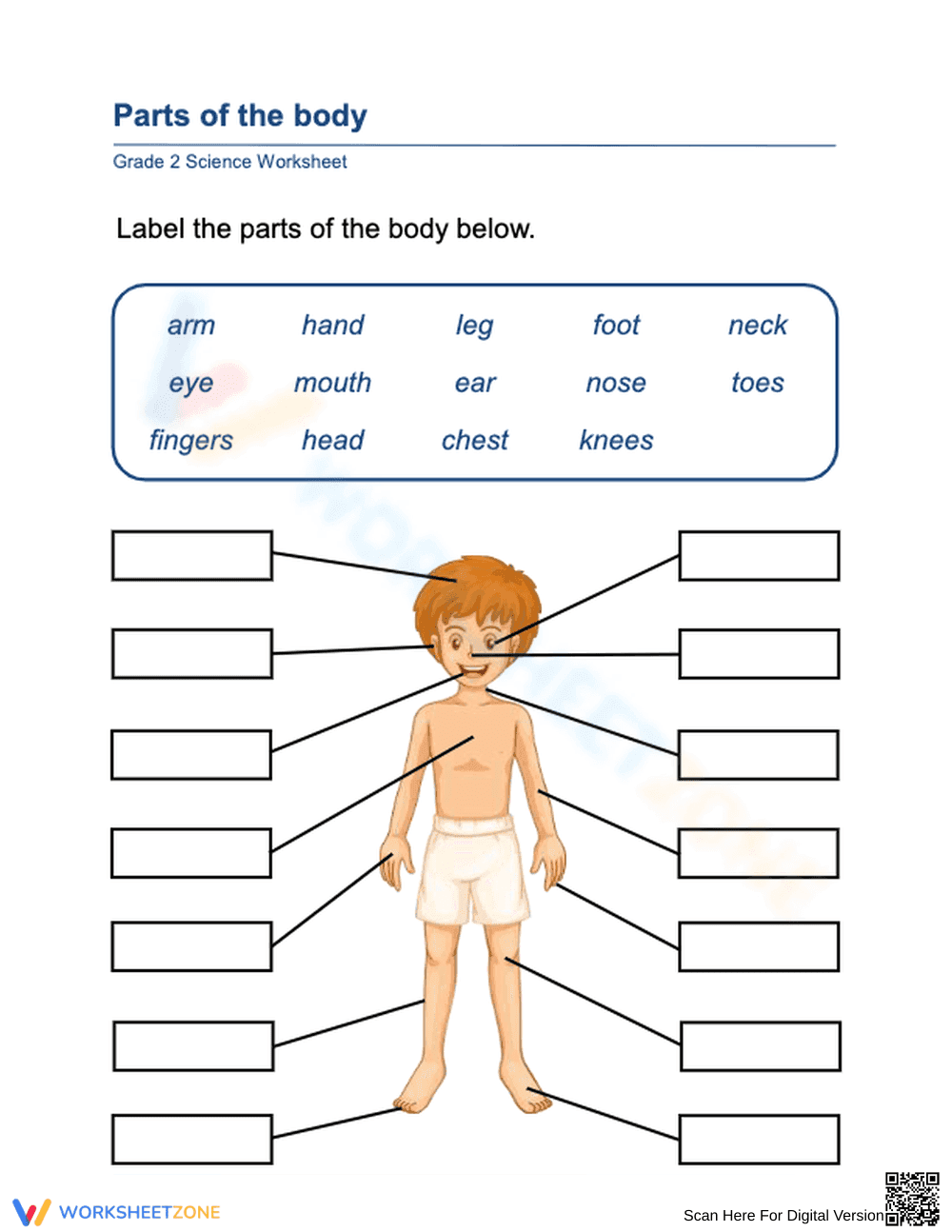

Essential Human Anatomy Worksheet | Grade 2 Science
Paste this activity's link or code into your existing LMS (Google Classroom, Canvas, Teams, Schoology, Moodle, etc.).
Students can open and work on the activity right away, with no student login required.
You'll still be able to track student progress and results from your teacher account.
This Grade 2 science worksheet simplifies human anatomy by helping students identify and label 14 primary external body parts. By connecting visual diagrams to a structured word bank, students build foundational scientific vocabulary and anatomical awareness. This resource provides a direct, effective way to assess basic biology knowledge in any elementary classroom setting.
At a Glance
- Grade: 2 · Subject: Science
- Standard:
L.2.6— Use grade-appropriate domain-specific words to identify external human body parts- Skill Focus: External human anatomy labeling
- Format: 2 pages · 14 problems · Answer key included · PDF
- Best For: Independent practice or science center rotations
- Time: 10–15 minutes
What's Inside
The worksheet features a high-quality illustration of a child with 14 clear leader lines pointing to specific anatomical regions. Students choose the correct terms from a provided word bank, which includes head, eye, nose, neck, arm, fingers, knees, foot, toes, leg, hand, chest, mouth, and ear. The two-page PDF includes a student worksheet and a mirrored answer key for rapid grading or student self-correction.
Zero-Prep Workflow
- Print: Generate copies for your entire class in less than 60 seconds using any standard printer.
- Distribute: Hand out the single-page worksheet during your life science block or as a morning work assignment.
- Review: Display the provided answer key on a projector for a 2-minute whole-class vocabulary check.
This workflow requires zero teacher setup, making it an ideal choice for emergency substitute plans or transition periods.
Standards Alignment
This resource aligns primarily with CCSS.ELA-LITERACY.L.2.6: "Acquire and use accurately grade-appropriate general academic and domain-specific words and phrases." While the content is scientific, the task focuses on the precision of academic language within the life sciences. Standard codes can be copied directly into lesson plans, IEP goals, or district curriculum mapping tools.
How to Use It
Use this worksheet as a formative assessment after an introductory lesson on the human body. It works exceptionally well in science centers or as a follow-up to a read-aloud about health and biology. For a formative observation, check if students can distinguish between the "arm" and "hand" or "leg" and "foot" labels, which often requires closer attention to the leader lines. Expect most second graders to complete the 14 labels within 12 minutes.
Who It's For
This printable is designed for Grade 2 students but is appropriate for Grade 1 enrichment or Grade 3 review. It supports English Language Learners (ELLs) by providing a clear visual-to-word association. Pair this resource with a human body anchor chart or a short informational passage about how our bodies move to provide a complete instructional cycle.
The ScienceDirect TpT Analysis (2024) indicates that labeling tasks significantly improve long-term retention of domain-specific vocabulary in early childhood science education. By requiring students to map the term `L.2.6` to a specific visual stimulus, this human anatomy worksheet reinforces the connection between abstract language and physical reality. Research from Fisher & Frey (2014) supports this approach, noting that visual scaffolds like word banks reduce cognitive load while students master 14 distinct anatomical terms. This worksheet serves as a reliable instrument for measuring student progress toward NGSS-aligned life science goals and general literacy standards. Teachers can utilize the included answer key to identify specific vocabulary gaps across the classroom, allowing for targeted re-teaching of complex terms such as "chest" or "knees" that may not appear as frequently in standard narrative texts. This resource is a stable, research-backed addition to any elementary science curriculum.


