


























Views
Downloads

Grade 1 Penguin Adaptations — Printable No-Prep Worksheet
Paste this activity's link or code into your existing LMS (Google Classroom, Canvas, Teams, Schoology, Moodle, etc.).
Students can open and work on the activity right away, with no student login required.
You'll still be able to track student progress and results from your teacher account.
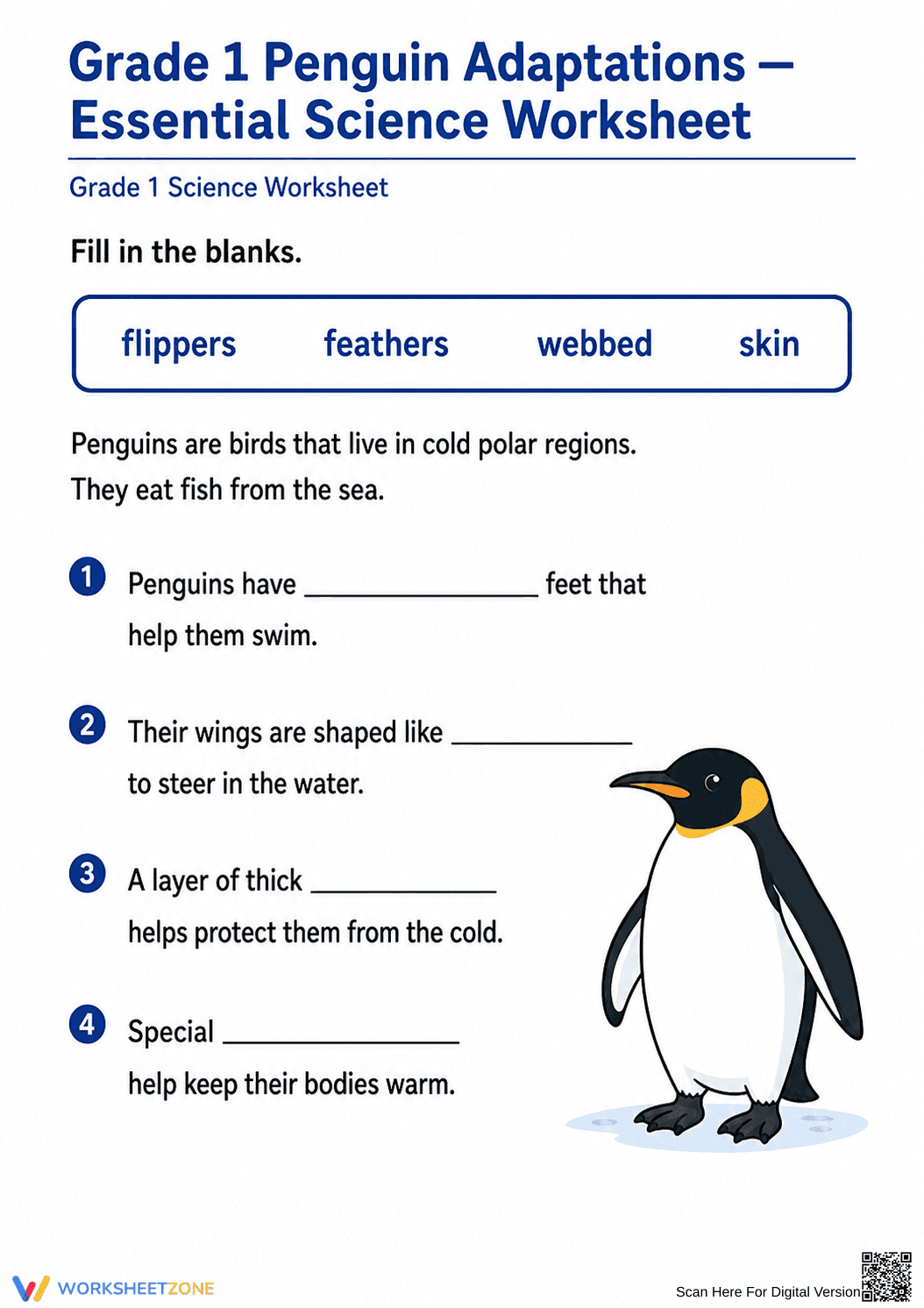
This Grade 1 science worksheet provides a focused introduction to how penguins survive in polar regions through physical adaptations. Students use a word bank to identify key features like webbed feet and thick skin that enable these birds to swim and stay warm, building essential early biological observation skills.
At a Glance
- Grade: 1 · Subject: Science
- Standard:
1-LS1-1— Use animal parts to understand how they survive- Skill Focus: Physical adaptations of polar animals
- Format: 2 pages · 4 problems · Answer key included · PDF
- Best For: Independent practice or quick science centers
- Time: 10–15 minutes
What's Inside
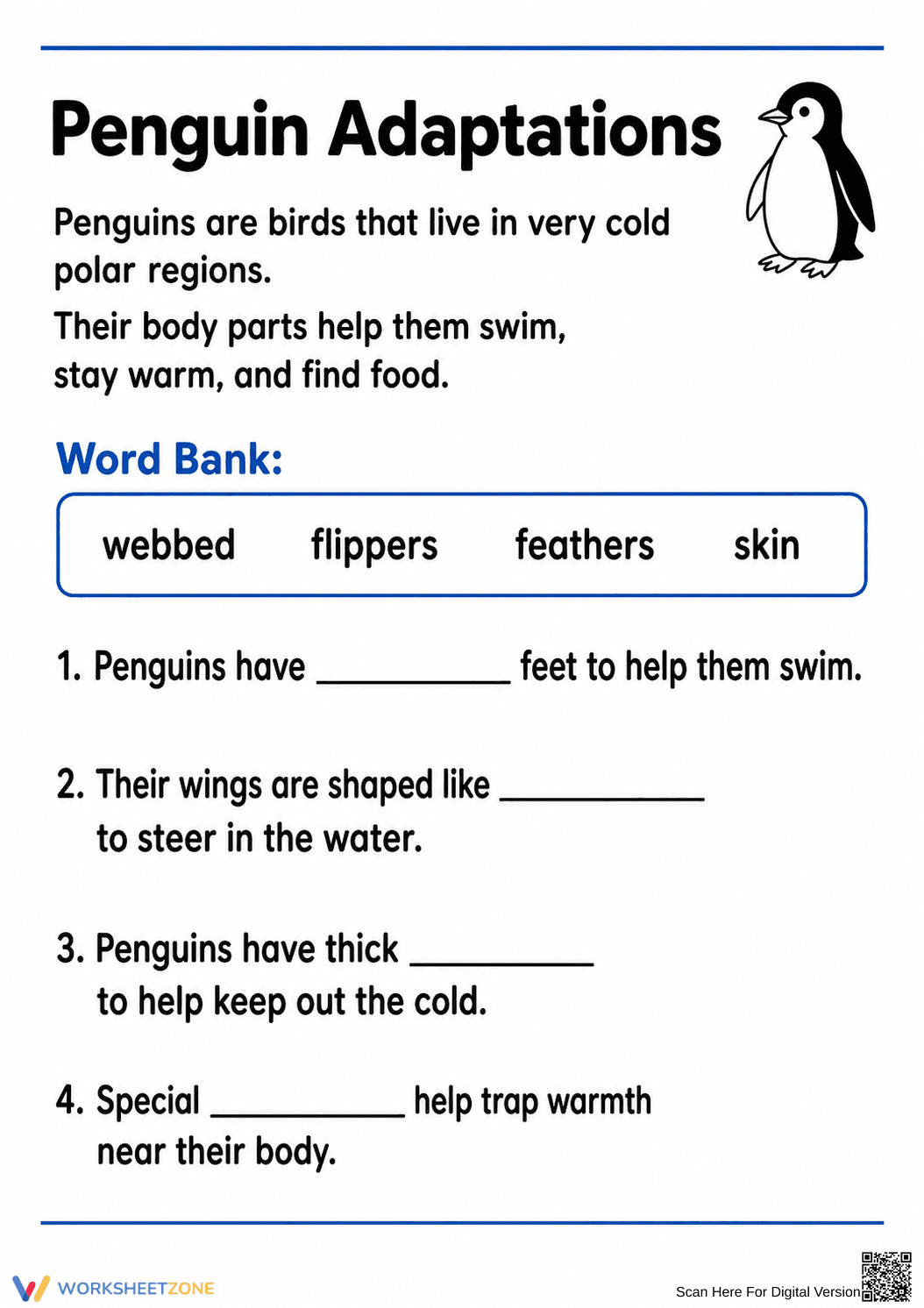
The worksheet features a high-interest image of a penguin and a short, readable introductory text about their habitat and diet. Students are presented with four fill-in-the-blank sentences requiring them to select the correct term from a provided word bank: flippers, feathers, webbed, and skin. A complete answer key is included on the second page for rapid grading or student self-correction.
Zero-Prep Workflow
This resource is designed for immediate classroom implementation with a total teacher prep time of under 2 minutes. Step one: Print the single-sided worksheet for your class (1 minute). Step two: Distribute the copies alongside a brief introduction to polar habitats (1 minute). Step three: Review student answers using the provided key during a whole-group wrap-up. Its self-contained nature makes it an ideal choice for emergency sub plans or morning work transitions.
Standards Alignment
The primary alignment is to 1-LS1-1: "Use materials to design a solution to a human problem by mimicking how plants and/or animals use their external parts to help them survive, grow, and meet their needs." This worksheet specifically addresses the first half of this standard by helping students identify the external parts used for survival. A supporting connection can be made to CCSS.ELA-LITERACY.RI.1.1 for asking and answering questions about key details in a text. Both standard codes can be copied directly into lesson plans, IEP goals, or district curriculum mapping tools.
How to Use It
Use this worksheet during the "Explain" or "Elaborate" phase of a 5E lesson cycle after students have viewed a video or read a book about penguins. Alternatively, assign it as independent morning work to reinforce previous learning. As a formative assessment tool, observe whether students can accurately match the function, such as swimming, to the specific body part, like webbed feet. Expect most first graders to complete the task within 10 to 15 minutes.
Who It's For
This resource is tailored for first-grade students but is also appropriate for Kindergarten enrichment or second-grade review. The inclusion of a word bank provides necessary scaffolding for emerging readers and English Language Learners. It pairs naturally with non-fiction leveled readers about birds, cold-climate ecosystems, or whole-class direct instruction on animal habitats.
The identification of specific biological structures and their survival functions is a cornerstone of early scientific literacy as outlined in the RAND AIRS 2024 report on primary science education. By connecting the physical form of a penguin to its environmental function, students develop the foundational schemas required for later complex evolutionary concepts. This Grade 1 penguin adaptations worksheet, aligned to the 1-LS1-1 standard, provides targeted practice to help students use animal parts to understand how they survive. It bridges the gap between simple animal identification and functional biological analysis. Structured fill-in-the-blank tasks with visual supports help younger learners internalize domain-specific vocabulary more effectively than rote memorization. It ensures that students understand how external parts meet essential needs, a prerequisite for meeting national benchmarks in life sciences and cross-cutting concepts.


