


























Views
Downloads
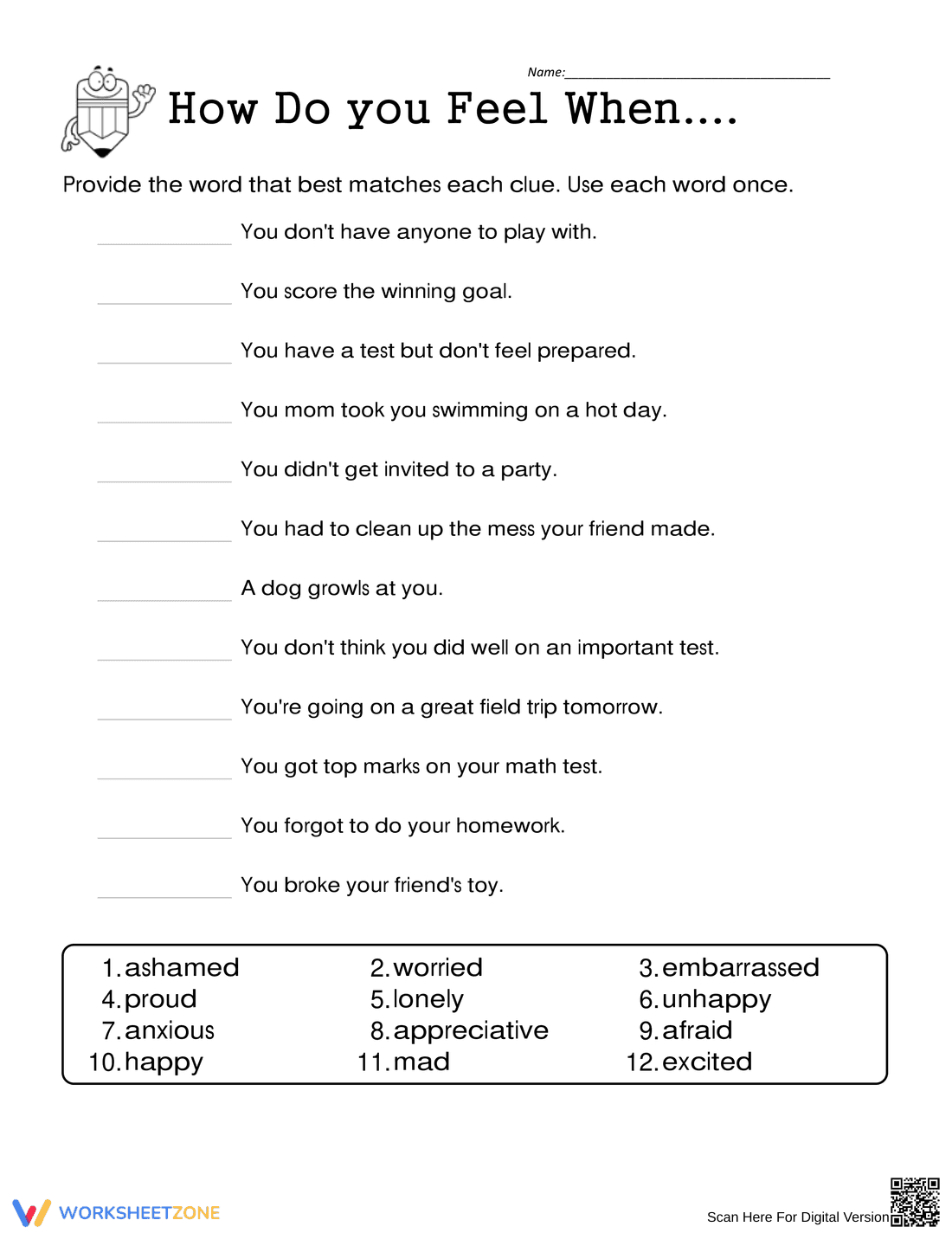

Identifying Emotions Worksheet | Grade 3-5 Essential
Paste this activity's link or code into your existing LMS (Google Classroom, Canvas, Teams, Schoology, Moodle, etc.).
Students can open and work on the activity right away, with no student login required.
You'll still be able to track student progress and results from your teacher account.
This identifying emotions worksheet helps students in grades 3 through 5 connect specific vocabulary words to real-world social scenarios. By matching 12 distinct feelings to situational clues, learners develop the emotional intelligence and precise language needed to describe complex internal states and interpersonal reactions effectively.
At a Glance
- Grade: 3-5 · Subject: English / Behavior
- Standard:
CCSS.ELA-LITERACY.L.3.6— Acquire and use domain-specific words to describe feelings and actions- Skill Focus: Emotional Vocabulary & Context Clues
- Format: 1 page · 12 problems · Answer key included · PDF
- Best For: SEL lessons and vocabulary building
- Time: 15–20 minutes
What's Inside
Inside this resource, you will find a single-page activity featuring 12 unique situational prompts ranging from academic stress to social exclusion. A clear word bank at the bottom provides 12 vocabulary terms, including nuanced words like anxious, appreciative, and ashamed. The layout is clean and distraction-free, ensuring students focus entirely on the text-to-emotion connection.
Zero-Prep Workflow
This worksheet is designed for a zero-prep classroom environment. First, print the single-page PDF (30 seconds). Next, distribute the sheets to students for independent or small-group work (1 minute). Finally, review the answers as a whole class to discuss why certain scenarios trigger specific emotions (5-10 minutes). Total teacher preparation time is under 2 minutes. This resource is also an excellent choice for emergency sub plans.
Standards Alignment
This activity aligns with CCSS.ELA-LITERACY.L.3.6, which requires students to acquire and use accurately grade-appropriate conversational, general academic, and domain-specific words and phrases. It also supports L.4.6 by expanding the breadth of adjectives used to describe human experiences. Both standard codes can be copied directly into lesson plans, IEP goals, or district curriculum mapping tools.
How to Use It
Use this worksheet as a formative assessment during a Social Emotional Learning (SEL) block or as a bell ringer in an English Language Arts class. Teachers should observe if students struggle to differentiate between similar emotions like worried and anxious. This provides a perfect opening for a deeper discussion on shades of meaning. Expected completion time is 15 to 20 minutes.
Who It's For
This resource is ideal for general education students in upper elementary, as well as English Language Learners (ELL) who need concrete examples of abstract feeling words. It pairs naturally with an anchor chart of Feeling Faces or a direct instruction lesson on character traits and internal conflict in literature.
Research from Fisher & Frey (2014) emphasizes that vocabulary acquisition is most effective when words are taught in meaningful contexts rather than through isolated memorization. This worksheet applies that principle by embedding 12 emotion-based vocabulary terms within relatable life scenarios. By requiring students to analyze the why behind a feeling, the activity bridges the gap between basic literacy and social-emotional competency. The inclusion of nuanced terms like appreciative and ashamed aligns with the CCSS.ELA-LITERACY.L.3.6 mandate for domain-specific word mastery. Educators can use this tool to gather evidence of student ability to interpret social cues and apply precise descriptors. Such targeted practice is essential for developing the communicative clarity required for both academic writing and healthy interpersonal relationships in the middle-grade years. This resource provides a structured pathway for students to internalize complex emotional language through practical application.


