


























Views
Downloads
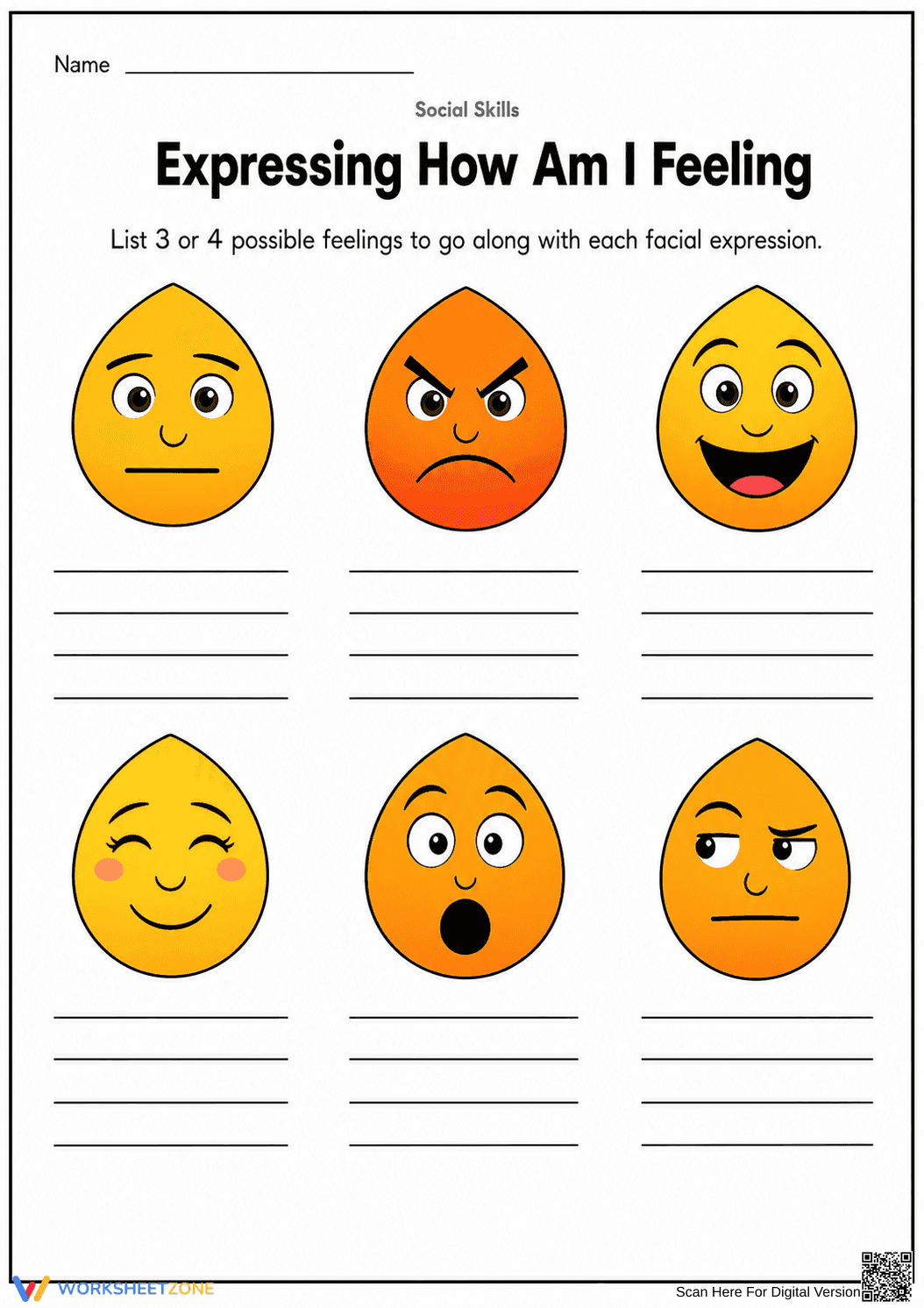

Printable Emotion Vocabulary Worksheet | Grade 6 SEL
Paste this activity's link or code into your existing LMS (Google Classroom, Canvas, Teams, Schoology, Moodle, etc.).
Students can open and work on the activity right away, with no student login required.
You'll still be able to track student progress and results from your teacher account.
This printable social-emotional learning worksheet helps students build emotional literacy by identifying and labeling complex feelings. By analyzing six distinct facial expressions, students generate multiple nuanced emotion words for each visual cue, expanding their vocabulary and improving their ability to communicate personal feelings effectively.
At a Glance
- Grade: 6 · Subject: Social Skills
- Standard:
CCSS.ELA-LITERACY.L.6.5.B— Distinguish among connotations of words with similar denotations- Skill Focus: Emotion Vocabulary
- Format: 1 page · 6 problems · No answer key · PDF
- Best For: Morning work or SEL blocks
- Time: 10–15 minutes
This single-page resource features six distinct cartoon faces displaying various emotions, from subtle annoyance to overt joy. Below each illustration, students are provided with blank lines to list three to four synonymous feeling words. Because emotional interpretation can be subjective, this worksheet does not include a rigid answer key, encouraging open-ended vocabulary generation and class discussion.
- Print (1 min): Simply print the single-page PDF for your entire class. No special materials are required.
- Distribute (1 min): Hand out the worksheets as students enter the room for an immediate, focused start to your SEL block.
- Review (3 mins): Quickly review the visual cues together, allowing students to share their diverse vocabulary choices.
Total teacher prep time is under two minutes, making this an ideal, self-explanatory activity for substitute teacher plans or unexpected schedule changes.
Aligned to primary standard CCSS.ELA-LITERACY.L.6.5.B: Use the relationship between particular words to better understand each of the words. It also supports general emotional intelligence frameworks by asking students to distinguish among the connotations of words with similar denotations. Both standard codes can be copied directly into lesson plans, IEP goals, or district curriculum mapping tools.
Use this worksheet as a bell-ringer activity before a broader discussion on empathy or character motivations in literature. Alternatively, assign it during a dedicated advisory period to help students articulate their current emotional states. As a formative assessment tip, observe whether students rely on basic terms or attempt to use more nuanced vocabulary, which can guide future instruction. Expected completion time is 10 to 15 minutes.
This resource is primarily designed for middle school students developing their social-emotional competencies, particularly those in Grade 6. It is highly effective for students working on specific IEP goals related to reading social cues. Pair this worksheet with a character analysis lesson in ELA to help students apply their new emotion vocabulary to fictional contexts.
Developing a robust emotion vocabulary is a critical component of adolescent social-emotional development and long-term academic success. By practicing how to distinguish among connotations of words with similar denotations, students improve both their interpersonal communication and their reading comprehension skills. According to the RAND AIRS 2024 report, integrating explicit emotional literacy tasks into daily middle school routines significantly enhances students' ability to navigate complex social interactions, resolve peer conflicts constructively, and self-regulate during rigorous academic challenges. This targeted practice directly supports CCSS.ELA-LITERACY.L.6.5.B by moving students beyond basic feeling words toward precise, nuanced emotional expression. When students can accurately label their feelings using specific vocabulary, they are better equipped to advocate for their personal needs, engage in collaborative group work, and demonstrate genuine empathy toward others in the classroom community.


