


























Views
Downloads
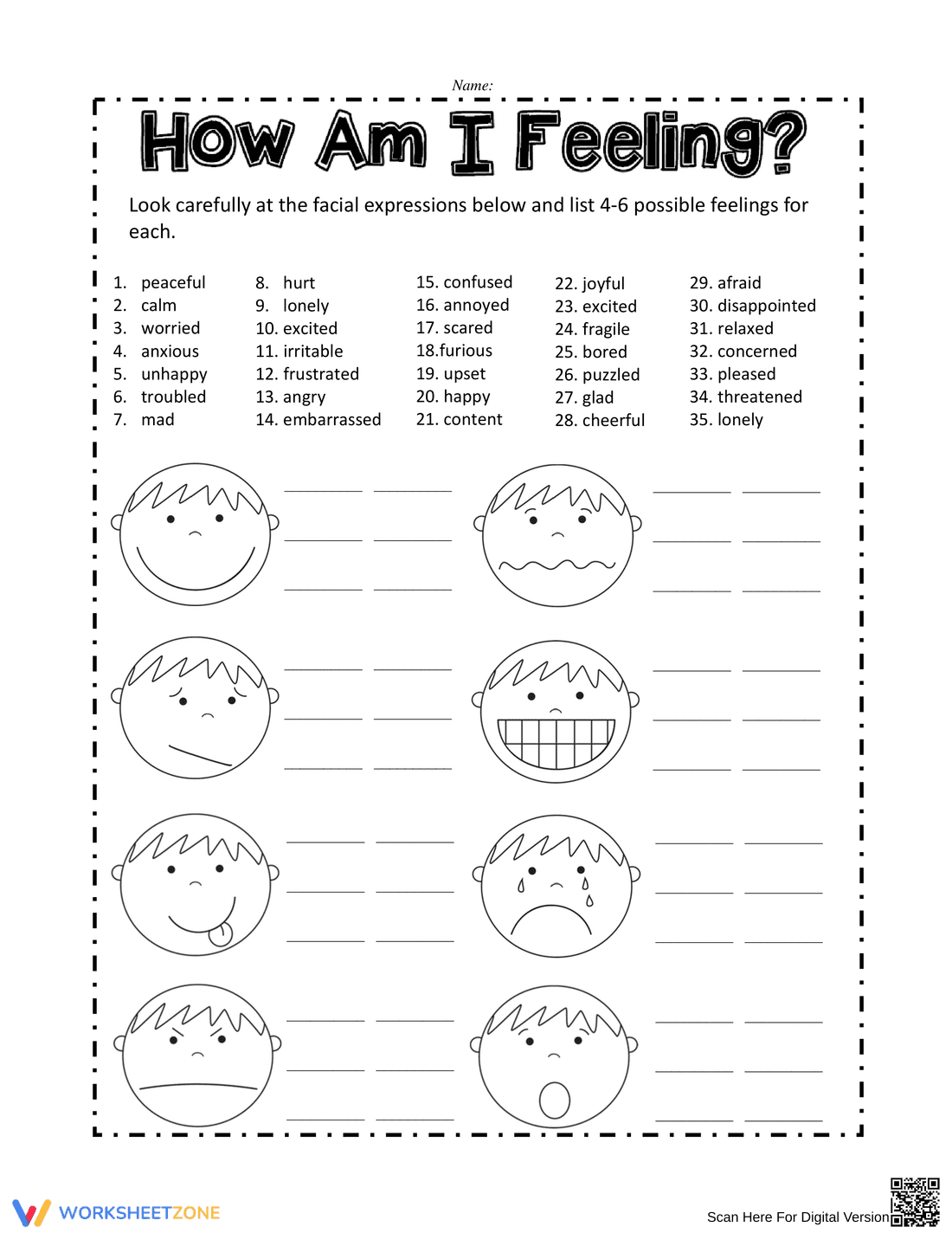

How Am I Feeling Worksheet | Grade 4 Essential SEL
Paste this activity's link or code into your existing LMS (Google Classroom, Canvas, Teams, Schoology, Moodle, etc.).
Students can open and work on the activity right away, with no student login required.
You'll still be able to track student progress and results from your teacher account.
This Grade 4 emotion vocabulary worksheet helps students identify and label complex feelings through visual social cues. By connecting facial expressions to a diverse word bank, learners expand their emotional intelligence and descriptive language skills. It provides a structured way to explore the nuances of human expression in a classroom setting.
At a Glance
- Grade: 4 · Subject: English
- Standard:
CCSS.ELA-LITERACY.L.4.5.C— Distinguish shades of meaning among related words describing states of mind- Skill Focus: Emotion Vocabulary & Social Cues
- Format: 1 page · 8 tasks · Answer key included · PDF
- Best For: Social-Emotional Learning and Vocabulary Building
- Time: 15–20 minutes
The worksheet features eight distinct hand-drawn facial expressions representing various emotional states. Above the illustrations, a comprehensive word bank provides 35 specific adjectives ranging from "peaceful" and "content" to "fragile" and "threatened." Students are tasked with selecting four to six appropriate descriptors for each face, encouraging them to see the overlap and nuance in how feelings are manifested physically.
This resource is designed for immediate classroom implementation with a total teacher prep time of under 2 minutes. First, print the single-page PDF for your roster. Second, distribute the sheets during a morning meeting or ELA block; the instructions are self-explanatory, requiring no lengthy introduction. Finally, review the varied student responses as a group to facilitate a discussion on social perspective-taking and synonym usage.
The primary focus is CCSS.ELA-LITERACY.L.4.5.C, which requires students to distinguish shades of meaning among related words that describe states of mind or degrees of certainty. By requiring multiple labels for a single expression, the activity forces students to move beyond basic happy or sad binaries. Both standard codes can be copied directly into lesson plans, IEP goals, or district curriculum mapping tools.
Use this worksheet as a formative assessment during a unit on character analysis to help students describe protagonists more vividly. It also serves as an excellent tool for small counseling groups or as a check-in activity. Teachers should observe if students can justify why "anxious" and "worried" might both fit the same visual cue, noting their ability to synthesize visual and textual information.
This activity is ideal for general education students in grades 3 through 5, as well as English Language Learners (ELLs) who need concrete visual anchors for abstract vocabulary. It is a natural pairing for a mentor text about feelings or an anchor chart focused on strong verbs and vivid adjectives in narrative writing.
According to research by Fisher & Frey (2014) on the gradual release of responsibility, providing visual scaffolds like facial illustrations alongside a robust word bank is essential for developing academic language in middle elementary grades. This worksheet addresses the need for students to move toward precise emotional labeling, which is a core component of both literacy and social-emotional development. By engaging with 35 distinct vocabulary terms, students build the linguistic flexibility required for complex text analysis and interpersonal communication. The inclusion of 8 specific visual prompts ensures that the cognitive load remains focused on word selection and nuance rather than artistic interpretation. This alignment with CCSS.ELA-LITERACY.L.4.5.C supports the mastery of shades of meaning, a skill that NAEP data suggests is critical for reading comprehension success. Educators can use this tool to bridge the gap between basic recognition and sophisticated expression.


